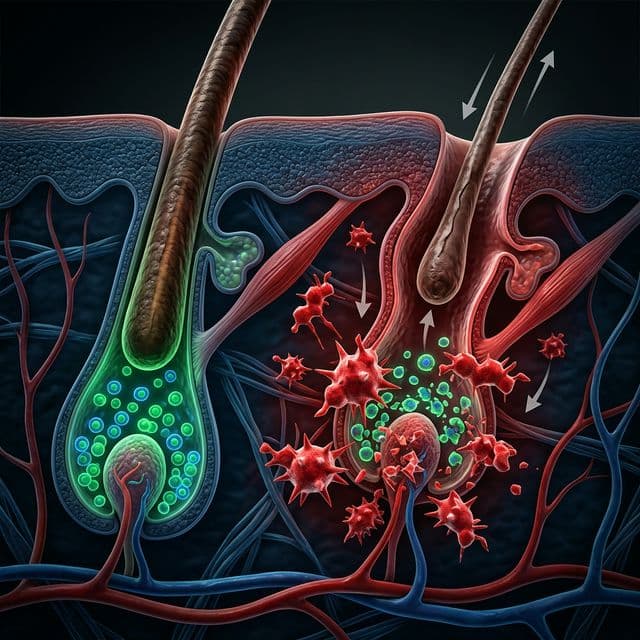
Early Stage — Perifollicular Infiltrate
T-cell attack beginning around follicle bulb. Hair still present but vulnerable. Early intervention window.
Severe Stage — Anagen Arrest
Complete immune destruction of anagen bulb. Bald patch formed. Follicle dormant but potentially recoverable.
Alopecia Areata
Alopecia areata is an autoimmune condition where T-lymphocytes attack hair follicles, causing sudden patchy, non-scarring hair loss. Unlike androgenetic alopecia, the follicles remain alive and regrowth is biologically possible. It affects approximately 2% of the global population and can occur at any age.
Key Characteristics
- Sudden onset of smooth, round or oval bald patches
- Patches typically coin-sized, with well-defined edges
- Exclamation mark hairs at patch borders (tapered at base)
- Scalp surface appears completely normal within patches
- Can progress to total scalp loss (alopecia totalis) in severe cases
Our Treatment Approach
Trichoscopy for scalp assessment and progress tracking. Scalp-calming protocols to soothe the follicle environment. Stress management through vagus nerve stimulation (cortisol is a documented trigger). Referral to dermatologist for dermatological treatment in severe or spreading cases.
Treatment Available At
Deep Dives
Science Articles on Alopecia Areata
8 min read
Alopecia Areata Malaysia: The Autoimmune Hair Loss That Head Spa Can (and Cannot) Treat
Alopecia areata occurs when T-cells mistakenly attack hair follicles. Understanding what triggers immune collapse — and the honest boundaries of clinical head spa treatment — is essential for Malaysian patients.
Read article →
8 min read
Male Pattern Baldness in Malaysia: The DHT Pathway and Clinical Intervention Timeline
Androgenetic alopecia affects 50% of Malaysian men by age 50. DHT miniaturises hair follicles progressively — and the earlier you intervene, the more hair you can retain. Here is the clinical science.
Read article →
8 min read
Why Is My Hair Thinning? A Clinical Diagnostic Guide for Malaysia
Hair thinning has 8 distinct biological causes — each requiring a different treatment. This diagnostic guide helps Malaysian patients identify which type they have before choosing a treatment.
Read article →
8 min read
Chronic Stress and Permanent Hair Loss: When Telogen Effluvium Becomes Irreversible
Short-term stress causes temporary hair loss. Chronic stress lasting 2+ years can accelerate genetic alopecia by a decade — permanently. Understanding this progression is critical for KL professionals under sustained workplace pressure.
Read article →
7 min read
Hair Fall vs Hair Loss: What's the Clinical Difference?
Hair fall is a normal biological process. Hair loss is a pathological one. The distinction matters clinically — and most people experiencing the former diagnose themselves with the latter, generating unnecessary anxiety and the wrong treatment.
Read article →
9 min read
The Cortisol-Follicle Pathway: How Stress Kills Hair Growth at the Cellular Level
Chronic psychological stress suppresses follicle stem cells via glucocorticoid signalling — not metaphorically, but through a measurable receptor cascade. Understanding the mechanism is the first step to interrupting it.
Read article →
Ready to transform your scalp health?
Book a consultation and let our specialists create a personalized protocol for alopecia areata.