Research on topical melatonin for hair loss is promising but limited. A small placebo-controlled trial found changes in the proportion of growing hairs in particular scalp regions and diagnoses. Other studies have weaker comparisons or test different formulations. These findings do not establish that every melatonin scalp serum regrows hair, has no systemic exposure or improves sleep.
Is topical melatonin the same as an oral supplement?
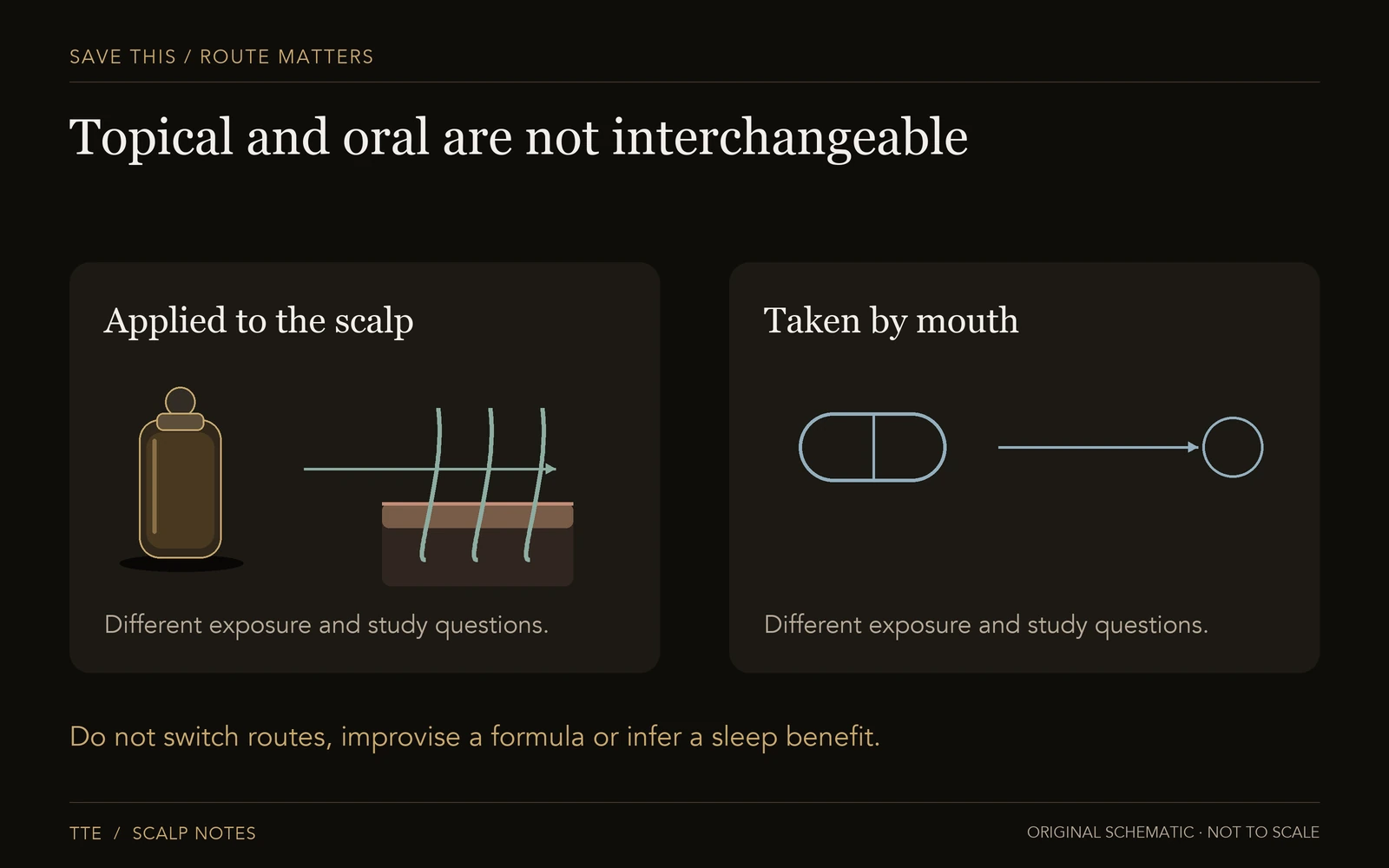
No. Topical application places a formulation on the skin; an oral supplement is swallowed. The route, amount and formulation determine what is being studied. A hair-product result cannot be transferred to a supplement, or a sleep-supplement result to a scalp serum.
Melatonin participates in circadian signalling, which helps explain why its name is familiar from sleep products. However, evidence and recommendations depend on the condition being addressed. The US National Center for Complementary and Integrative Health discusses specific sleep uses and the limits of supplement evidence; that information is not proof of a topical hair benefit. NCCIH melatonin overview.
If your main question concerns late nights and shedding, our sleep and hair-shedding guide covers that separately. A scalp ingredient should not become a substitute explanation for every sleep or hair concern.
Why are researchers interested in follicles?
The hair follicle is living tissue with its own complex signalling. In laboratory research, isolated human follicles displayed rhythmic clock-gene activity even outside the body. Manipulating particular clock genes changed the duration of their growth phase. This is evidence about human tissue in organ culture, not proof that a serum resets someone's follicle clock. Original human follicle study.
The scalp-biology guide explains the growth cycle in more detail. For reading melatonin studies, the key term is anagen: the active growth phase. An increased proportion of sampled hairs in anagen is a useful research measurement, but it is not identical to a visibly fuller head of hair.
What did the human studies actually test?
The concentrations below describe research formulations. They are not instructions for choosing a dose or mixing a product at home.
| Study | Population and comparison | Duration and endpoint | Main limitation |
|---|---|---|---|
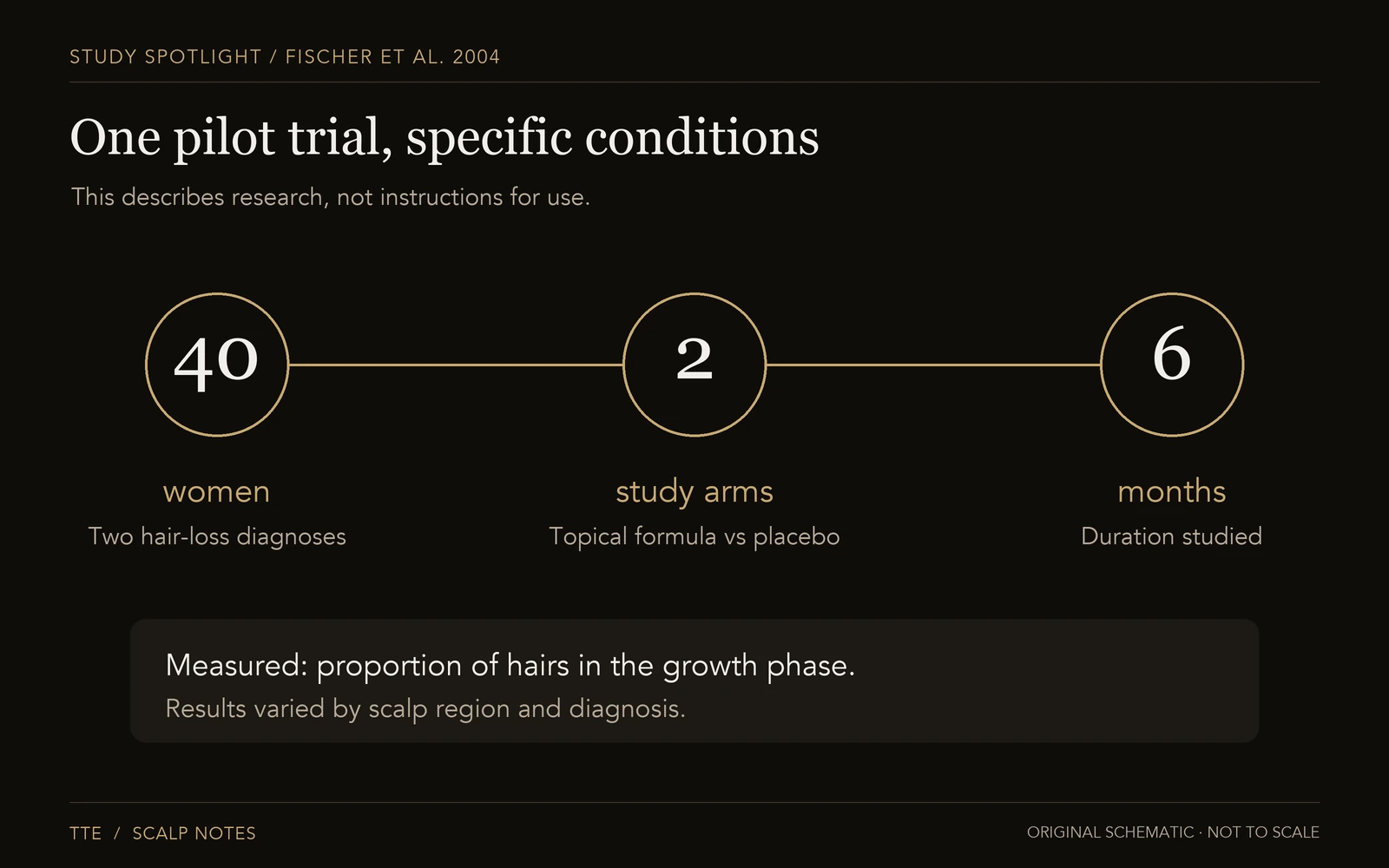
| Fischer, 2004 | 40 women; 0.1% topical solution versus placebo, randomized and blinded | Six months; anagen and telogen proportions | Small pilot; findings varied by diagnosis and scalp region |
| Fischer, 2012 programme | A pharmacodynamic study plus four clinical pre/post studies | Different follow-up periods and hair assessments | Four efficacy studies lacked a comparable placebo framework |
| Hatem, 2018 | A melatonin-containing nanovesicle formulation versus melatonin solution | Hair-pull, dermoscopic and shaft assessments | Tests delivery formulations, not melatonin versus no melatonin |
| Imbernon-Moya, 2026 | 20 people; 1% topical solution, no control group | Three months; reported clinical changes | Small case series with no randomized comparison |
In the 2004 trial, significant anagen findings appeared in the occipital region in women with androgenetic alopecia and the frontal region in women with diffuse alopecia. Other regional comparisons were not significant. Blood melatonin increased but remained below the physiological nighttime peak. The study therefore does not support a blanket claim of no systemic absorption. Original randomized pilot.
The 2012 paper explicitly describes one pharmacodynamic study and four pre/post studies. Its reported improvements are reasons for further investigation, but “five studies” should not become “five randomized trials proving regrowth.” Without an adequate comparison, changes over time cannot be attributed confidently to the ingredient alone. Original clinical programme.
The 2018 nanovesicle study reported more favourable outcomes with its delivery formulation than with melatonin solution. Because both sides involved melatonin and the carrier included vitamin-C-based material, it answers a different question from an inactive-placebo comparison. Original formulation study.
The 2026 series observed partial grey-hair repigmentation in four women. Nine women with chronic telogen effluvium reported reduced shedding and increased thickness; men showed no clinical improvement. These uncontrolled observations cannot establish a reliable response rate or prove that a product reverses greying. Original case series.
Why do formulation and measurement matter?
Two bottles can list melatonin while differing in concentration, solvent, other ingredients and intended application. A delivery system is part of the product being tested. Research on one formula should be described with that identity, rather than borrowed to endorse every formula sharing an ingredient.
Also distinguish the endpoints. A hair-pull result, a questionnaire, anagen proportion and hairs per square centimetre answer different questions. A trial that reports one does not automatically demonstrate all the others. Before-and-after photographs also need consistent lighting, hair arrangement and timing to be informative.
This is why a headline percentage needs context. Ask who improved, compared with what, on which measurement and over what period. Our scalp-analysis report guide explains how to keep visible measurements and diagnosis separate.
What is still uncertain?
These studies do not establish a single best topical formulation, a dependable long-term benefit across different hair-loss diagnoses or a sleep benefit from scalp use. The cited trials also do not provide a basis for claiming equivalence or superiority to established treatment options.
Absorption cannot be judged from the word topical alone. A European scientific safety assessment examined a particular low-concentration hair formulation and reviewed exposure information. Its conclusion was specific to the concentration considered, not a general assurance covering stronger products or every user. SCCS assessment of melatonin.
What should you ask before trying a product?
Bring the complete label and your product history to a dermatologist or pharmacist. Ask whether the intended use fits your diagnosis, which evidence matches the formula, what adverse effects to watch for and when to review the result. Mention medicines and other scalp treatments rather than assuming the new bottle is independent of them.
For ongoing hair fall, assessment of the cause comes first. At TTE, a conversation about cleansing, comfort and your routine can accompany a restorative appointment; it does not establish medical suitability for melatonin. Use the serum selection guide to organise the label questions.
Frequently asked questions
Q: Is topical melatonin interchangeable with a supplement? A: No. The routes and formulations differ. Do not apply a swallowed product to the scalp or assume its research applies to a topical serum.
Q: Does scalp application improve sleep? A: The hair studies discussed here do not establish that benefit. Persistent sleep problems deserve their own assessment rather than relying on a scalp product.
Q: Can one formulation's results be applied to another? A: Only with relevant supporting evidence. Sharing the word melatonin does not make concentrations, delivery systems, application schedules or study populations equivalent.