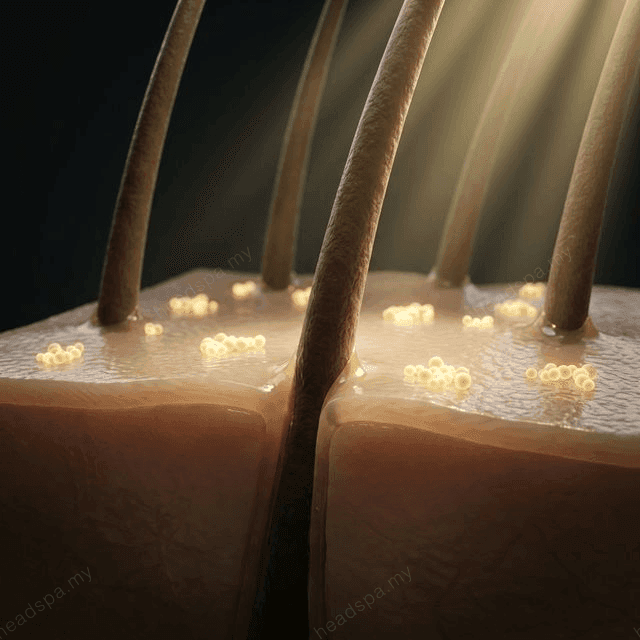
There is a four-hour window every night when your hair follicles receive their most potent biological signal to grow. It runs from roughly 11pm to 3am. During this window, pulsatile growth hormone (GH) release — tightly coupled to slow-wave sleep (SWS) — triggers a cascade that activates the anagen (growth) phase in follicles, stimulates dermal papilla cells, and repairs the scalp barrier from the day's oxidative damage. For a significant portion of KL's working population, this window passes entirely while they are still awake, scrolling, finishing deliverables, or commuting.
The consequences are not cosmetic. They are biological and cumulative.
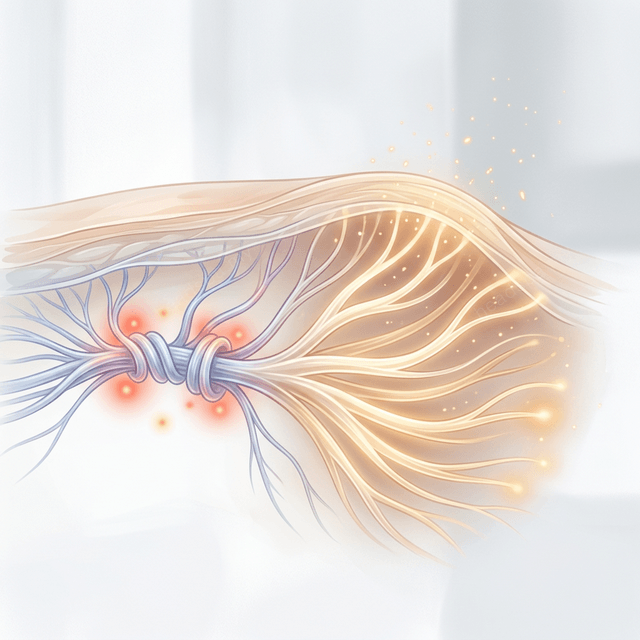
The GH–IGF-1–Follicle Axis
Growth hormone does not act on hair follicles directly. Its downstream mediator, insulin-like growth factor 1 (IGF-1), is the functional signal. The sequence is precise: SWS onset triggers hypothalamic GHRH release → anterior pituitary secretes GH in a pulsatile burst → liver and peripheral tissues (including the dermis) convert GH to IGF-1 → IGF-1 binds receptors on dermal papilla cells → Wnt/β-catenin pathway activation → anagen phase signalling.
This cascade is not replaceable by sleep at other hours. GH secretion is phase-locked to the early nocturnal SWS period. Sleeping from 3am to 9am produces a fraction of the GH output generated by sleeping from 10:30pm to 6am — even if total sleep duration is identical. The 2000 Van Cauter study demonstrated that slow-wave sleep accounts for the dominant GH secretory pulse; fragmented or phase-shifted sleep produces attenuated pulses with measurably lower amplitude.
A University of Malaya 2019 cross-sectional study found that 68% of urban Malaysian professionals scored above 5 on the Pittsburgh Sleep Quality Index (PSQI), indicating clinically poor sleep quality. The most common pattern: sleep onset after midnight, wake before 6:30am, high sleep fragmentation. This is not a lifestyle observation. This is a population-level suppression of the GH regenerative window.
Cortisol: The Biological Antagonist
Growth hormone and cortisol operate on an inverse relationship. In a healthy circadian profile, cortisol is lowest between 10pm and 2am — precisely the window that permits maximal GH output. In KL professionals under sustained workload, evening cortisol suppression fails. Late-night deadline pressure, screen exposure, and anxiety maintain cortisol at concentrations that directly inhibit GH pulse amplitude.
The mechanism is competitive: cortisol activates somatostatin release from the hypothalamus, which acts as a GH brake. Elevated late-night cortisol therefore produces a blunted GH pulse, reduced IGF-1 synthesis, and diminished anagen signalling — all without the person losing a single hour of sleep. The problem is not only duration; it is cortisol-mediated suppression of the regenerative signal even when sleep occurs.
Inflammatory Cytokines and the Scalp Microenvironment
Sleep deprivation elevates systemic inflammatory markers within 24 hours. IL-6 and TNF-α concentrations rise measurably after a single night of poor sleep; with chronic deprivation, the baseline elevation becomes persistent. At the scalp, elevated circulating IL-6 and TNF-α translate to microinflammation at the dermal–epidermal junction — an environment hostile to follicle cycling.
This scalp microinflammation is clinically subtle. There is rarely visible redness or overt dermatitis. Instead, there is subclinical perifollicular inflammation that shortens anagen phase duration, increases telogen shedding, and progressively narrows the follicle's regenerative capacity. Patients describe it as "hair that used to grow faster" or "density that isn't what it was three years ago." The timeline typically matches a period of sustained sleep disruption.
| Sleep Pattern | GH Pulse Quality | Cortisol Profile | Follicle Impact |
|---|---|---|---|
| 10:30pm–6:30am (8h) | Full amplitude SWS pulse | Normal evening suppression | Optimal anagen signalling |
| 12:30am–6:30am (6h) | Partial — misses early SWS window | Mildly elevated at midnight | Reduced IGF-1; shortened anagen |
| 2am–6am (4h) | Severely attenuated | Elevated through midnight | Chronic anagen suppression; TE risk |
| Fragmented (any hour) | Interrupted SWS — pulse truncated | Variable; often elevated | Inflammatory microenvironment |
Melatonin Deficit and Antioxidant Loss at the Follicle
Melatonin functions as a direct antioxidant in hair follicle cells — not only as a circadian hormone. Follicular keratinocytes and dermal papilla cells express melatonin receptors and rely on melatonin-driven free radical scavenging to counter the oxidative load generated during the day. Screen-driven melatonin suppression, common in KL professionals who work until midnight, removes this antioxidant protection precisely when follicle cells are attempting to enter the repair phase.
Reactive oxygen species that accumulate in unprotected follicle cells damage mitochondrial DNA and impair the energy-intensive process of hair shaft synthesis. The result is structurally weaker hair with reduced tensile strength — observable clinically as increased breakage without a corresponding increase in root shedding.
The TTE Sleep Healing Protocol
The TTE Sleep Healing Headspa is designed to address this cascade at the nervous system level, not merely at the scalp surface. The treatment protocol integrates craniosacral-influenced pressure mapping with 432Hz sound resonance and thermal regulation to shift the autonomic nervous system into a parasympathetic-dominant state. Post-treatment delta wave induction — measured by observable physiological markers including reduced respiratory rate and slowed blink frequency — creates the neurological conditions that permit earlier SWS onset on the night of treatment and the 48–72 hours following.
This is not a relaxation claim. It is a mechanistic intervention: lower sympathetic tone → reduced late-night cortisol → restored GH pulse amplitude → improved IGF-1 availability at the follicle. Understanding the delta wave and sleep healing connection helps explain why the protocol produces scalp outcomes alongside sleep quality improvements.
For those experiencing poor sleep and stress-related scalp changes, the clinical priority is nervous system regulation first, and topical treatment second. A follicle that is receiving suppressed IGF-1 and bathing in elevated inflammatory cytokines will respond poorly to growth serums regardless of formulation quality.
---
FAQ
Q: How many nights of poor sleep does it take to affect hair growth? A: A single night of sleep deprivation measurably elevates IL-6 and TNF-α within 24 hours. Hair follicle impact is cumulative — a consistent pattern of sleeping after midnight for 4–6 weeks is sufficient to shift a proportion of follicles from anagen into telogen prematurely. Visible shedding typically lags 6–12 weeks behind the trigger.
Q: Will sleeping 8 hours but late (3am–11am) still protect my follicles? A: Partially. Total sleep duration matters, but GH secretion is phase-locked to the early nocturnal period (approximately 10pm–2am). Sleeping from 3am to 11am will produce reduced GH amplitude relative to early-phase sleep, even with equivalent duration. Chronobiological alignment — not just duration — determines regenerative output.
Q: I take melatonin supplements. Does that protect my follicles from sleep deprivation? A: Exogenous melatonin at low doses (0.5–1mg) can support circadian alignment and may provide some antioxidant benefit at the follicle. It does not, however, replicate the full endogenous melatonin surge or meaningfully compensate for cortisol-driven GH suppression. Supplementation is supportive, not substitutive. Addressing the cortisol elevation that underlies the disruption is the primary intervention.
Q: Does the TTE Sleep Healing Headspa work in a single session? A: A single session produces measurable autonomic state change and clients consistently report improved sleep onset on the night of treatment. Sustained HPA axis recalibration — the kind that persistently reduces late-night cortisol elevation — generally requires a course of 3–5 sessions over 4–6 weeks. Consult the TTE KL clinic for a protocol assessment.
Q: Are Malaysian professionals genetically more susceptible to stress-related hair loss? A: Genetic predisposition to androgenetic alopecia varies by individual. However, the population-level sleep patterns documented in Malaysian urban professionals (PSQI >5 in 68% of the cohort) create a biological environment that will accelerate alopecia progression in anyone with underlying genetic sensitivity. This is an environmental modifier, not a genetic certainty.