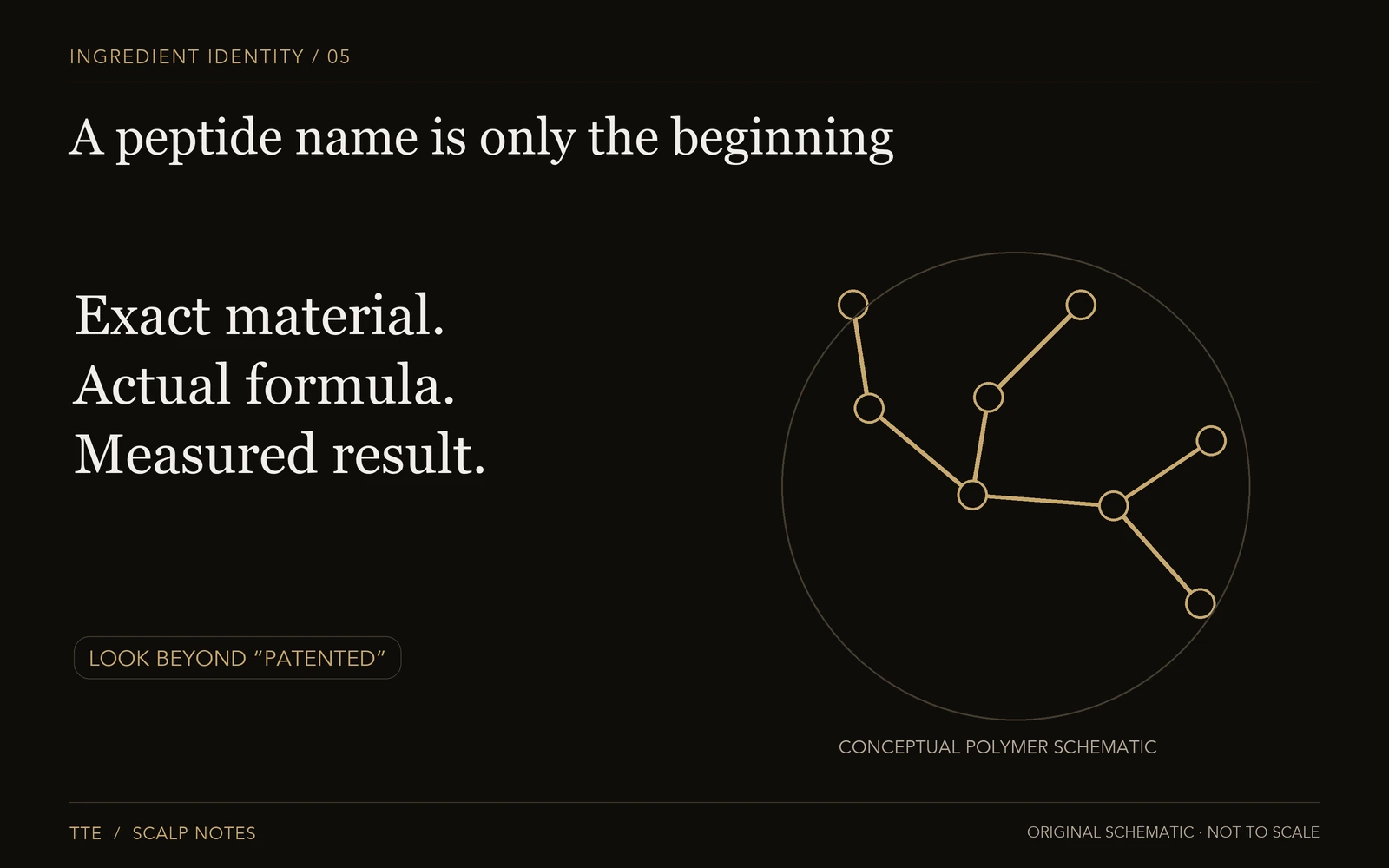
A peptide hair serum should be judged by its exact ingredients and the evidence for the finished formula. Peptides are a broad group, so a promising result for one material does not prove that another serum increases hair growth. Ask what was tested, on whom, by which route and against what comparison.
What are amino acids, peptides and polymers?
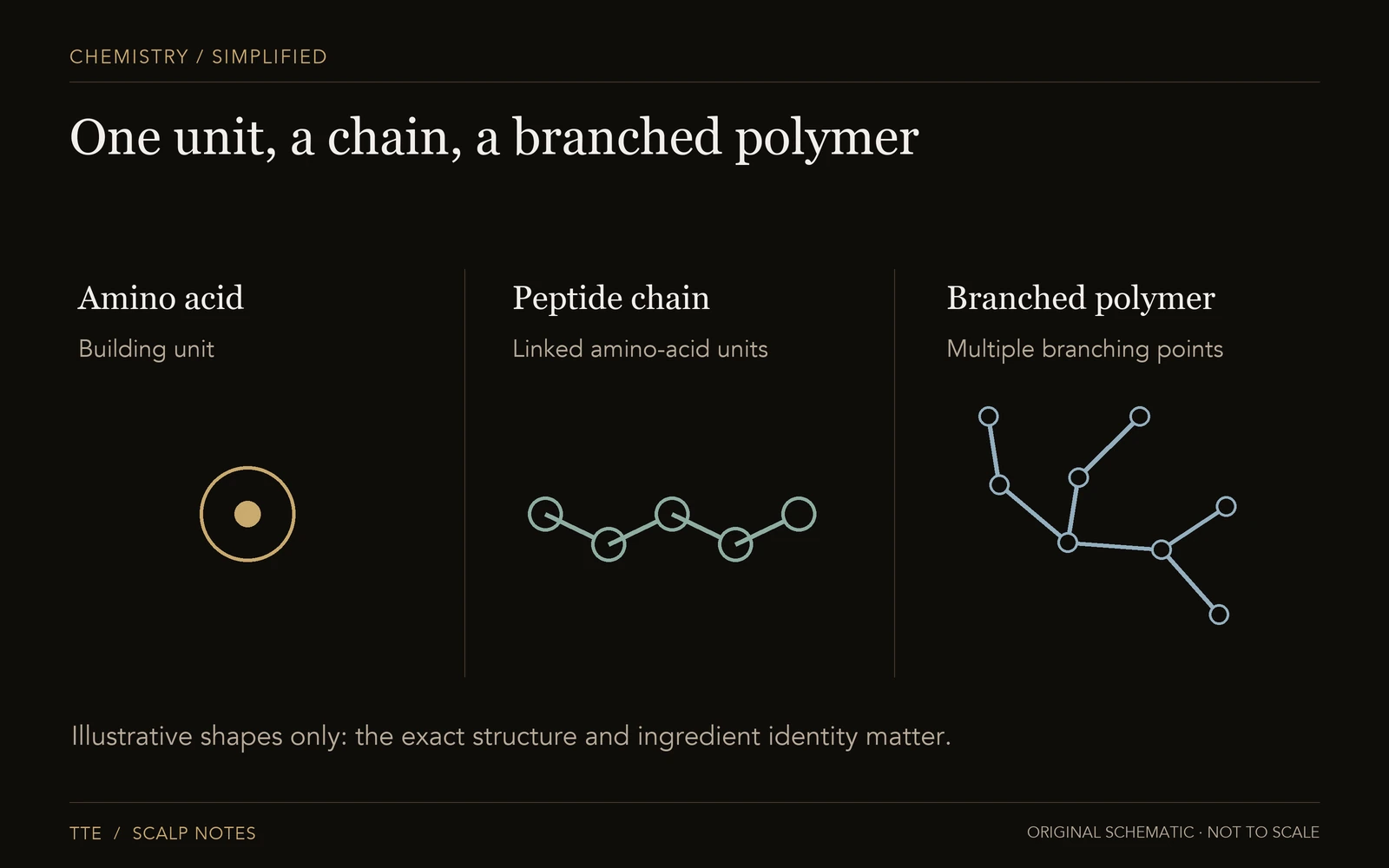
Amino acids are molecular building blocks. Joining them creates chains; peptides are chains of amino acids, while polymers are larger structures built from repeating units. The sequence, length and arrangement help determine a material's properties. Similar-sounding names can describe different substances.
Polylysine is built from lysine units. A hyperbranched polylysine has a branched architecture rather than simply being described as one straight chain. In ingredient discussions, the abbreviation HBPL may be used for hyperbranched polylysine, but the abbreviation alone does not identify a particular commercial material.
You do not need to memorise molecular structures to shop sensibly. You do need the full ingredient identity behind a headline such as “advanced peptide complex.” If the explanation keeps returning to the category name without identifying the material, there is not enough information to match it to a study.
Does research on a peptide mean it works in a serum?
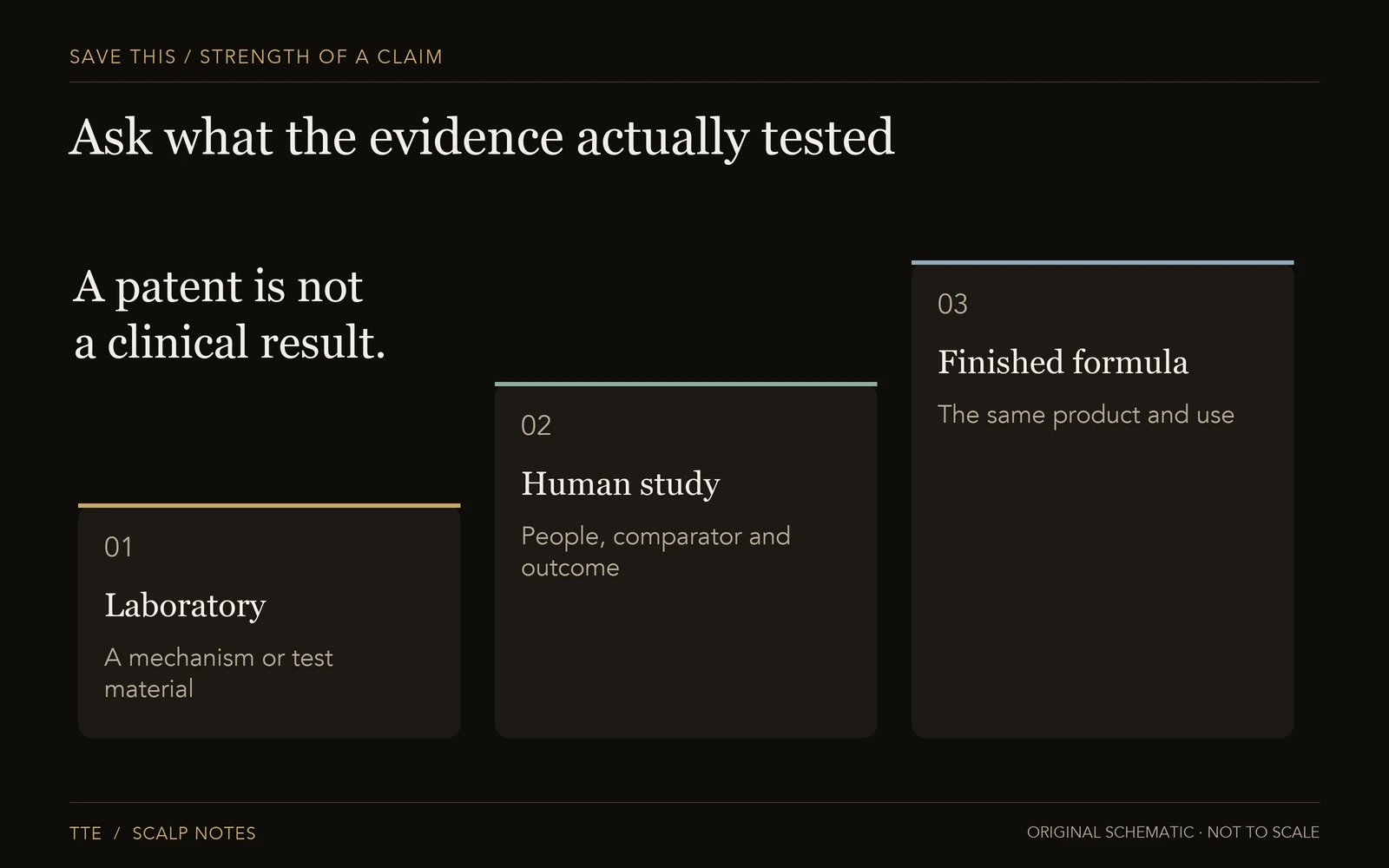
Consider a published study of the copper-peptide complex AHK-Cu. Researchers examined human follicles and dermal papilla cells in laboratory culture and reported effects relevant to follicle growth. Human tissue was involved, but people were not randomized to use a retail scalp serum. That distinction matters when reading “human hair growth” in a study title. Original AHK-Cu laboratory study.
Such work can identify a biological possibility worth testing. It does not establish the effectiveness of every copper peptide, the best application schedule, or the performance of a multi-ingredient bottle. Ask for the next step: research using a defined formula in people with a clearly described concern.
What does the HBPL antimicrobial study show?
A 2024 paper investigated identified hyperbranched polylysine materials, including HBPL-6, in combination with antibiotics against Gram-negative bacteria. The work reported enhanced antibacterial activity in its experimental setting. It was not a human trial of a scalp serum, and its organisms and outcomes do not establish a treatment for Malassezia-related scalp problems. Original HBPL study.
This is an important boundary for polylysine scalp-care claims. Laboratory antibacterial activity is not the same as demonstrated scalp comfort, barrier repair, selective preservation of resident microbes or hair growth. Each claim needs evidence relevant to its own outcome and the material actually used.
If a supplier cites that paper, ask how its product matches the tested material. A label saying polylysine does not, on its own, establish the same molecular structure, formulation or experimental exposure. Our microbiome product guide explains why changes in microorganisms also need to be connected to a useful benefit.
Does a patent prove clinical effectiveness?
A patent concerns rights over an invention. WIPO explains patents as exclusive rights granted for inventions; the document describes an invention and its scope. That is different from a controlled clinical result in the product's intended users. WIPO explanation of patents.
When a product advertises patents in several countries, request the publication or grant numbers and the name of the owner. Then check what the documents concern: a manufacturing process, a material or a particular formulation. An application and a granted patent should not be presented as the same status.
You can appreciate an inventive formulation while still asking for outcome evidence. The useful purchasing question is not only whether something is patented, but whether the product you will use has shown a worthwhile benefit under relevant conditions. A patent badge cannot answer that second question.
How would you compare two serum claims?
Imagine two hypothetical bottles. Bottle A says “contains a patented peptide.” Bottle B names a formula studied against its base formulation and explains the participant group, duration and outcome. Neither description alone tells you which is suitable, but Bottle B gives you more information to assess.
| Question | A useful answer | What remains uncertain without it |
|---|---|---|
| Which material? | Exact ingredient and formulation identity | Whether the cited study is relevant |
| Who used it? | Participants and the concern being studied | Whether results apply to your situation |
| Compared with what? | A meaningful control or comparison | How much change might have occurred anyway |
| What improved? | A defined measurement and time period | Whether the headline means comfort, appearance or growth |
| Was it tolerated? | Adverse events and withdrawals reported | What happened to people who stopped using it |
Also ask what else participants used. If a study combines several active ingredients or procedures, an improvement cannot automatically be assigned to the peptide. Likewise, a topical result cannot validate an injection, and a procedure cannot validate a leave-on cosmetic.
Keep peptide serums, cell extracts and extracellular-vesicle preparations distinct. They are different descriptions requiring different identity and evidence questions. The exosome terminology guide explains that separate topic; a scientific-sounding umbrella term should not make the products interchangeable.
What would make a result relevant to you?
Start with your concern. Smoother lengths and a fuller-looking hairstyle are useful cosmetic outcomes when that is your aim. They are different from an increase in growing hairs or treatment of a diagnosed cause of loss. Our scalp-health guide explains the difference between the hair fibre and the living follicle.
For a widening part or progressive thinning, use the thinning-hair guide to prepare questions for assessment. Do not let a new ingredient name postpone finding out why the change is happening. If you are choosing routine care, the scalp serum guide helps compare labels and application.
Bring the bottle and any study supplied with it to a consultation. At TTE, your product history can inform a conversation about cleansing and comfort. A calm appointment can make that discussion easier, without turning a laboratory mechanism into a promise about the ritual.
Frequently asked questions
Q: Are all peptides effectively the same in hair care? A: No. Identity, structure and formulation matter. A study of one defined peptide cannot establish the performance of every product using the category name.
Q: Does an antimicrobial result prove a serum treats dandruff? A: No. Ask whether the finished formula was tested on people with dandruff and whether relevant symptoms improved. A laboratory result against selected bacteria answers a narrower question.
Q: Does a peptide or HBPL claim demonstrate heavy-metal detox? A: Not by itself. Request evidence for the exact product, the metal being measured, the exposure being addressed and a meaningful result in its intended use. An ingredient name, patent or unrelated antibacterial study does not supply those details.