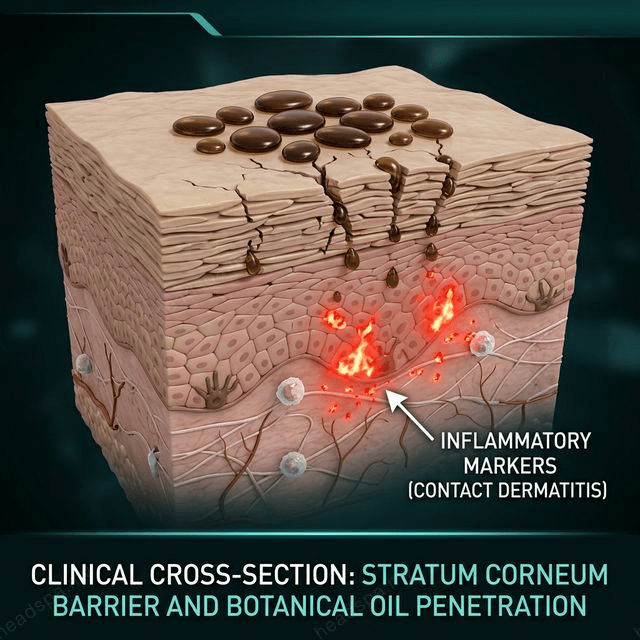
Rosemary oil contains camphor and 1,8-cineole — two documented contact sensitizers that can trigger inflammatory dermatitis on a scalp barrier already compromised by tropical humidity. In a temperate European clinic, rosemary shows modest promise; in Kuala Lumpur's 33°C, 80% humidity environment, the clinical risk profile changes entirely.
The Rosemary Oil Phenomenon !3D botanical barrier repair diagram — rosemary oil ceramide restoration on damaged scalp
If you search "natural hair loss treatment Malaysia" on any platform, rosemary oil dominates the results. Viral social media content, wellness influencers, and even some headspa brands position rosemary essential oil as a natural alternative to pharmaceutical interventions like minoxidil. The appeal is intuitive: a plant-based solution that smells pleasant and avoids synthetic chemicals.
The clinical basis for this claim rests almost entirely on a single 2015 study (Panahi et al., *Skinmed*) which compared rosemary oil to 2% minoxidil over six months and reported similar efficacy for androgenetic alopecia. This study is legitimate. However, it was conducted in Tehran — a semi-arid climate with approximately 35% average relative humidity. The conditions under which rosemary oil was tested bear almost no resemblance to the biological reality of the Malaysian scalp.
The Chemistry of Rosemary on a Tropical Scalp
To understand why climate changes the risk profile, we must examine the chemical composition of rosemary essential oil (*Rosmarinus officinalis*).
Rosemary oil is not a single compound. It is a complex mixture of volatile organic chemicals, primarily: 1,8-cineole (eucalyptol, 38–55%), camphor (5–15%), α-pinene (9–14%), and borneol (1–6%). These are the terpene compounds responsible for rosemary's sharp, penetrating aroma.
In dermatological literature, both 1,8-cineole and camphor are classified as moderate contact sensitizers and penetration enhancers. This means they actively break through the stratum corneum (the scalp's outermost protective barrier) to reach the live epidermis beneath.
In a temperate climate where the stratum corneum is relatively intact (low humidity, minimal sweating, cool ambient temperatures), this penetration effect is generally tolerable. However, on a Malaysian scalp — where the barrier is already chronically compromised by KL's 80–90% humidity, alkaline tap water (pH 7.0–8.0), and repeated HVAC-driven thermal shock — the terpenes encounter a drastically weakened defense.
Penetration Enhancement on a Broken Barrier
When camphor and cineole penetrate a compromised stratum corneum, they reach the live keratinocytes and Langerhans cells (the immune sentinels of the skin) far more rapidly than intended. This accelerated penetration triggers a localised immune response: the release of pro-inflammatory cytokines (IL-1α, TNF-α) and histamine.
The clinical result is Allergic Contact Dermatitis (ACD) — presenting as intense burning, redness, scaling, and paradoxical hair shedding at the exact sites of application. The scalp does not just fail to improve; it actively worsens. A 2002 study published in the *Australasian Journal of Dermatology* (Bleasel et al.) documented multiple cases of ACD triggered specifically by essential oil application to compromised skin, noting that the risk increases substantially in hot, humid environments where transepidermal water loss alters barrier permeability.
The Malassezia Problem with Botanical Oils
Beyond the contact sensitization risk, there is a second, less intuitive biological concern. Rosemary oil, like all plant-based lipids, contains fatty acid chains. When applied to the scalp in significant quantities, these lipids become substrate (food) for *Malassezia* yeast.
*Malassezia globosa* is a lipophilic organism — it feeds exclusively on the lipid-rich environment of the scalp. In KL's tropical humidity, Malassezia proliferation is already 3× higher than in temperate climates. Adding an external lipid source directly onto the scalp surface provides the yeast with additional metabolic fuel. The yeast metabolizes the triglycerides and excretes oleic acid, a potent inflammatory irritant that penetrates the weakened stratum corneum and triggers severe pruritus (itching) and accelerated flaking.
This explains a common complaint among Malaysian users of rosemary oil: "It worked for the first two weeks, then my dandruff suddenly got much worse." The initial anti-inflammatory terpene effect (a genuinely documented property of rosemary) provides temporary symptomatic relief, but the steady lipid supply simultaneously feeds the fungal population. Once the Malassezia colony reaches a critical mass, the inflammatory load overwhelms the terpene's modest anti-inflammatory capacity.
What Actually Treats the Mechanism
The scalp conditions that rosemary oil is promoted to address — hair thinning, dandruff, itch — each have distinct biological mechanisms. Treating them clinically requires specificity, not a single botanical extract.
For barrier compromise (the root cause of most scalp issues in tropical climates), the intervention is bio-identical ceramides. Ceramides are the primary lipids in the stratum corneum's "brick and mortar" structure. When applied topically at pH 4.5–5.5, they physically integrate into the existing lipid matrix, repairing microscopic fissures without feeding fungal populations or sensitizing the immune system.
For sebum regulation, the intervention is pH-calibrated amino acid cleansers — not oil-stripping surfactants — that maintain the acid mantle while dissolving oxidized squalene inside the follicular funnel.
For inflammation-driven shedding, the intervention is systemic — reducing the cortisol load through autonomic nervous system regulation, not by applying a topical anti-inflammatory oil to the symptom site.
Understanding Scalp Biology at this level reveals why a single essential oil cannot simultaneously repair a barrier, regulate sebum, suppress Malassezia, and modulate cortisol. Each of these processes operates through a different biochemical pathway.
The Clinical Alternative in Malaysia
At TTE Elephant, we do not dismiss the well-documented anti-inflammatory properties of rosemary's ursolic acid component. We reject the delivery mechanism. Applying undiluted or crudely diluted essential oils to a barrier already damaged by Malaysia's tropical conditions is a clinical gamble with a documented downside risk.
Instead, our treatment protocols at the head spa in Kuala Lumpur build the intervention from the barrier upward. Trichoscopic diagnosis identifies the specific pathology. Enzymatic dissolution clears follicular blockages. Ceramide infusion rebuilds the stratum corneum. And the Sleep Healing Headspa addresses the cortisol-driven component through vagal nerve stimulation — a systemic intervention that no topical oil can replicate.
The popularity of rosemary oil reflects a genuine consumer desire for natural, non-pharmaceutical solutions to scalp conditions. That desire is clinically valid. The solution, however, must match the biological complexity of the problem — and a single botanical extract applied to a compromised barrier in 33°C tropical heat does not meet that standard.
Frequently Asked Questions
Q: Does rosemary oil actually help with hair loss? A: One clinical trial (Panahi et al., 2015) showed rosemary oil comparable to 2% minoxidil over 6 months — but this was conducted in a dry, 35% humidity climate. In Malaysia's 80% humidity, the camphor and cineole in rosemary penetrate a weakened scalp barrier far more aggressively, increasing the risk of contact dermatitis rather than promoting growth.
Q: Can rosemary oil make dandruff worse? A: Yes. Rosemary oil is a plant-based lipid that feeds *Malassezia* yeast on the scalp. In tropical humidity, where Malassezia populations are already 3× higher than temperate climates, adding external lipids accelerates fungal growth. Initial symptom relief is often followed by a severe inflammatory rebound.
Q: What should I use instead of rosemary oil for my scalp in Malaysia? A: Bio-identical ceramides repair the stratum corneum barrier without feeding fungal populations. pH-calibrated amino acid cleansers (pH 4.5–5.5) maintain the acid mantle while clearing follicular blockages. These are the clinically validated alternatives for tropical scalp conditions.
Q: Is it safe to use essential oils on my scalp in Malaysia? A: Essential oils like rosemary, tea tree, and peppermint contain volatile terpenes classified as contact sensitizers. In Malaysia's hot, humid climate, where the scalp barrier is chronically weakened, the risk of allergic contact dermatitis is significantly elevated compared to temperate environments. Professional scalp assessment should precede any topical application.