Choose a scalp serum in Malaysia by the problem you want to address, the application instructions and the evidence for that exact product. A scalp serum goes on scalp skin; a hair serum may be intended only for the lengths. An impressive ingredient name cannot answer whether either suits your routine.
What are you trying to change?
Write down one priority before browsing: a tight feeling after washing, oily roots by evening, visible flakes, breakage along the lengths or a widening part. These are different observations. A bottle promising several benefits can make it difficult to decide which improvement would justify buying it again.
Include the timing. Does discomfort start immediately after a particular shampoo? Do the flakes appear after several days of dry shampoo? Has shedding increased over several months? Our guides to oily roots and dry ends and scalp buildup versus dandruff help organise those questions before another product enters the routine.
For persistent shedding or progressive thinning, establishing the cause matters more than comparing cosmetic textures. A dermatologist may use your history, examination and, when appropriate, additional tests to guide treatment. A serum chosen from a shelf cannot supply that diagnosis. AAD explains the hair-loss assessment process.
Is it for the scalp or the hair lengths?
The word serum describes a product format, not a single function. Read the intended application area and the actual claim together.
| Your purpose | Where the product belongs | Evidence to look for | What it does not establish |
|---|---|---|---|
| Improve scalp comfort or hydration | Scalp, if labelled for scalp use | Relevant comfort or hydration assessment | Treatment of every cause of itch |
| Improve slip, smoothness or appearance | Hair lengths, following directions | Hair-fibre or user-use assessment | New growth from follicles |
| Manage a diagnosed scalp condition | As directed for the chosen treatment | Evidence for the condition and formulation | Suitability of an unrelated cosmetic serum |
| Evaluate a hair-growth claim | Depends on the studied product | Human results with a useful comparator | Efficacy from an ingredient name alone |
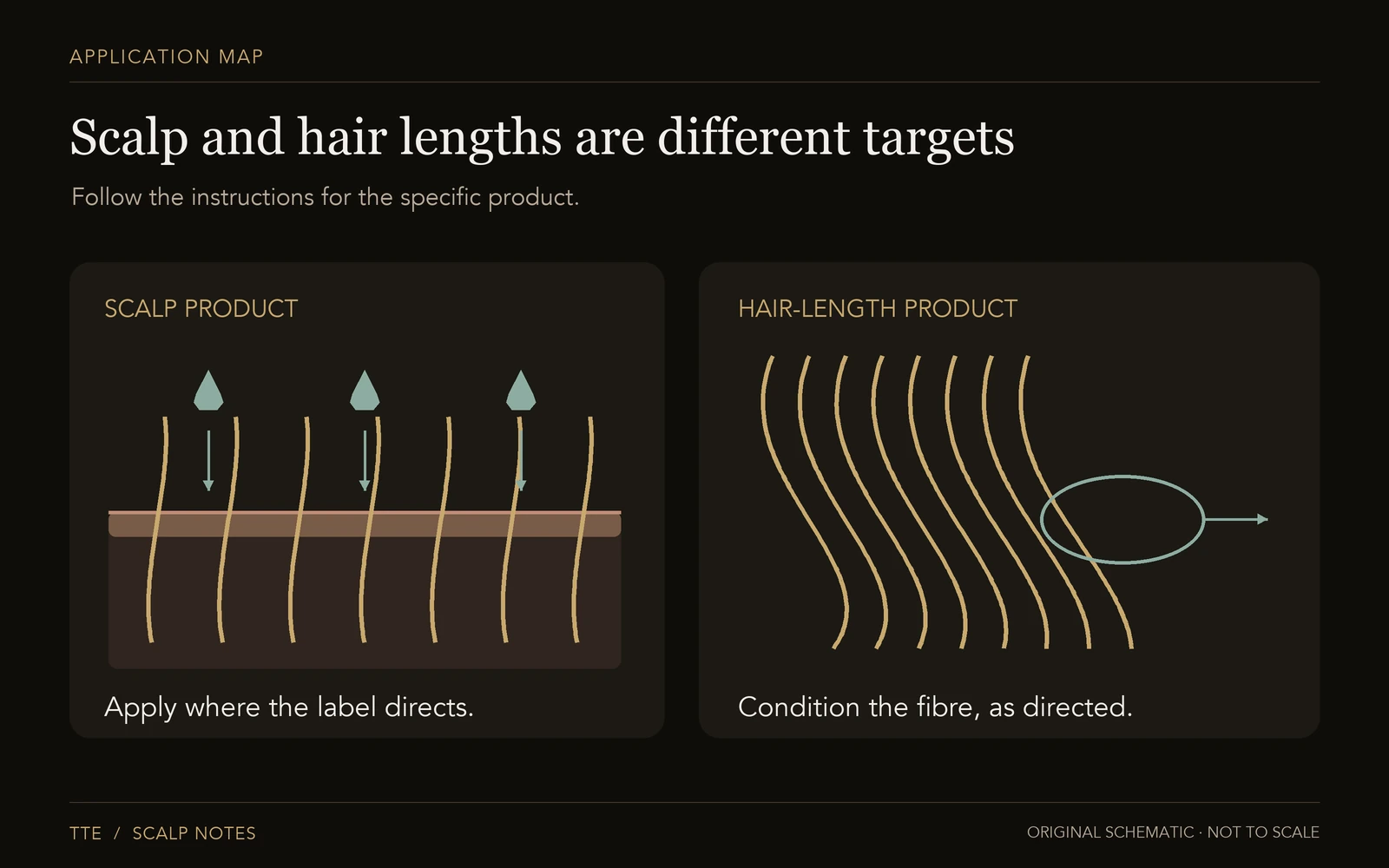
Someone with oily roots and dry ends may need different products for the two areas. There is no need to cover the scalp with a rich length serum simply because the ends feel rough. Equally, a lightweight scalp liquid may do little for tangles. Matching the area is the first useful decision.
What should you read on the label?
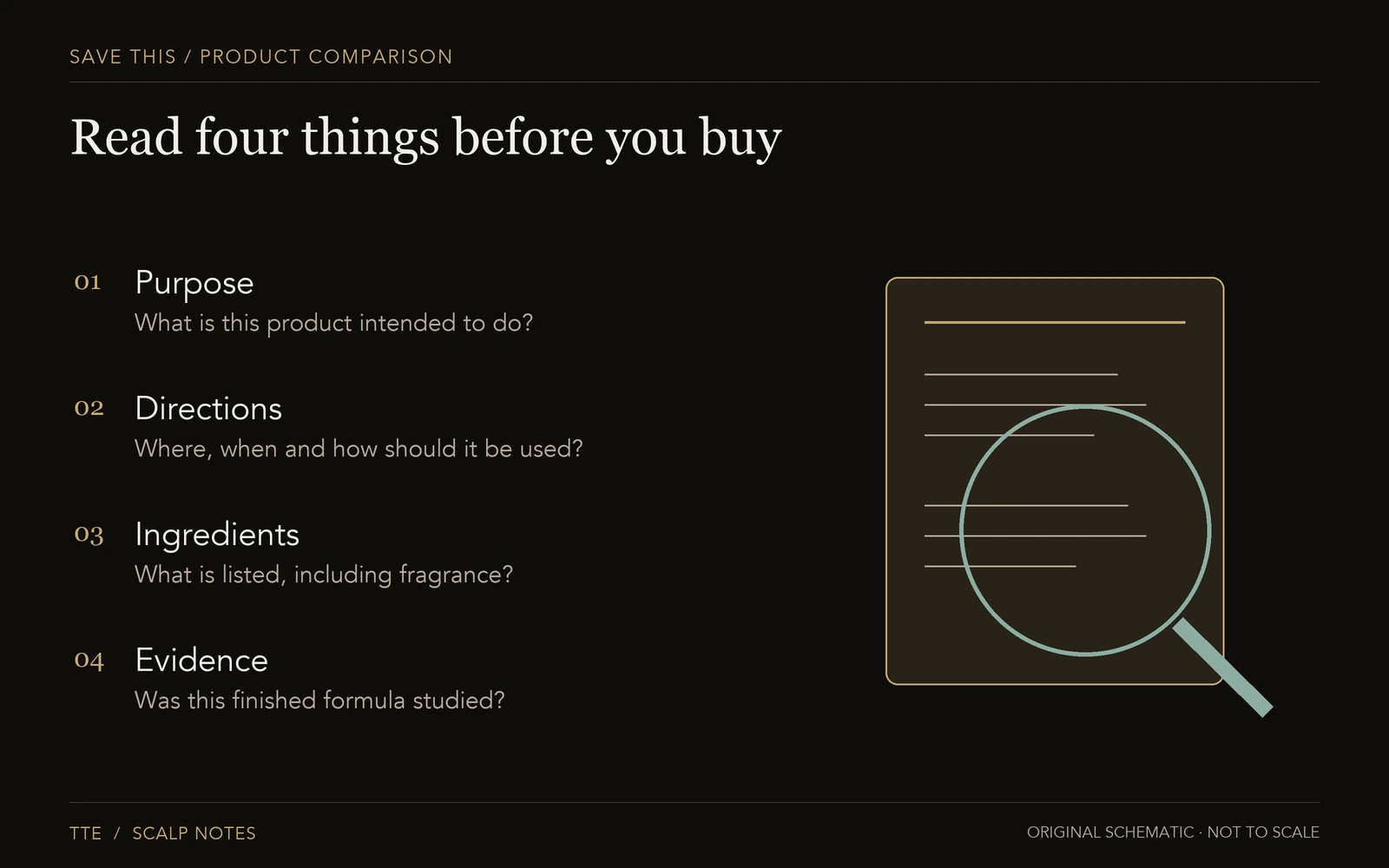
Start with the purpose and directions, then the complete ingredient list. Check whether it is leave-on or rinse-off, whether application is to dry or damp scalp, the stated amount and frequency, and any warnings. Keep the original packaging until you know the product suits you.
Look for a manufacturer or responsible company, an identifiable product name and a batch or expiry detail where supplied. When comparing Malaysian product status, use the exact variant rather than assuming that every bottle from the same brand has the same status. The official NPRA product-status search is a starting point for checking the relevant record.
Cosmetic positioning and medical treatment claims also differ. Malaysia's cosmetic-claims guidance considers the product's intended use and presentation; keeping hair in good condition is different from presenting a product as a treatment for disease. A regulatory record should not be read as a clinical trial demonstrating regrowth. NPRA cosmetic-claims guidance.
Is a spray better than a dropper?
A spray may be convenient for covering a broad area. A dropper may make it easier to follow a parting and see where the liquid lands. Those are practical differences. A fine mist, fast drying or a cooling feel does not itself demonstrate that more ingredient reaches a follicle or that the product works better.
Part the hair so you can follow the labelled instructions without losing most of the product on the lengths. Use the supplied applicator as directed, keep spray away from the eyes and face, and avoid improvising a larger dose. If the instructions are unclear, ask the manufacturer or pharmacist before use.
For a KL workday or a JB commute, the useful question is whether the routine fits your actual morning and wash schedule. A leave-on that makes your roots unpleasant to touch may be difficult to use consistently. That is a reasonable reason to reconsider it; stronger sensory effects are not a requirement.
How should you compare ingredient claims?
Ask what was tested: a single ingredient in a laboratory, the full formula on volunteers, or a product with a similar name. Then ask what improved. Softer-feeling hair, fewer broken fibres and more hairs per square centimetre are different outcomes.
Botanical, peptide and microbiome language does not remove those questions. Our peptide serum evidence guide explains how to read ingredient studies. If your main concern is the feeling after application, see warm, cool and tingling scalp serums. A pleasant fragrance can be a preference; it is not a measure of scalp suitability.
What should you bring to a consultation?
Bring the label, a list of other scalp products and a short account of when the concern started. Include recent colouring, changes in washing and any prescribed treatments. Clear photographs taken under similar lighting can help explain a change you have noticed, without treating them as a diagnosis.
At a TTE consultation, the label can support a discussion about your current routine and preferences. Our scalp-analysis guide explains the limits of visible observations. Keep your desired comfort and treatment pressure in the conversation too: a considered ritual should fit the person using it, while medical questions receive appropriate assessment.
Frequently asked questions
Q: Does a scalp serum replace washing? A: A leave-on serum is not a substitute for cleansing unless the product is specifically designed and labelled for that purpose. Keep a wash routine suited to your scalp and the instructions for any treatment you use.
Q: Can I apply it to damp hair? A: Follow that product's directions. Instructions for dry scalp, towel-dried hair and application before washing are not interchangeable. Ask for clarification if the label does not say.
Q: Is a spray better than a dropper for oily scalp? A: The applicator alone cannot establish that. Compare the formula's intended use, how easily you can reach the scalp and the finish you can comfortably live with.