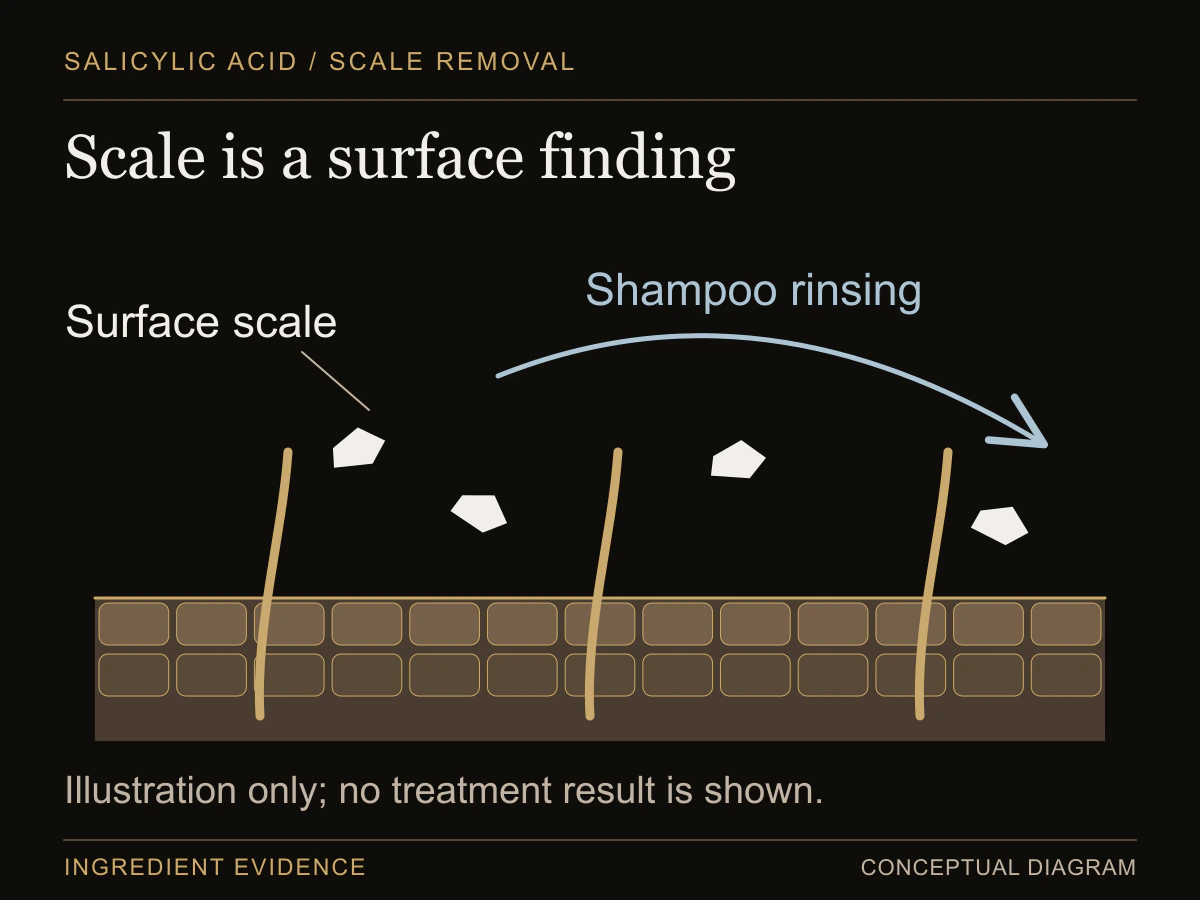
Salicylic acid for the scalp is mainly relevant to loosening and removing scale. This keratolytic role can be useful in a shampoo, but it does not establish that the ingredient fixes every cause of flakes or removes every kind of buildup. The supporting clinical studies often tested it with other actives. Clinical shampoo study.
The useful question is precise: what are you trying to remove, and what is causing it to return? Our scalp buildup versus dandruff guide provides a starting point for that conversation.
What does “removes scale” actually mean?
Scale refers to material shed from the skin surface. In one controlled shampoo study, researchers assessed visible scaling and counted shed skin cells. Those endpoints tell us about flaking; they do not measure styling-product residues, mineral deposits or “toxins” inside hair follicles. Leyden et al., 1987.
That distinction matters when a bottle promises a scalp detox. Ask the claim to name a measurable result. Fewer visible flakes is understandable. A general promise to “unblock everything” leaves the reader unable to judge what was tested or what improvement should look like.
If your main concern is a coated feeling after styling, tell the person advising you which products you use. If flakes return with itching or redness, describe those symptoms too. A more specific account gives a pharmacist or clinician a better question than “Which acid is strongest?”
Why combination shampoos need careful interpretation
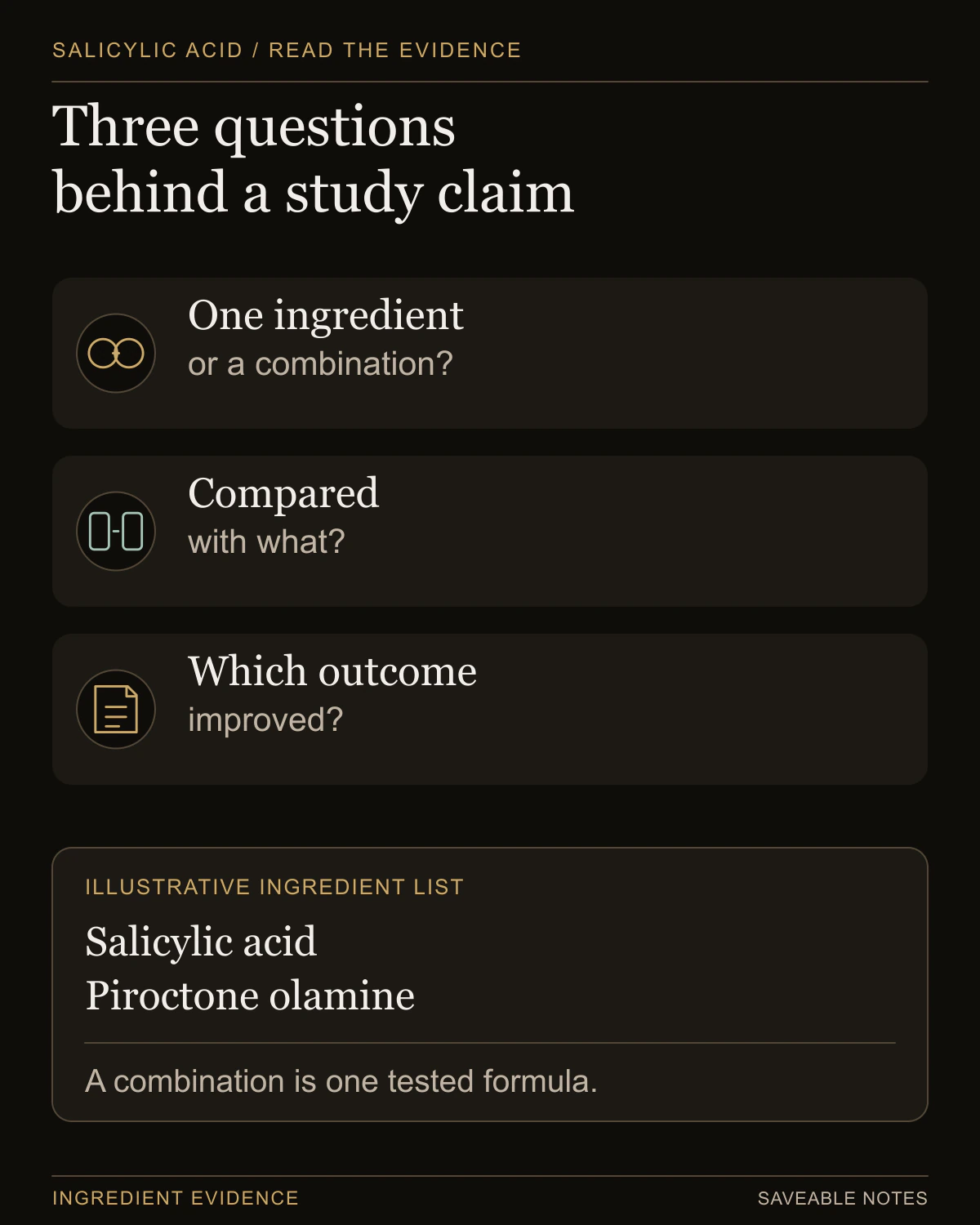
A small study compared a piroctone olamine–salicylic acid shampoo with zinc pyrithione shampoo. Both improved dandruff, but the study could not isolate salicylic acid’s contribution. Lodén and Wessman.
Another trial tested salicylic acid alongside piroctone olamine and elubiol against a coal-tar shampoo. Its findings describe that three-active formula. They are not evidence that every salicylic shampoo performs in the same way. Primary formula comparison.
There is also newer research on a selenium disulfide shampoo containing salicylic acid. Both it and the ketoconazole comparator improved scalp symptoms. Because ingredients and use schedules differed, the result cannot tell us what salicylic acid alone would have achieved. Barbosa et al., 2024.
Read a phrase such as “clinically studied” with those details in mind. The next question should be: studied as what, against what, and for which outcome? This is a practical way to recognise useful evidence without expecting a label to answer every question about your scalp. Our dandruff shampoo ingredient guide puts these formula comparisons in a wider label-reading context.
Choosing a product without chasing stronger exfoliation
First, check whether the product is intended for scalp use and whether it is rinsed off. Malaysian cosmetic restrictions distinguish product categories and include specific conditions for salicylic acid. A permitted concentration is not a personalised recommendation or proof that a stronger product will suit you. NPRA Annex III.
Next, read the complete directions. Contact time and washing advice belong to the finished product. Do not turn a percentage from a research paper into a homemade mixture or combine several exfoliants simply to reproduce a study. Dermatology guidance recommends following the shampoo instructions and accounting for hair type. American Academy of Dermatology.
Finally, decide what you will observe. A short note about visible flakes, comfort and the products used can make the next discussion more concrete. Record discomfort as well as improvement; the aim is a suitable routine, not the strongest possible sensation.
Frequently asked questions
Q: Is salicylic acid the same as an antifungal shampoo? A: No. In research pairing it with ciclopirox olamine, the antifungal and scale-removing components have different roles. That combination’s benefit should not be assigned to salicylic acid alone. Primary clinical study.
Q: Can it permanently cure dandruff or regrow hair? A: Those claims are not established by the scale-removal evidence discussed here. Malaysian cosmetic guidance also excludes permanent dandruff elimination and hair-growth claims from acceptable cosmetic claims. NPRA claims guidance.
Q: When should I stop treating flakes as simple buildup? A: Get medical advice if the scalp is very itchy, red or swollen, or dandruff is severe or persists despite appropriate care. NHS guidance. Our dandruff and dry-scalp overview can help you prepare questions.
Make scalp care a considered ritual
For readers in KL and JB, bring your current routine and concerns to a TTE consultation. Explore our branches to discuss the experience you want and the questions you have. A considered ritual can make space for comfort and attention while ongoing medical concerns receive appropriate clinical care.