
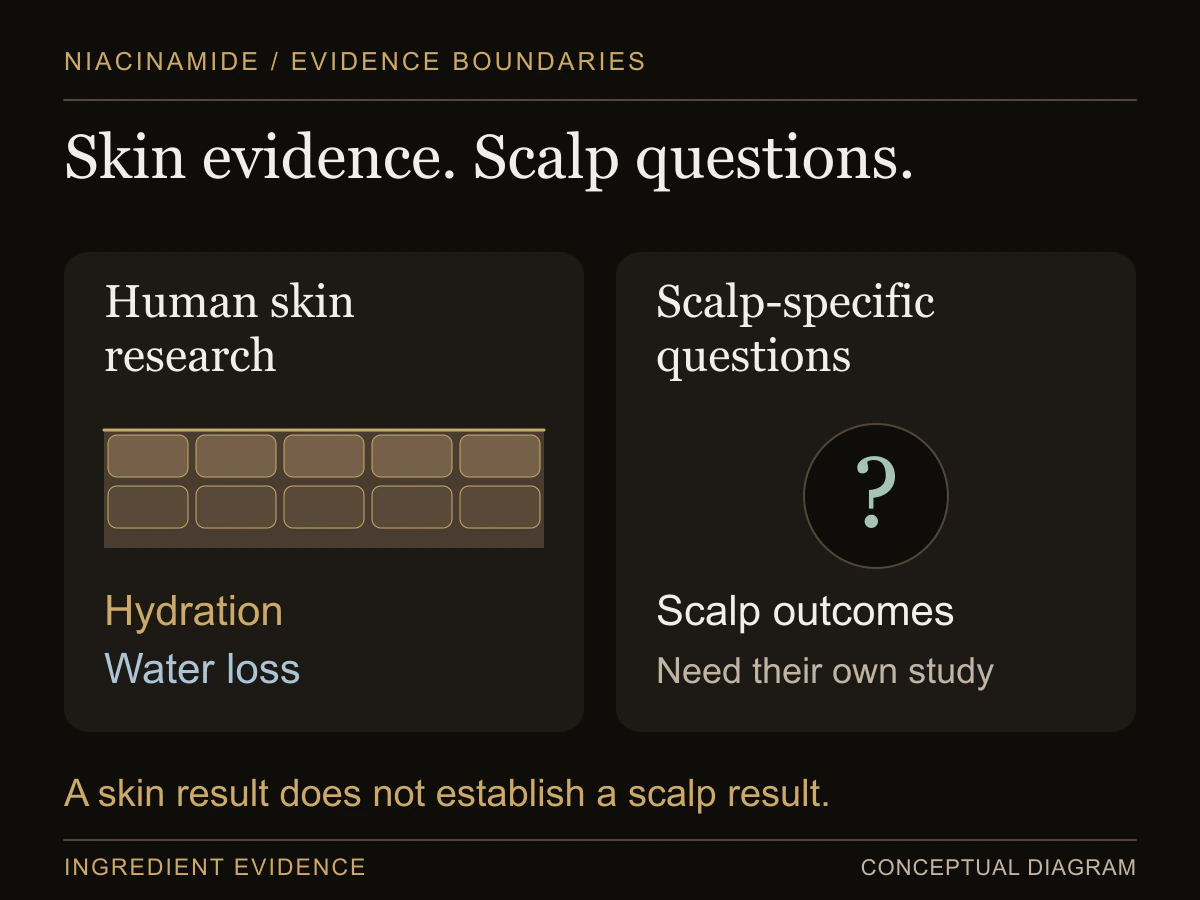
Niacinamide has a credible skin-barrier research background, but that does not make every niacinamide scalp product clinically proven. Human studies support certain moisturising formulations on body or facial skin. Evidence establishing niacinamide's independent effect on scalp dryness, oil production or hair growth is much less clear. Its presence is a reason to examine a formula, rather than a promise of a particular result.
Why niacinamide appears in barrier-care formulas
Niacinamide, also called nicotinamide, is a form of vitamin B3. The outer skin barrier contains lipids that help limit water loss. Researchers have investigated whether niacinamide can support the processes that produce those lipids.
A foundational study combined experiments in human skin cells with measurements in dry skin. It reported increased production of several barrier lipids and reduced water loss after topical application. The cell findings help explain a possible mechanism; they do not show that a scalp serum rebuilds follicles. Tanno and colleagues, 2000.
That distinction matters when a label turns “supports the skin barrier” into “restores scalp health.” The second phrase is much broader. A useful claim should identify the outcome actually tested: hydration, water loss, discomfort, visible flaking or another clearly defined measure.
What the human studies actually tested
In a small study of 28 people with atopic dry skin, a niacinamide cream improved forearm hydration and water-loss measurements. The comparison was with petrolatum, rather than the same cream without niacinamide, so other formulation differences could contribute. These were forearms, not scalps. Soma and colleagues, 2005.
A later trial enrolled 122 adults with mild atopic dermatitis. Niacinamide-containing body products improved several clinical and barrier measurements compared with the control regimen. Participants also received an antihistamine. The findings concern complete products within that study; they cannot tell us how niacinamide alone would perform in a different scalp formulation. Zhu and colleagues, 2023.
Together, these studies justify interest in niacinamide for moisturising skin care. They do not establish a scalp-disease treatment, a guaranteed comfort response or a reason to replace a prescribed routine.
Does niacinamide regulate an oily scalp?
Some of the oil-control discussion comes from facial research. A study of a niacinamide moisturiser assessed facial sebum in Japanese and US participants. Scalp oil production was not its endpoint. Draelos and colleagues, 2006.
It is therefore more accurate to ask whether the actual scalp product has been tested for the concern you want to address. A face study cannot establish that a niacinamide shampoo will keep roots fresher through a KL workday or a JB commute. Local routines make the question relevant; they do not supply the missing clinical evidence.
Read the whole formula and its purpose
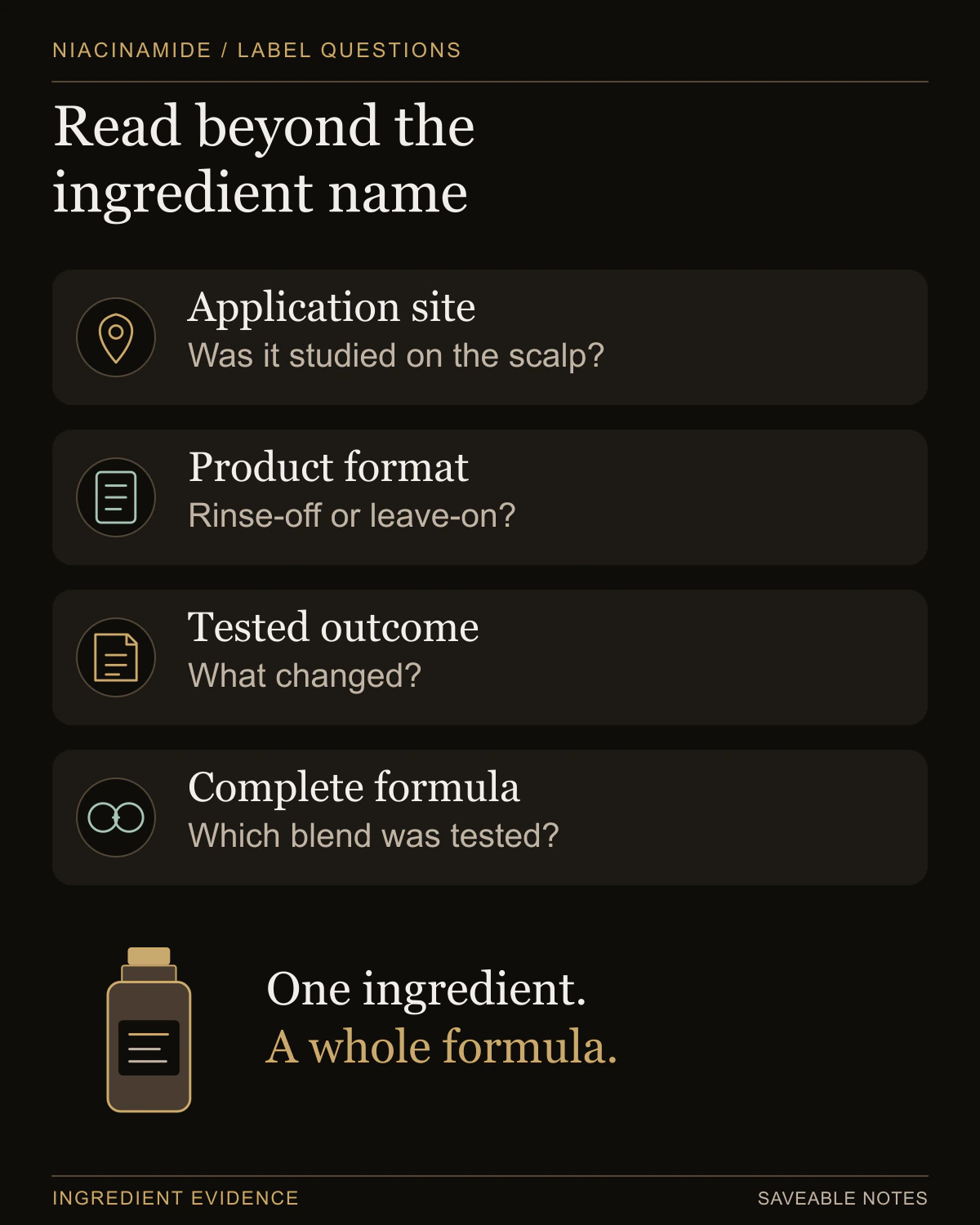
Start with three questions: Is this product intended for scalp application? Is it rinsed off or left on? What outcome does its evidence support? The ingredient list alone does not answer all three.
A product may contain niacinamide alongside humectants, fragrance, exfoliating ingredients or other actives. If a study tested that combination, credit the combination. A prominent percentage is not a measure of personal suitability, and the studies discussed here are not instructions for adapting a facial serum or mixing a scalp treatment.
For suspected fragrance sensitivity, fragrance-free deserves attention; “unscented” can still involve fragrance ingredients. No label makes a formula allergy-proof. American Academy of Dermatology guidance. Our scalp-serum selection guide explains the broader product questions. For humectants and barrier lipids, see our dry-scalp ingredient guide.
Comfort belongs in a considered scalp ritual. It does not require a strong sensory effect, and these ingredient studies did not test sleep improvement or nervous-system recovery.
Frequently asked questions
Q: Can niacinamide regrow hair? A: The barrier and moisturiser studies above do not establish hair regrowth. Progressive thinning needs assessment of its cause; an ingredient's skin benefits cannot supply that diagnosis.
Q: Is it suitable for every sensitive scalp? A: No. Suitability depends on the complete formula and the reason for sensitivity. Use the sensitive-scalp guide to organise symptoms, rather than treating an ingredient name as reassurance.
Q: Should a niacinamide product tingle? A: Tingling is not evidence of barrier improvement. Our warm, cool and tingling guide explains how to interpret the sensation without using it as a performance test.
Bring the label into the conversation
At TTE Elephant, bring your product label and describe your washing routine, comfort concerns and recent changes. That makes the discussion more specific before choosing a restorative appointment. Explore our KL and JB branches. Persistent itch or unexplained scalp changes deserve medical assessment; several different conditions can look like simple dryness. AAD scalp guidance.