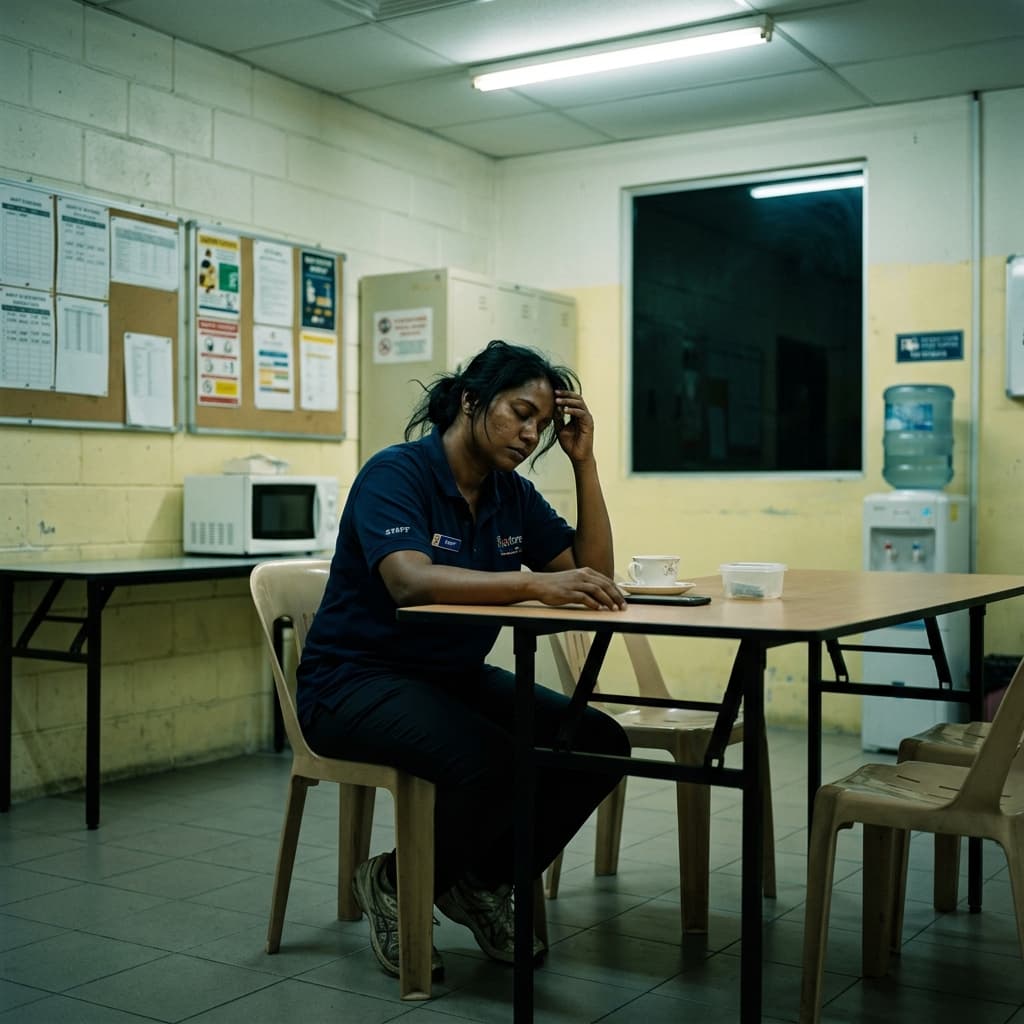
Adrenal fatigue from years of emotional masking in customer-facing roles depletes the cortisol reserve, creating a paradoxical hormonal state where the body can no longer mount an adequate stress response. This dysregulation disrupts DHEA, oestrogen, and testosterone balance, triggering diffuse hair thinning across the entire scalp that looks and feels different from stress-related shedding.
The Biology of Emotional Masking
Retail, F&B, and customer service roles require a specific psychological skill called "surface acting" — maintaining a pleasant, professional demeanour regardless of your internal emotional state. You smile when you are exhausted. You apologise when you are not at fault. You remain calm when customers are aggressive.
This constant emotional suppression is not psychologically neutral. Each instance of surface acting triggers a micro-dose of cortisol release as the amygdala (the brain's threat detection centre) registers the disconnect between felt emotion and displayed emotion. Over the course of a 10-hour retail shift with dozens or hundreds of customer interactions, these micro-doses accumulate into a significant cortisol load.
Chrousos (2009, Nature Reviews Endocrinology) described this as "chronic intermittent hypercortisolism" — a pattern where cortisol does not stay constantly elevated but spikes repeatedly throughout the day, preventing the HPA axis from ever fully resetting.
From Cortisol Overload to Adrenal Depletion
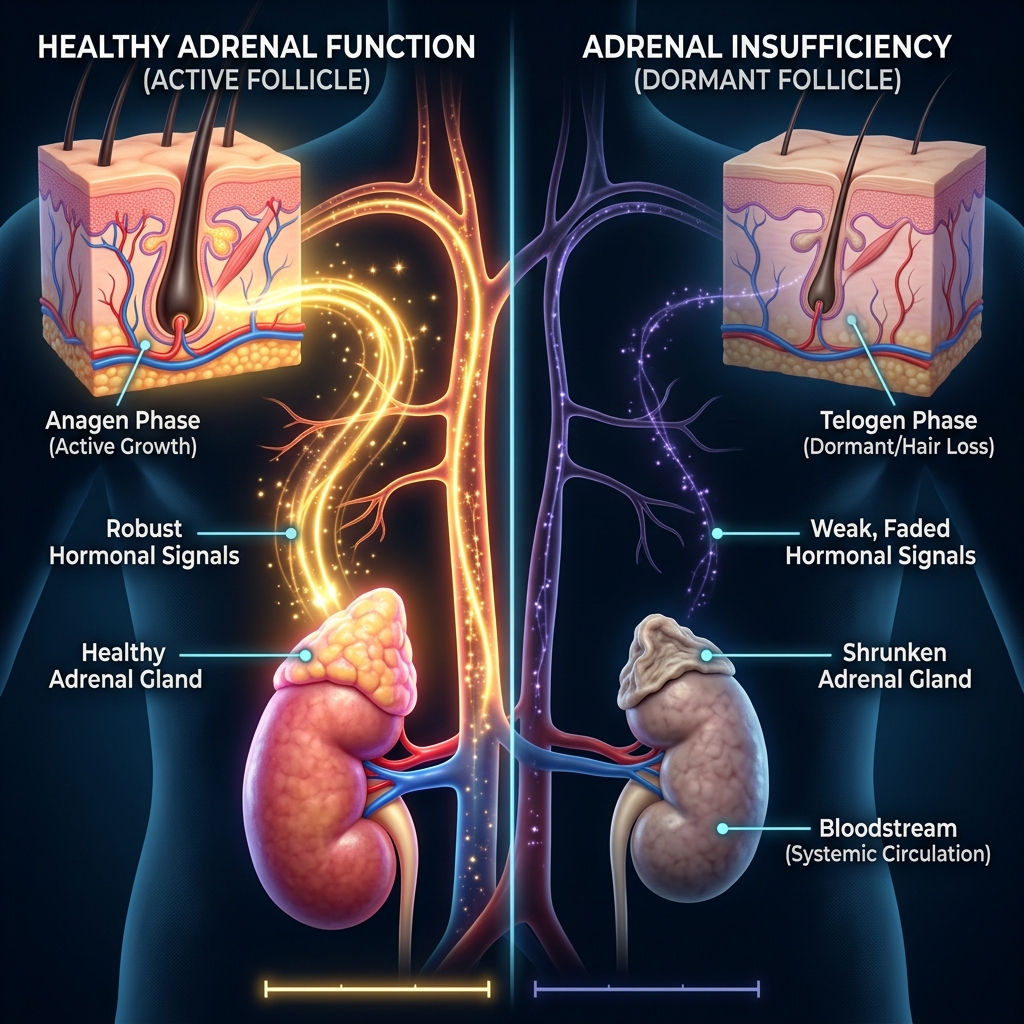
Healthy adrenal glands sending robust signals to active follicles (left) versus depleted glands with weakened hormonal output and dormant follicles (right).
After years of chronic intermittent cortisol demand, the adrenal glands begin to lose their responsiveness. The adrenal cortex — the outer layer responsible for cortisol, DHEA, and aldosterone production — becomes functionally exhausted.
This creates a cascade of hormonal disruption:
- DHEA declines. DHEA is a precursor to both oestrogen and testosterone. Reduced DHEA means reduced oestrogen — the hormone that directly extends the hair growth (anagen) phase.
- Relative androgen excess. As oestrogen falls, the relative influence of androgens (even at normal levels) increases. This accelerates follicle miniaturisation, particularly at the temples and crown.
- Impaired cortisol awakening response. The morning cortisol surge that provides energy and focus is blunted. You wake up exhausted, relying on caffeine to function — further stressing the adrenals.
The Malaysian Retail Reality
Malaysian retail and F&B workers often operate under conditions that intensify adrenal burden:
- Long, standing shifts. 10–12 hour shifts on concrete floors in air-conditioned malls create both physical fatigue and the sustained temperature shock (34°C outside → 19°C inside) that disrupts the scalp's acid mantle.
- Split shifts. Workers who clock in for a morning shift, break for 3 hours, then return for evening service never achieve a continuous rest period — fragmenting any recovery the adrenals might attempt.
- Commission and KPI pressure. The constant background anxiety of meeting sales targets adds an anticipatory stress layer on top of the emotional labour.
Why Hair Products Cannot Address Hormonal Depletion
Shampoos, conditioners, and topical serums operate at the surface level of the scalp. They can improve the appearance of existing hair, reduce breakage, and manage sebum. But they cannot influence DHEA levels, adrenal cortex function, or the systemic hormonal balance that governs follicle cycling.
The problem is endocrine, not cosmetic.
Resetting the Adrenal Axis
At [TTE Elephant Head Spa](/headspa-kl), the [Sleep Healing Headspa](/sleep-healing) protocol addresses adrenal depletion through deep vagal nerve stimulation.
The vagus nerve directly modulates HPA axis activity. Sustained vagal stimulation signals the hypothalamus to reduce CRH output, giving the adrenal glands a genuine physiological rest period. For a retail worker whose adrenals have been driven relentlessly by years of emotional masking, this externally imposed parasympathetic state can initiate recovery that the body has been unable to achieve on its own.
Our protocol pairs the vagal reset with intensive scalp vascular therapy — mechanically increasing blood flow to feed the follicles that have been starved by hormonal and circulatory disruption simultaneously.
Frequently Asked Questions
Q: My hair is thinning evenly all over, not in patches. Is this adrenal-related?
A: Diffuse, even thinning (as opposed to patches or a receding hairline) is the signature pattern of hormonal dysregulation from chronic stress. It reflects a systemic issue rather than a localised scalp condition.
Q: I'm only 34 — isn't it too early for hormonal hair loss?
A: Age-related hormonal changes typically begin around 40–45. If you're experiencing diffuse thinning in your mid-30s, it strongly suggests an external stressor (such as chronic adrenal demand from emotional labour) is accelerating the timeline.
Q: Can I just take DHEA supplements?
A: DHEA supplementation should only be undertaken with medical supervision and blood work. Self-supplementing can worsen hormonal imbalances. The more sustainable approach is to restore adrenal function naturally through nervous system regulation.
Q: I don't feel "stressed" — I just feel tired all the time. Is that still a stress response?
A: Yes. Chronic fatigue despite adequate sleep hours is a hallmark of adrenal depletion. The stress itself may no longer feel acute because the body has exhausted its ability to mount a strong cortisol response — but the hair follicle damage continues silently.
Soalan Lazim
My hair is thinning evenly all over, not in patches. Is this adrenal-related?
Diffuse, even thinning (as opposed to patches or a receding hairline) is the signature pattern of hormonal dysregulation from chronic stress. It reflects a systemic issue rather than a localised scalp condition.
I'm only 34 — isn't it too early for hormonal hair loss?
Age-related hormonal changes typically begin around 40–45. If you're experiencing diffuse thinning in your mid-30s, it strongly suggests an external stressor (such as chronic adrenal demand from emotional labour) is accelerating the timeline.
Can I just take DHEA supplements?
DHEA supplementation should only be undertaken with medical supervision and blood work. Self-supplementing can worsen hormonal imbalances. The more sustainable approach is to restore adrenal function naturally through nervous system regulation.
I don't feel "stressed" — I just feel tired all the time. Is that still a stress response?
Yes. Chronic fatigue despite adequate sleep hours is a hallmark of adrenal depletion. The stress itself may no longer feel acute because the body has exhausted its ability to mount a strong cortisol response — but the hair follicle damage continues silently.
Artikel Berkaitan