
Anticipatory anxiety — the chronic low-grade dread of uncertain outcomes — is neurochemically distinct from acute stress. It keeps the HPA axis engaged without resolution, flooding the scalp with neurogenic inflammatory mediators like Substance P and CGRP that directly attack the follicle's immune privilege, triggering an inflammatory cascade that no topical product can interrupt.
The Startup Nervous System Profile
Corporate stress has a rhythm. Deadlines arrive, pressure peaks, the deadline passes, cortisol subsides. The nervous system cycles between sympathetic activation and parasympathetic recovery.
Startup stress does not cycle.
Women in KL's tech and creative agency ecosystem live in a state of perpetual uncertainty. Will the funding come through? Will this client renew? Is the pivot working? Will the team survive the next quarter? This is anticipatory anxiety — a sustained sympathetic arousal state where the threat is always imminent but never resolved.
Neurochemically, anticipatory anxiety differs from acute stress in a critical way: it preferentially activates the peripheral nervous system's neuropeptide signalling rather than the classic cortisol pathway. While cortisol is certainly elevated, the dominant mediators are Substance P and Calcitonin Gene-Related Peptide (CGRP) — neuroinflammatory molecules released by nerve endings directly in the skin and scalp.
The Substance P Inflammatory Loop
Arck et al. (2006, Journal of Investigative Dermatology) demonstrated that psychological stress triggers Substance P release from peripheral nerve endings in the skin. In the scalp, Substance P has devastating effects:
- Mast cell degranulation. Substance P activates mast cells in the dermis, causing them to release histamine and pro-inflammatory cytokines. This creates perifollicular inflammation — an invisible ring of immune attack around each hair follicle.
- Immune privilege collapse. Hair follicles normally maintain "immune privilege" — a protected status that shields the follicle from the body's immune system during the growth phase. Substance P breaks this privilege, exposing the follicle matrix cells to immune surveillance and attack.
- Premature catagen induction. The inflammatory environment forces follicles to abort the growth phase and enter catagen (transition) → telogen (rest) → shedding, weeks or months ahead of schedule.
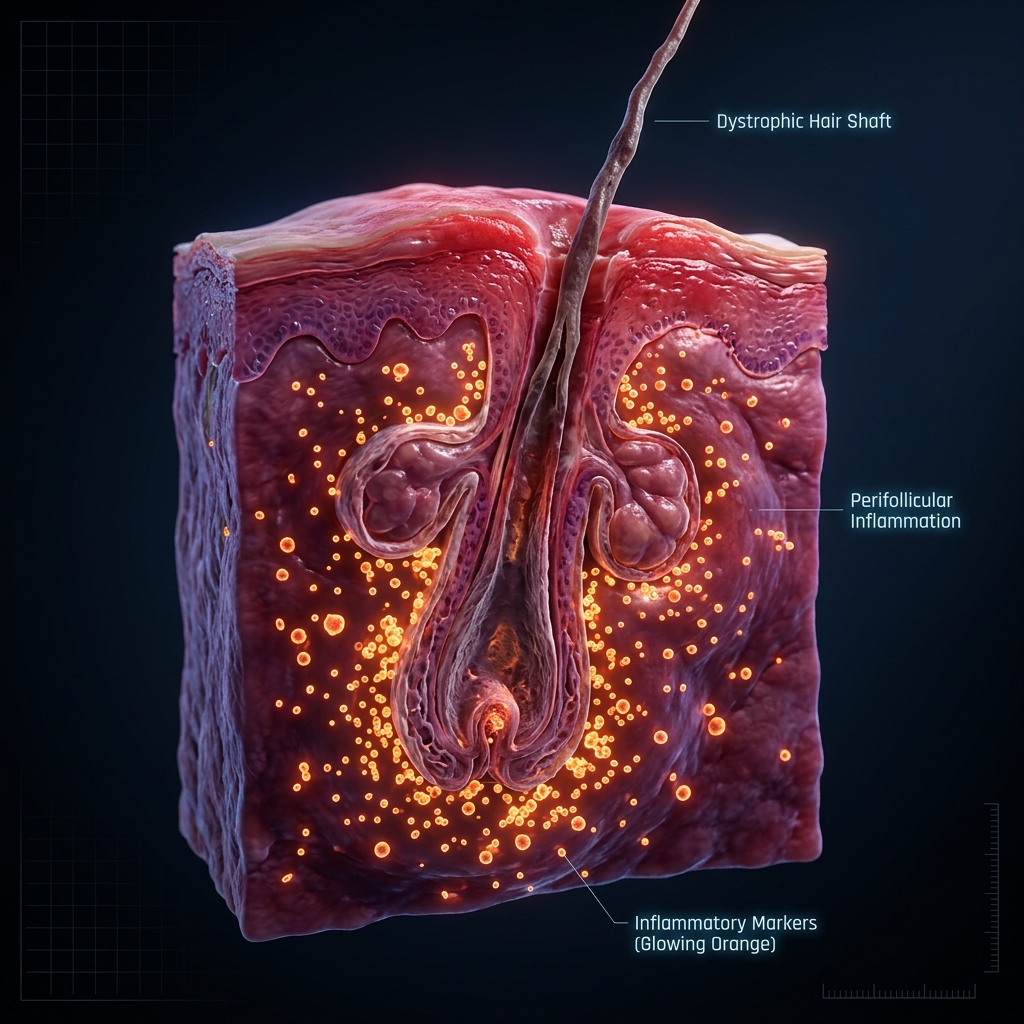
Microscopic cross-section showing perifollicular inflammation — the invisible inflammatory ring that destroys follicle integrity under chronic stress.
Why Tech Culture Specifically Amplifies This
KL's startup ecosystem compounds the neurogenic inflammation through several structural factors:
- Screen-first lifestyle. Extended screen exposure (12+ hours daily) suppresses melatonin and disrupts circadian rhythm, removing the parasympathetic recovery window when the scalp's inflammatory mediators would normally clear.
- Caffeine dependence. The startup coffee culture directly stimulates adrenal cortisol output, layering hormonal stress on top of neurogenic inflammation.
- Imposter syndrome. Women in male-dominated tech environments frequently report heightened self-monitoring and performance anxiety — a cognitive stressor that sustains Substance P release throughout the workday.
- "Hustle culture" sleep deprivation. The glorification of working late and sleeping little actively prevents the slow-wave sleep necessary for growth hormone secretion and follicle repair.
The Inflammation Must Be Addressed First
This is a crucial clinical distinction: in startup-related hair loss, treating the cortisol pathway alone is insufficient. The neurogenic inflammation driven by Substance P and CGRP operates independently and must be specifically targeted.
Anti-inflammatory shampoos and scalp serums cannot reach the perifollicular zone where Substance P is acting. The inflammation is happening at the level of the dermis, around the hair bulb — deeper than any topical product can penetrate in clinically relevant concentrations.
Breaking the Loop: Parasympathetic Override
At [TTE Elephant Head Spa](/headspa-kl), the [Sleep Healing Headspa](/sleep-healing) protocol for tech professionals targets both the HPA cortisol axis AND the peripheral neurogenic inflammation simultaneously.
The vagal nerve stimulation component downregulates central cortisol output. Simultaneously, the sustained slow-frequency massage of the scalp's dermatomal zones mechanically mediates a process called neurogenic anti-inflammation — where prolonged, gentle stimulation of large-diameter mechanoreceptors (Aβ fibres) in the scalp gates the transmission of pain and inflammatory signals from the small-diameter C-fibres that carry Substance P.
In clinical terms: the therapeutic touch physically overwrites the inflammatory signalling at the nerve level.
For a startup founder whose nervous system has been locked in anticipatory mode for years, this represents the first genuine neurological rest the scalp microenvironment has experienced — the prerequisite for follicle recovery to begin.
Frequently Asked Questions
Q: My scalp feels itchy and sensitive, but my dermatologist couldn't find any condition. Could this be neurogenic?
A: Yes. Neurogenic scalp itch (pruritus) caused by Substance P release is one of the most commonly misdiagnosed scalp complaints. Standard dermatological examination looks for fungal, bacterial, or allergic causes — neurogenic inflammation is invisible under standard trichoscopy and requires a different diagnostic framework.
Q: I work remotely — does that reduce the stress impact on my scalp?
A: Remote work eliminates the physical commute cortisol but often intensifies anticipatory anxiety through isolation, boundary-less work hours, and the constant pressure to demonstrate productivity. Many remote tech workers actually experience worse scalp outcomes than their office counterparts.
Q: Can mindfulness or meditation help with Substance P levels?
A: Mindfulness practice can modestly reduce Substance P levels over time. However, for established neurogenic inflammation, the clinical intensity and duration of a professional Sleep Healing session is significantly more effective at creating the parasympathetic override necessary to break the inflammatory cycle.
Q: How many sessions before I notice reduced scalp sensitivity?
A: Most clients with neurogenic scalp inflammation report a noticeable reduction in scalp itch and sensitivity within 2–3 sessions. The inflammatory mediators clear relatively quickly once parasympathetic dominance is established — visible hair density improvements follow over the subsequent 2–3 months.
Soalan Lazim
My scalp feels itchy and sensitive, but my dermatologist couldn't find any condition. Could this be neurogenic?
Yes. Neurogenic scalp itch (pruritus) caused by Substance P release is one of the most commonly misdiagnosed scalp complaints. Standard dermatological examination looks for fungal, bacterial, or allergic causes — neurogenic inflammation is invisible under standard trichoscopy and requires a different diagnostic framework.
I work remotely — does that reduce the stress impact on my scalp?
Remote work eliminates the physical commute cortisol but often intensifies anticipatory anxiety through isolation, boundary-less work hours, and the constant pressure to demonstrate productivity. Many remote tech workers actually experience worse scalp outcomes than their office counterparts.
Can mindfulness or meditation help with Substance P levels?
Mindfulness practice can modestly reduce Substance P levels over time. However, for established neurogenic inflammation, the clinical intensity and duration of a professional Sleep Healing session is significantly more effective at creating the parasympathetic override necessary to break the inflammatory cycle.
How many sessions before I notice reduced scalp sensitivity?
Most clients with neurogenic scalp inflammation report a noticeable reduction in scalp itch and sensitivity within 2–3 sessions. The inflammatory mediators clear relatively quickly once parasympathetic dominance is established — visible hair density improvements follow over the subsequent 2–3 months.
Artikel Berkaitan