
Chronic muscle tension in the neck, jaw, and upper trapezius — the signature physical burden of teachers — compresses the occipital arteries and greater occipital nerve, physically restricting the volume of oxygenated blood reaching the posterior and vertex scalp. This vascular strangulation starves hair follicles of their metabolic fuel, triggering progressive thinning that standard hair products cannot address.
The Teacher's Body Holds Stress Differently
Every profession carries stress. But teaching creates a unique physical tension profile that directly targets the anatomy feeding your scalp.
Consider the posture of a typical Malaysian teacher:
- Forward head tilt — hours spent looking down at student work, marking exercises, and reading administrative documents pushes the head forward of the cervical spine, loading the suboccipital muscles.
- Jaw clenching — the constant emotional regulation required to manage classrooms, difficult parents, and administrative pressure triggers unconscious bruxism (teeth grinding) and masseter muscle tension.
- Rounded shoulders — carrying stacks of books, hunching over a laptop for lesson planning, and the general weight of chronic fatigue pull the upper trapezius into a permanently contracted state.
This triad — forward head, clenched jaw, rounded shoulders — creates a muscular vice around the back of the skull.
The Occipital Blood Flow Connection
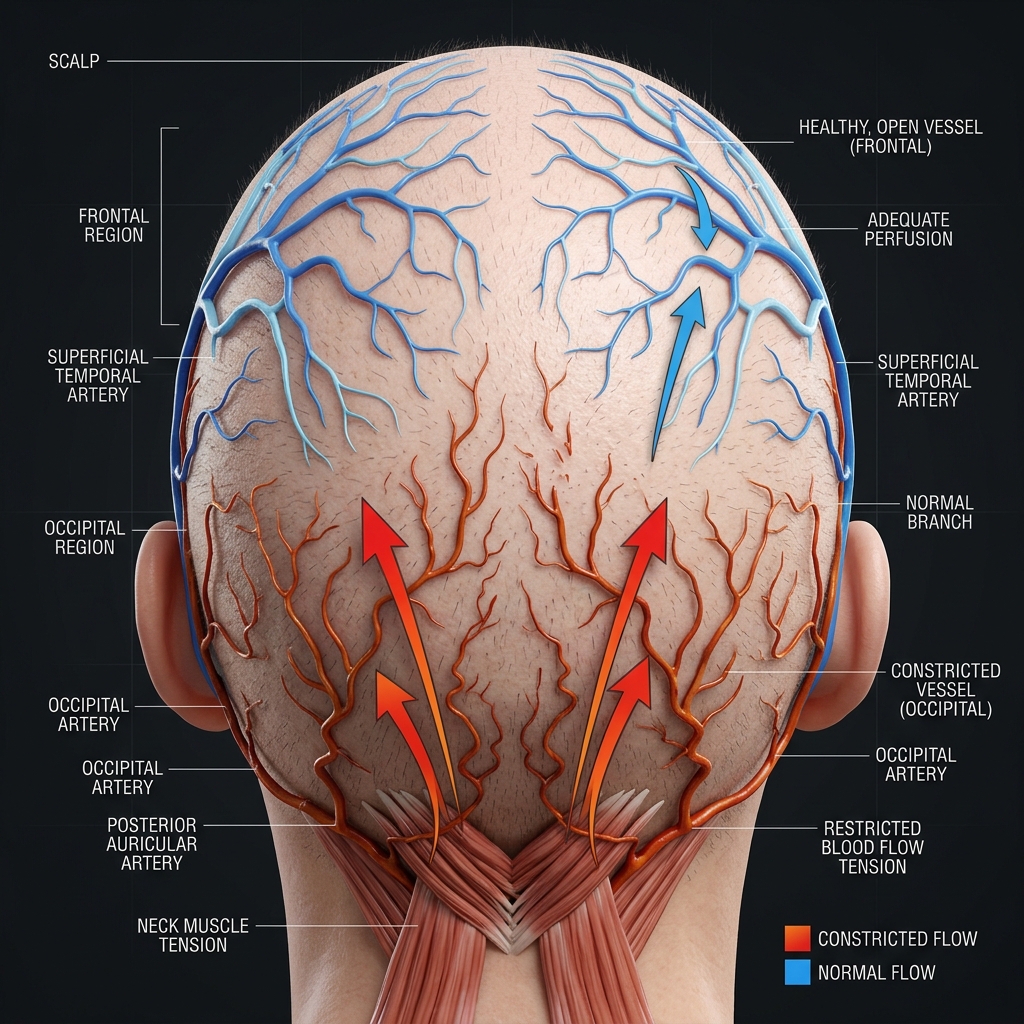
Blood vessel mapping showing constricted occipital arteries (red) from chronic neck tension versus healthy frontal flow (blue).
The occipital arteries — the primary blood vessels feeding the back and crown of the scalp — run directly through the suboccipital muscle group at the base of the skull. When these muscles are chronically contracted (as they are in the teaching posture), the arteries are physically compressed.
Furthermore, the greater occipital nerve travels through the same muscular corridor. Compression of this nerve causes tension headaches (extremely common in teachers) and also disrupts the neurogenic signals that regulate follicle cycling. Botchkarev (2003, American Journal of Pathology) demonstrated that neuropeptide signalling directly influences hair follicle transition between growth and rest phases.
The result: the back and crown of the scalp — the areas fed by the compressed occipital arteries — receive progressively less blood flow. The follicles in these regions are the first to enter premature telogen.
The Emotional Labour Tax
Teaching is classified as high emotional labour work — professionals who must continuously suppress or modify their own emotional responses to perform their role. A teacher having a terrible day cannot express frustration in front of students. A teacher dealing with a difficult parent meeting must remain calm and professional regardless of internal distress.
This emotional suppression has a direct neurochemical cost. Arck et al. (2006, Journal of Investigative Dermatology) demonstrated that chronic emotional stress triggers neurogenic inflammation via Substance P release from peripheral nerve endings. In the scalp, this manifests as perifollicular inflammation — a silent, invisible process that weakens follicle anchoring and accelerates shedding.
According to Hiredly Malaysia's 2024 Teacher Workload Survey, 72% of Malaysian teachers report working beyond their contractual hours daily, with lesson planning, grading, and administrative compliance consuming evenings and weekends.
Why Massages Don't Reach the Problem
Standard neck and shoulder massages provide temporary muscular relief. But they typically address the upper trapezius and superficial cervical muscles — not the deep suboccipital group where the occipital arteries and nerves are entrapped.
Furthermore, conventional massage does not address the neurogenic inflammation component. Even if muscular tension is temporarily relieved, the Substance P cascade continues independently until the nervous system itself is reset.
The Sleep Healing Protocol for Teachers
At [TTE Elephant Head Spa](/headspa-kl), the [Sleep Healing Headspa](/sleep-healing) protocol specifically targets the suboccipital triangle — the anatomical space where the occipital arteries, greater occipital nerve, and deep cervical muscles converge.
Our therapists apply sustained, precise pressure to mechanically release the suboccipital muscles, immediately decompressing the arteries and restoring blood flow to the posterior scalp. Simultaneously, the vagal nerve stimulation component of the protocol activates the parasympathetic nervous system, suppressing the Substance P-driven inflammation that has been damaging follicles for months or years.
For a teacher whose body has been locked in a forward-head, clenched-jaw, tense-shoulder posture for a decade, this targeted release is profoundly therapeutic — both for the scalp and for the chronic headaches that have become "normal."
Frequently Asked Questions
Q: I've noticed my hair thinning mainly at the crown. Is this related to my posture?
A: Very likely. The crown (vertex) region is supplied by the occipital arteries, which are the most vulnerable to compression from chronic neck tension. This pattern is characteristic of tension-mediated vascular restriction.
Q: Can improving my posture reverse hair loss?
A: Correcting posture helps reduce ongoing compression, but it does not reverse the existing follicle damage or neurogenic inflammation. Clinical intervention through targeted suboccipital release and vagal stimulation accelerates recovery significantly beyond posture correction alone.
Q: I get tension headaches almost daily. Are they connected to my hair thinning?
A: Yes. Tension headaches and scalp hair thinning in teachers frequently share the same anatomical cause: compression of the greater occipital nerve and occipital arteries by chronically contracted suboccipital muscles.
Q: How is the Sleep Healing session different from a regular head massage?
A: A regular head massage focuses on superficial scalp muscles and feels pleasant but rarely reaches the deep suboccipital triangle. Our protocol specifically targets the anatomical structures that control blood flow and nerve signalling to the scalp, creating measurable physiological changes rather than temporary relaxation.
Soalan Lazim
I've noticed my hair thinning mainly at the crown. Is this related to my posture?
Very likely. The crown (vertex) region is supplied by the occipital arteries, which are the most vulnerable to compression from chronic neck tension. This pattern is characteristic of tension-mediated vascular restriction.
Can improving my posture reverse hair loss?
Correcting posture helps reduce ongoing compression, but it does not reverse the existing follicle damage or neurogenic inflammation. Clinical intervention through targeted suboccipital release and vagal stimulation accelerates recovery significantly beyond posture correction alone.
I get tension headaches almost daily. Are they connected to my hair thinning?
Yes. Tension headaches and scalp hair thinning in teachers frequently share the same anatomical cause: compression of the greater occipital nerve and occipital arteries by chronically contracted suboccipital muscles.
How is the Sleep Healing session different from a regular head massage?
A regular head massage focuses on superficial scalp muscles and feels pleasant but rarely reaches the deep suboccipital triangle. Our protocol specifically targets the anatomical structures that control blood flow and nerve signalling to the scalp, creating measurable physiological changes rather than temporary relaxation.
Artikel Berkaitan