
Rotating night shifts invert the cortisol-melatonin cycle, eliminating the slow-wave sleep window during which growth hormone pulses exclusively repair hair follicle stem cells. For Malaysian nurses and doctors working 12-hour rotations, this circadian destruction is not occasional — it is structural, built into the career itself.
The Circadian Clock Controls Your Hair
Your hair follicles are not passive structures. They possess their own peripheral circadian clocks — molecular timekeeping mechanisms that synchronise cell division, DNA repair, and growth factor secretion with the body's master clock in the suprachiasmatic nucleus (SCN) of the hypothalamus.
Under normal circadian rhythm:
- Cortisol peaks at 6–8 AM (the cortisol awakening response), mobilising energy for the day.
- Melatonin rises after 9 PM, signalling the onset of repair mode.
- Growth hormone pulses during slow-wave sleep (typically 11 PM – 2 AM), directly stimulating follicle stem cell proliferation.
When a nurse works a 7 PM to 7 AM shift, every one of these signals inverts. Cortisol spikes at night (when it should be declining). Melatonin is suppressed by hospital fluorescent lighting (a potent blue-light source). Growth hormone secretion is fragmented because daytime sleep rarely achieves adequate slow-wave depth.
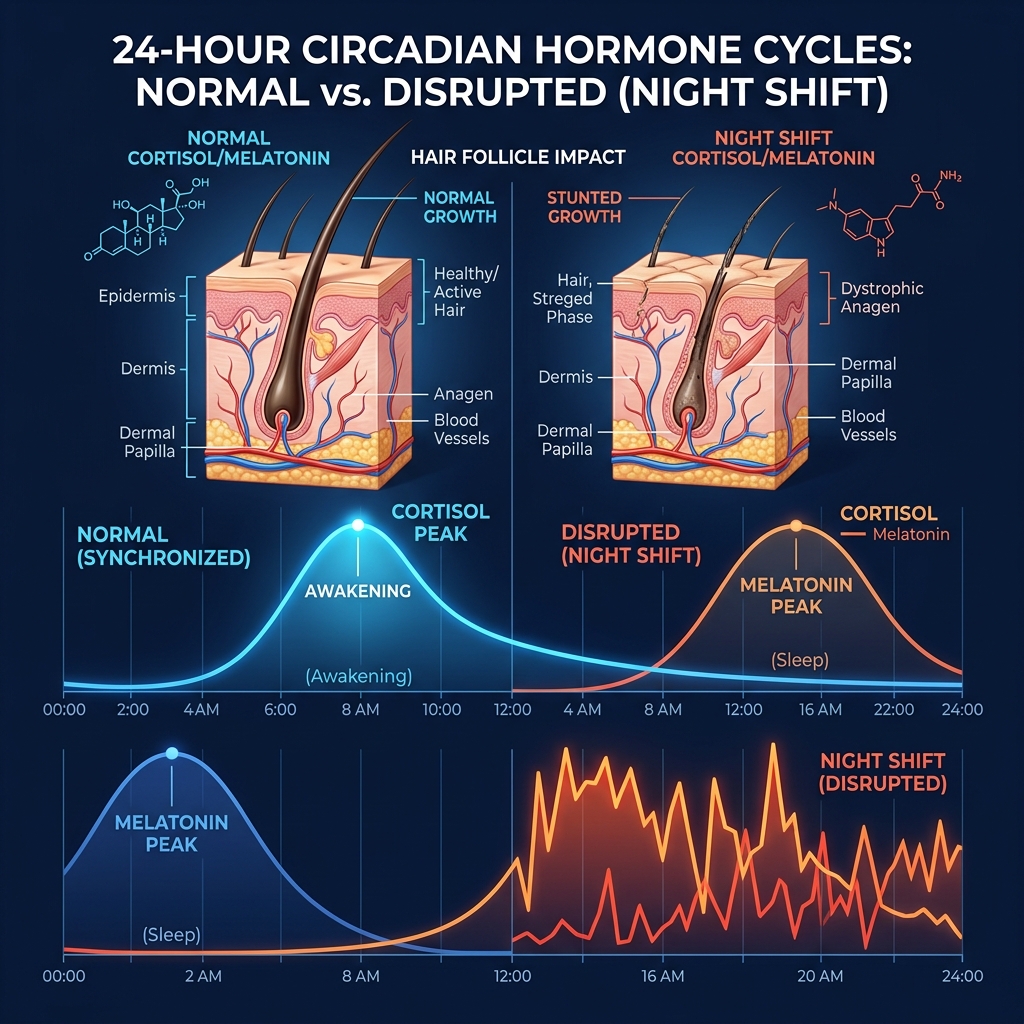
Normal vs night-shift hormone cycles — showing how circadian inversion starves the follicle of its repair window.
Melatonin: The Forgotten Hair Protector
Melatonin is not just a sleep hormone. Fischer et al. (2008, Journal of Pineal Research) demonstrated that melatonin directly influences hair follicle biology as a potent antioxidant and anti-apoptotic agent within the follicle itself. Melatonin protects the dermal papilla from oxidative damage and extends the anagen (growth) phase.
Night-shift workers are chronically melatonin-deficient. Hospital wards maintain constant bright lighting — exactly the spectral conditions that maximally suppress pineal melatonin synthesis. Even when a nurse attempts to sleep during the day, ambient light leaking through curtains, daytime noise, and the body's natural thermoregulatory cycle all conspire to prevent the deep, sustained melatonin surge that occurs during undisturbed nocturnal sleep.
The Malaysian Healthcare Reality
The Malaysian Medical Association's 2023 Junior Doctor Welfare Survey revealed that 78% of junior doctors report chronic sleep deprivation, with many averaging fewer than 5 hours of fragmented sleep on rotation days. Nurses face similar patterns, compounded by emotional labour — the constant suppression of personal distress while caring for critically ill patients.
This emotional labour triggers its own cortisol burden, separate from the circadian disruption. The combined load is devastating: circadian misalignment strips the follicle of its repair window, while emotional cortisol simultaneously constricts blood flow to the scalp.
Why "Sleeping In" on Your Off Day Cannot Fix This
After a stretch of night shifts, healthcare workers often attempt to "catch up" on sleep by sleeping 10–12 hours on their days off. While this reduces subjective fatigue, it does not restore circadian alignment.
The peripheral clocks in hair follicles take approximately 7–10 days to resynchronise after a phase shift. With rotating rosters that change weekly, the follicle's clock never stabilises. It exists in a permanent state of jet lag — perpetually unsure whether to grow, rest, or repair.
The Clinical Solution: Forced Parasympathetic Reset
At [TTE Elephant Head Spa](/headspa-kl), the [Sleep Healing Headspa](/sleep-healing) protocol is specifically designed to manually override a dysregulated autonomic nervous system.
For healthcare professionals, we focus intensively on vagal nerve stimulation through sustained occipital and mastoid pressure — mechanically activating the parasympathetic branch regardless of the time of day. This forces the body into genuine repair mode even when the circadian clock is confused.
The 90-minute session creates a pharmacologically measurable drop in salivary cortisol and a simultaneous rise in peripheral blood flow to the scalp. For a nurse whose body has forgotten how to switch off, this externally imposed parasympathetic state can be the difference between continued shedding and the beginning of follicle recovery.
Frequently Asked Questions
Q: I've been on night shifts for 5 years and my hair is noticeably thinner. Is it reversible?
A: In most cases, yes. Telogen effluvium from circadian disruption is reversible once the cortisol burden is addressed and follicle repair cycles are restored. However, the longer the disruption persists, the more sessions are typically needed to break the pattern.
Q: Should I take melatonin supplements?
A: Oral melatonin can help with sleep onset but does not replicate the precise, sustained surge that natural nocturnal secretion provides. For hair-specific benefits, the follicle needs consistent circadian signalling — which requires addressing the sleep architecture, not just adding a supplement.
Q: Can I book a Sleep Healing session between my shift rotations?
A: Absolutely. Many of our healthcare clients schedule sessions on their first off-day after a night-shift block. The forced parasympathetic reset is most impactful when it occurs at this transition point.
Q: Is the hair loss pattern different from normal ageing?
A: Yes. Circadian-driven hair loss is typically diffuse (all over the scalp) rather than patterned (temples and crown), and it often correlates with the onset or intensification of shift work rather than age alone.
Soalan Lazim
I've been on night shifts for 5 years and my hair is noticeably thinner. Is it reversible?
In most cases, yes. Telogen effluvium from circadian disruption is reversible once the cortisol burden is addressed and follicle repair cycles are restored. However, the longer the disruption persists, the more sessions are typically needed to break the pattern.
Should I take melatonin supplements?
Oral melatonin can help with sleep onset but does not replicate the precise, sustained surge that natural nocturnal secretion provides. For hair-specific benefits, the follicle needs consistent circadian signalling — which requires addressing the sleep architecture, not just adding a supplement.
Can I book a Sleep Healing session between my shift rotations?
Absolutely. Many of our healthcare clients schedule sessions on their first off-day after a night-shift block. The forced parasympathetic reset is most impactful when it occurs at this transition point.
Is the hair loss pattern different from normal ageing?
Yes. Circadian-driven hair loss is typically diffuse (all over the scalp) rather than patterned (temples and crown), and it often correlates with the onset or intensification of shift work rather than age alone.
Artikel Berkaitan