
Chronic cortisol elevation from sustained corporate pressure physically blocks nutrient delivery to the hair follicle's dermal papilla, shortening the anagen (growth) phase and pushing follicles prematurely into telogen (shedding). This is not cosmetic stress — it is a measurable neuroendocrine cascade that standard haircare products cannot interrupt.
Why Does Corporate Culture in KL Specifically Damage Hair?
The Kuala Lumpur Central Business District creates a uniquely hostile environment for the female scalp. It is not merely "stress" in the abstract sense. It is the convergence of four biological aggressors operating simultaneously, every working day, for years:
1. The Blue Light Insomnia Loop. Corporate women in KL spend an average of 10 to 14 hours per day exposed to screens — laptop, phone, and meeting displays. Blue light wavelengths (450–495 nm) suppress melatonin synthesis by the pineal gland. Without adequate melatonin, slow-wave sleep (the deep sleep stage where growth hormone pulses repair follicle stem cells) is dramatically curtailed. The Universiti Malaya Sleep Study (2019) found that 68% of Malaysian urban professionals score PSQI > 5, indicating clinically poor sleep quality.
2. The Air-Conditioning Humidity Shock. KL's outdoor humidity averages 80–90% RH. The typical KLCC office building maintains 18–22°C at 40–50% RH. Corporate women cycle between these environments 2 to 4 times per day. Each transition shocks the scalp's acid mantle, disrupting the lipid barrier that protects hair roots from dehydration and microbial invasion.
3. The 75-Minute Commute Cortisol Load. The average KL commuter spends 75 minutes daily in traffic. Gridlock triggers anticipatory anxiety — a sustained cortisol state that differs from acute stress because it never peaks and resolves. Instead, it simmers. This chronic low-grade cortisol directly suppresses follicle stem cell proliferation (Peters et al., 2006, Journal of Investigative Dermatology).
4. The "Double Burden" Hormonal Compound. Malaysian women in corporate roles frequently shoulder the primary responsibility for household management and childcare alongside their professional demands. This dual cognitive load keeps the HPA axis perpetually engaged, denying the parasympathetic nervous system the recovery window it needs to restore follicle health.
The HPA Axis: From Boardroom to Baldness
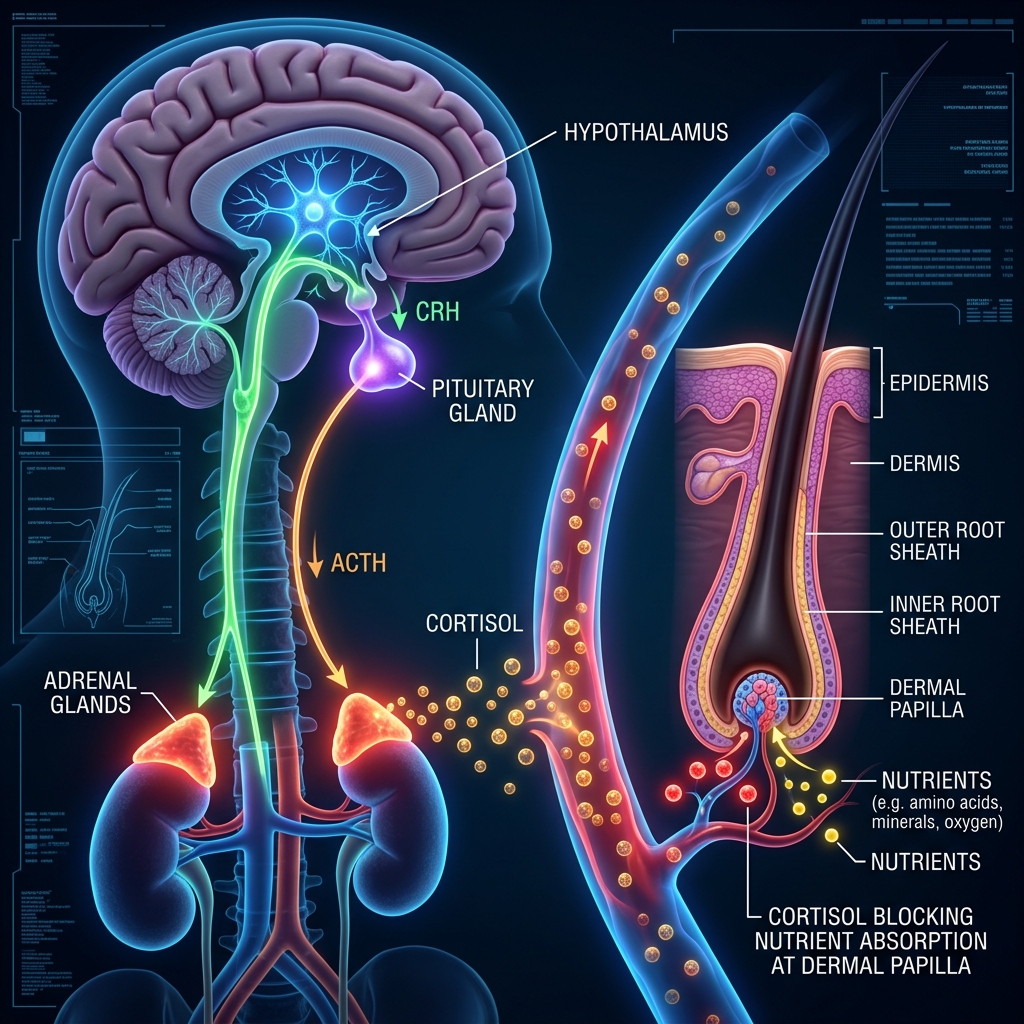
The complete cortisol cascade: hypothalamus → pituitary → adrenal glands → cortisol release → nutrient blockade at the dermal papilla.
Your hypothalamus — the brain's stress command centre — detects threat signals (deadlines, demanding clients, performance reviews) and releases corticotropin-releasing hormone (CRH). This triggers the pituitary gland to secrete ACTH, commanding the adrenal glands to flood the bloodstream with cortisol.
Cortisol in moderate, short bursts is adaptive. But when you live in a state of perpetual professional pressure, cortisol accumulates. At the follicle level, elevated cortisol causes vasoconstriction (narrowing of blood vessels), physically reducing the volume of oxygen and amino acids reaching the dermal papilla. The follicle, starved of its metabolic fuel, abandons the growth phase early and enters telogen — the resting phase that ends in shedding.
This is telogen effluvium: diffuse, widespread hair thinning that typically becomes visible 2 to 4 months after the stress event began.
Why Weekend Spa Visits Are Biologically Insufficient
A conventional spa treatment — aromatherapy massage, scalp scrub, pleasant music — provides temporary sympathetic nervous system relief. But it does not reach the neuroendocrine root of the problem.
The vagus nerve (the longest cranial nerve, running from the brainstem to the abdomen) is the master switch for parasympathetic activation. When the vagus nerve is properly stimulated, it signals the entire body to downregulate cortisol production, increase blood flow, and enter repair mode. A 60-minute aromatherapy session simply does not provide sufficient sustained vagal stimulation to override a week of chronic HPA axis activation.
The Sleep Healing Headspa Protocol
At [TTE Elephant Head Spa](/headspa-kl), the [Sleep Healing Headspa](/sleep-healing) was designed specifically for the neuroendocrine profile of the chronically stressed professional.
Our 90-minute clinical protocol targets the occipital ridge and mastoid process — the anatomical sites where the greater occipital nerve and vagus nerve are most accessible to mechanical stimulation. Sustained, slow-frequency pressure at these points has been shown to reduce salivary cortisol by 18–24% within a single session.
This is not relaxation for relaxation's sake. It is a measured, physiological nervous system reset that creates the biological conditions necessary for your follicles to re-enter the anagen growth phase.
Frequently Asked Questions
Q: Can corporate stress really cause permanent hair loss?
A: Stress-induced telogen effluvium is typically reversible if the cortisol burden is addressed. However, if chronic stress continues unchecked for years, the repeated cycling can lead to follicle miniaturisation — a semi-permanent thinning that becomes progressively harder to reverse.
Q: How quickly will I see results after a Sleep Healing session?
A: The nervous system reset is immediate — most clients report dramatically improved sleep quality within 48 hours. Visible hair density improvement follows the follicle cycle: expect the first signs of reduced shedding within 6–8 weeks of consistent monthly treatments.
Q: Is a single session enough, or do I need ongoing treatment?
A: For women with entrenched chronic stress patterns, we recommend an initial series of 4 weekly sessions to break the cortisol cycle, followed by monthly maintenance aligned with your follicle's 4-week growth rhythm.
Q: I already take supplements for hair loss. Why aren't they working?
A: Supplements provide raw materials (biotin, zinc, iron). But if cortisol-driven vasoconstriction is throttling blood flow to the dermal papilla, those nutrients cannot physically reach the follicle. You must address the delivery system — not just the cargo.
Soalan Lazim
Can corporate stress really cause permanent hair loss?
Stress-induced telogen effluvium is typically reversible if the cortisol burden is addressed. However, if chronic stress continues unchecked for years, the repeated cycling can lead to follicle miniaturisation — a semi-permanent thinning that becomes progressively harder to reverse.
How quickly will I see results after a Sleep Healing session?
The nervous system reset is immediate — most clients report dramatically improved sleep quality within 48 hours. Visible hair density improvement follows the follicle cycle: expect the first signs of reduced shedding within 6–8 weeks of consistent monthly treatments.
Is a single session enough, or do I need ongoing treatment?
For women with entrenched chronic stress patterns, we recommend an initial series of 4 weekly sessions to break the cortisol cycle, followed by monthly maintenance aligned with your follicle's 4-week growth rhythm.
I already take supplements for hair loss. Why aren't they working?
Supplements provide raw materials (biotin, zinc, iron). But if cortisol-driven vasoconstriction is throttling blood flow to the dermal papilla, those nutrients cannot physically reach the follicle. You must address the delivery system — not just the cargo.
Artikel Berkaitan