
<!-- RESEARCH NOTES Market data found: Focus on "anak tudung" (inner cap) tension and heavy bun "sanggul" styles popular in Malaysia. Competitors checked: Salons push hair growth serums without addressing mechanical tension. Studies found: Billero & Miteva (2018) outlining mechanical damage to the dermal papilla from prolonged tensile force. -->
Traction alopecia is a biological tragedy because it is entirely physical, entirely preventable, and yet incredibly common among Hijabis. If you've started noticing that the hair around your temples is becoming alarmingly thin, or that your frontal hairline is creeping backward, it isn't necessarily a genetic curse or a hormonal shift.
It is a silent, daily mechanical injury.
### The Hidden Violence of the 'Anak Tudung'
Traction alopecia occurs when hair rests under constant, prolonged tension. For Malaysian Muslimahs, this tension originates from two primary sources: the tightly pulled bun (*sanggul*) used to anchor the hijab, and the gripping elastic edge of the *anak tudung* (inner cap) designed to keep stray hairs hidden.
While the force feels negligible in the moment, it exerts immense microscopic pressure. When hair is perpetually pulled backward, the shaft acts as a physical lever against the follicle root.
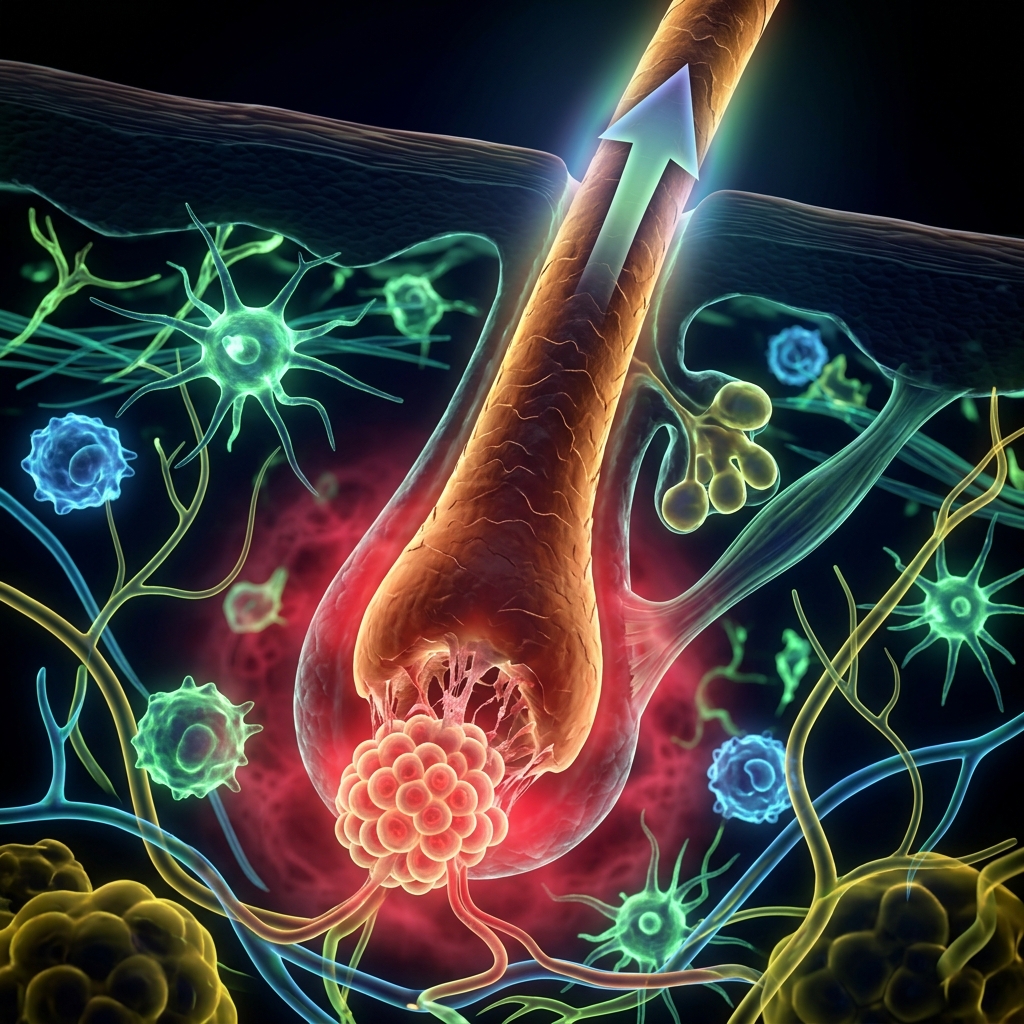
### Inside the Dermal Papilla
At the very base of every hair follicle lies the *dermal papilla*, a highly vascularized structure that feeds oxygen and nutrients to the dividing cells responsible for hair growth.
When chronic mechanical tension forces the hair shaft to strain against its sheath day after day, the body interprets this constant pulling as micro-trauma. The immune system rushes inflammatory markers to the site. The area around the follicle becomes inflamed, slightly red, and sometimes characterized by tiny, painful bumps (perifollicular erythema).
If the tension is ignored, the inflammation eventually results in fibrosis—scar tissue begins replacing the follicle structure. Blood flow to the dermal papilla is choked off entirely, and the follicle permanently dies. This is why late-stage traction alopecia is completely irreversible without a clinical transplant.
### The "Sanggul" Weight Factor
Adding to the tension is the weight of thick Malaysian hair tied into a bun to support a voluminous hijab style. Hair behaves elastically, but under constant heavy load, the hair structures suffer "creep"—a permanent physical deformation. Moving about the bustling city of KL, the micromovements of walking and commuting cause that heavy bun to bounce and sway slightly beneath the fabric, creating sharp, repetitive micro-yanks directly on the frontal hairline anchors.
### Reversing the Damage Before Scarring Occurs
The critical window for reversing Traction Alopecia occurs before the follicle scars over.
The absolute first step is mechanical: you must alternate your partition daily, switch to a silk-lined, looser *anak tudung*, and tie your bun lower and significantly looser using a soft local scrunchie, not tight elastics.
Secondly, the traumatized follicles require clinical intervention to suppress the active inflammation and force-feed oxygen back into the starved dermal papilla. Standard hair serums cannot penetrate deeply enough if the surrounding tissue is actively inflamed and constricted.
At [TTE Elephant Head Spa](/headspa-kl), our Muslimah-focused specialists utilize a proprietary deep-tissue manual technique that relaxes the fibrotic tightening of the scalp muscles. In our completely private, hijab-free sanctuaries, we apply transdermal nutrient infusions natively paired with red-light vascular stimulation. This mechanically opens the floodgates for blood flow, rescuing the traumatized papilla before irreversible scarring occurs.
---
Frequently Asked Questions
Q: Can wearing an inner cap really cause my hairline to recede? A: Yes. The constant friction and elastic pressure from a tight *anak tudung* creates chronic tensile force. Over time, this physically uproots and damages the frontal hair follicles, leading to Traction Alopecia.
Q: Are the small bumps around my hairline acne or something else? A: Tiny, sometimes tender bumps along the frontal or temporal hairline are often *traction folliculitis*—an inflammatory response to the structural pulling of the hair root. It is an early warning sign that permanent hair loss is imminent.
Q: If I stop tying my hair tightly, will the hair grow back? A: If caught early (before scarring or fibrosis sets in), removing the tension allows the follicles to recover. However, pairing tension release with clinical Headspa vascular stimulation significantly accelerates the revival of dormant follicles.