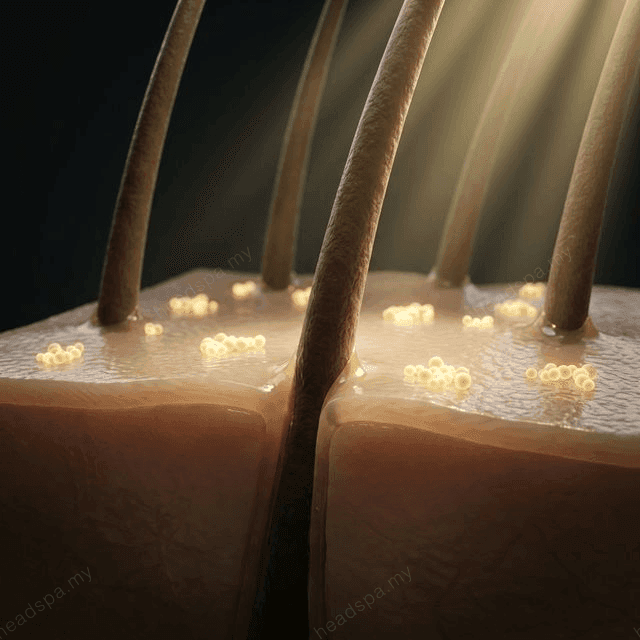
Traction alopecia is the only common form of hair loss that is entirely preventable — and among the most commonly dismissed until it has progressed to an irreversible stage. For Malaysian Muslim women who wear the hijab daily, the biomechanics of certain styling practices create a low-grade, chronic tensile force on the frontal and temporal follicle roots. The scalp does not signal distress loudly. There is no dramatic shedding event, no sudden patch. The follicle simply miniaturises, inflames, fibroses, and disappears — over months to years.
Understanding the mechanism is the first clinical step. Once follicular fibrosis is established, no topical or systemic treatment can restore what the scar tissue has replaced.
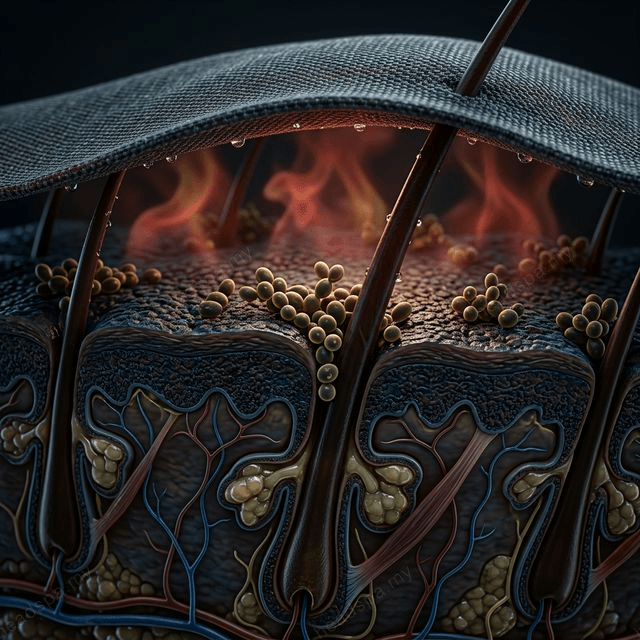
The Follicle Damage Mechanism
A hair follicle is anchored in the dermis by the follicular connective tissue sheath. Repetitive tensile stress — the mechanical force of a tight undercap, a hijab pin positioned at the hairline, or a ponytail pulled taut beneath the scarf — applies shear force at the follicle isthmus. This is the narrowest and mechanically most vulnerable point of the follicle structure.
The body's response to this repetitive microtrauma follows a predictable inflammatory cascade:
- Mechanical stress activates follicular keratinocytes, triggering release of pro-inflammatory cytokines (IL-1β, TNF-α)
- Perifollicular inflammation develops — visible on trichoscopy as a peripilar cast (a keratinous sleeve encircling the proximal hair shaft)
- Chronic low-grade inflammation stimulates fibroblast activity in the follicular sheath
- Perifollicular fibrosis begins to replace healthy connective tissue with collagen scar tissue
- Follicle miniaturisation occurs as the fibrotic environment restricts dermal papilla function
- Follicle replacement by fibrosis — the terminal event; regrowth is no longer biologically possible
This sequence — from mechanical stress to permanent follicle loss — can occur within 2–5 years of regular high-tension styling, depending on individual inflammatory threshold and genetic predisposition.
Reversible vs Irreversible Stages
The critical clinical distinction in traction alopecia is whether the follicle is still present and functional or has been replaced by fibrous tissue. Trichoscopy is the only reliable method to make this distinction without biopsy.
| Stage | Trichoscopy Findings | Clinical Signs | Reversibility |
|---|---|---|---|
| Early | Peripilar casts, mild perifollicular erythema, no fibrosis | Frontal hairline recession, small folliculitis papules | Fully reversible with tension removal |
| Intermediate | Perifollicular fibrosis beginning, reduced follicle density, shaft miniaturisation | Established recession, thinning at temples | Partially reversible; requires intervention |
| Advanced | Dense perifollicular fibrosis, absent follicular openings, follicle replacement complete | Smooth, shiny skin at former hairline; no regrowth | Irreversible; surgical options only |
Early-stage traction alopecia reverses completely when the mechanical cause is eliminated. Intermediate-stage may benefit from low-level laser therapy, platelet-rich plasma, or topical minoxidil to stimulate remaining follicles before fibrosis advances. Advanced-stage offers no medical recourse — only hair transplant surgery can restore coverage, and only if sufficient donor density exists.
High-Risk Styling Practices
Not all hijab styles create equivalent follicular stress. The following practices are clinically associated with the highest traction risk:
Tight synthetic underscarves (inner caps): A rigid, tight-fitting inner cap that grips the entire hairline applies sustained circumferential pressure. When worn 12–16 hours daily, this amounts to thousands of hours of cumulative tension annually.
Safety pins positioned at the hairline: Pinning the hijab at the temporal or frontal hairline creates a focal tension point directly over the most vulnerable follicle zone. The force vector pulls toward the pin insertion, stretching the follicle root with each head movement.
Pulled-back ponytails or braids under the hijab: Gathering hair into a tight ponytail before covering applies upward and posterior tension on the frontal follicles. This is compounded when the hijab is then pinned tightly over the gathered hair.
Heavy outer hijab fabrics: Dense, heavy fabrics increase the mechanical load on securing pins, amplifying the tension at anchor points.
Prevention Protocol
Traction alopecia is preventable with mechanical modifications that reduce sustained follicular tension:
- Use a loose-fitting, soft cotton inner cap — satin-lined bonnets distribute pressure more evenly and reduce friction at the hairline
- Position hijab pins behind the ear or on the temporal bone — not at or anterior to the hairline
- Alternate hairstyles daily — rotating between a loose bun, a low gathered style, and a completely loose arrangement distributes tensile stress temporally
- Apply no-heat stretching at the end of the day — massaging the frontal and temporal scalp for 3–5 minutes after removing the hijab restores microcirculation to compressed follicle zones
- Schedule weekly scalp rest days — where hair is left completely unbound for at least 12 hours
TTE Elephant's hijab scalp care protocol includes a biomechanical styling assessment that identifies your specific high-risk tension points before damage accumulates.
The Frontal Fibrosing Alopecia Distinction
Frontal fibrosing alopecia (FFA) is a distinct condition that mimics traction alopecia: it produces a band-like recession of the frontal and temporal hairline with perifollicular fibrosis. FFA is believed to be a lymphocytic lichenoid process — an autoimmune follicular attack — rather than mechanically induced. The clinical presentation is nearly identical in the early stages.
Distinguishing traction alopecia from FFA is clinically important because the treatments differ completely. FFA requires immune-modulating therapy (hydroxychloroquine, topical calcineurin inhibitors); eliminating hair tension will not halt an autoimmune process. Trichoscopy findings differ: FFA characteristically shows a perifollicular violaceous hue and loss of eyebrows and facial vellus hairs — features absent in traction alopecia. See /blog/hijabi-scalp-care-science for the full differential.
When to Seek Clinical Assessment
The treatment window for traction alopecia closes silently. Seek assessment at /headspa-kl immediately if you observe any of the following:
- Frontal or temporal hairline recession that has progressed visibly over 12 months
- Small folliculitis papules or pustules at the hairline after wearing the hijab
- Peripilar scaling or crusting at the frontal hairline
- Areas of the hairline where hair no longer grows back despite resting the style
TTE's trichoscopy assessment provides a definitive fibrosis mapping within a single session — identifying whether your current stage is still within the reversible window. For Johor Bahru appointments, see /headspa-jb.
FAQ
Q: Can I reverse traction alopecia if I've been wearing a tight hijab for years? A: Reversal depends entirely on stage. If follicular openings are still visible on trichoscopy and fibrosis has not replaced the follicle, stopping the tension and supporting follicle recovery with clinical-grade treatment gives a strong prognosis. If follicular openings are absent and the skin is smooth and pale at the recession line, those follicles are gone. This is why trichoscopy — not visual inspection alone — determines your treatment options.
Q: Does the type of hijab fabric affect hair loss risk? A: Yes. Coarse synthetic fabrics create more friction at the hairline than smooth silk or satin. Friction compounds tensile damage — the combination of pulling and rubbing accelerates peripilar cast formation. Switching to a satin-lined inner cap meaningfully reduces cumulative mechanical stress.
Q: My hairline has been receding slowly for three years. Is it too late? A: Three years of slow recession does not necessarily mean complete follicle loss. The recession rate, the trichoscopy findings, and the absence or presence of follicular openings at the recession front all determine prognosis. A significant proportion of patients presenting with three-year recession histories still have viable follicles in the intermediate zone. The earlier you assess, the larger the intervention window that remains.
Q: Will minoxidil help traction alopecia? A: Topical minoxidil can stimulate existing follicles that are miniaturised but not yet fibrosed. It has no effect on follicles that have already been replaced by scar tissue. It is most useful in the early-to-intermediate stage, applied concurrently with elimination of the mechanical cause. It is not a substitute for removing the tension source.
Q: How often should I get a scalp check if I wear hijab daily? A: An annual trichoscopy assessment is reasonable for women with no current recession. For those with any degree of hairline change, a six-monthly assessment allows intervention before fibrosis advances. A baseline trichoscopy at any age provides a reference point for detecting future changes.