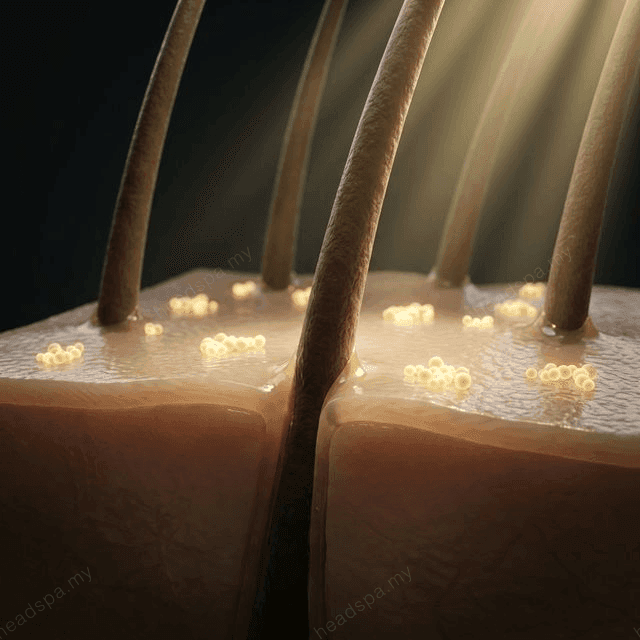
The scalp functions as a biological ecosystem in dynamic equilibrium. Temperature, humidity, sebum composition, microbial balance, and immune activity are not independent variables — they form a coupled system where changes in one drive compensatory or compounding responses in others. For Malaysian Muslim women who wear the hijab for 8 to 14 hours daily in an equatorial climate, the microclimate created beneath the covering represents a sustained environmental modification to that ecosystem — one that has not, until relatively recently, been studied with the clinical specificity it warrants.
The published data, while still developing, is directionally consistent: the hijab microclimate is a genuine biological variable, not a theoretical concern, and it requires a protocol designed specifically for covered-scalp biology rather than adapted from general scalp care literature developed for uncovered populations.
The Measured Microclimate: What the Numbers Mean
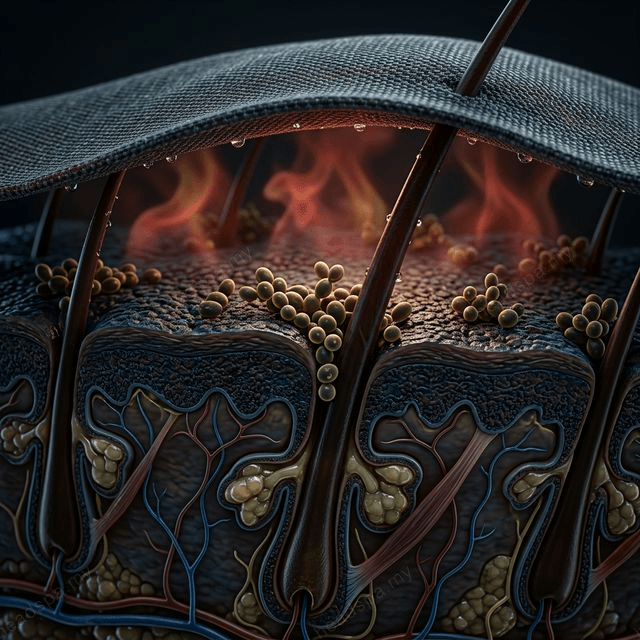
The al-Hejin et al. 2014 study provides the most direct measurement data: beneath hijab fabric, scalp surface temperature rises 3–5°C above the uncovered baseline and relative humidity increases by 15–20 percentage points. These are not marginal shifts. Consider the baseline conditions in Malaysia: outdoor ambient temperature in KL averages 32–34°C with relative humidity of 75–85%. Under the hijab in these conditions, effective scalp surface temperature approaches 36–39°C with local humidity at or near 90–95%.
This is not the scalp's normal operating environment. It is an environment closer to an incubation chamber — and Malassezia yeast, the primary microbial driver of seborrhoeic dermatitis and scalp flaking, has growth kinetics that reflect this reality precisely.
Malassezia Proliferation: The Temperature-Humidity Growth Curve
Malassezia furfur and Malassezia globosa are lipid-dependent yeasts that colonise every human scalp. At normal scalp temperatures (33–35°C) and humidity below 70%, the resident Malassezia population exists in commensal balance — metabolising sebum triglycerides, producing free fatty acids, but held in check by the skin's innate immune defences and the competitive balance of the scalp microbiome.
Above 28°C and 70% relative humidity, Malassezia replication rate increases non-linearly. The growth curve is exponential in the 30–38°C range — this is documented in the Gupta & Batra 2003 mycological studies. At the effective microclimate conditions inside a Malaysian hijab (36–39°C, 90–95% RH), Malassezia is operating at near-optimal growth conditions for extended daily periods.
The clinical result is a predictable pattern: accelerated sebum metabolism producing elevated arachidonic acid byproducts that trigger scalp inflammation; disruption of the acid mantle; and secondary inflammatory conditions including seborrhoeic dermatitis, folliculitis, and in persistent cases, contact sensitisation from the combined effect of heat, microbial metabolites, and product residue accumulation.
| Environmental Condition | Temperature | Relative Humidity | Malassezia Growth Rate | Clinical Risk |
|---|---|---|---|---|
| Temperate climate, uncovered | 25–28°C | 40–60% | Baseline commensal | Low |
| KL outdoor, uncovered | 32–34°C | 75–85% | Elevated | Moderate |
| KL outdoor, under hijab | 36–39°C | 90–95% | Exponential | High without management |
| Indoor (air-conditioned), under hijab | 28–32°C | 65–75% | Moderately elevated | Low-moderate with correct protocol |
Sebum Oxidation Under Heat and the Inflammatory Cascade
Sebum composition changes under sustained heat exposure. At elevated scalp temperatures, unsaturated fatty acids within sebum — particularly linoleic acid — oxidise at accelerated rates, producing lipid peroxides and reactive aldehydes. These oxidation products are themselves pro-inflammatory, activating Toll-like receptors on keratinocytes and triggering IL-8 and IL-1α release independent of microbial signals.
This is a second inflammatory pathway that operates alongside Malassezia-driven inflammation. Under hijab microclimate conditions, both are active simultaneously. The compound effect — Malassezia metabolite-driven inflammation plus sebum oxidation-driven inflammation — creates a scalp environment under sustained inflammatory load during waking hours. Chronic sub-clinical inflammation at this level is sufficient to impair follicle cycling, reduce anagen phase duration, and progressively compromise barrier integrity.
Reduced UV Exposure and Vitamin D Deficit
The hijab microclimate has a protective benefit that its risks must be weighed against: significantly reduced UV-B exposure to the scalp. UV-B is the primary driver of scalp photodamage, and hijab-wearing individuals have demonstrably lower incidence of scalp actinic keratosis. However, UV-B is also the primary stimulus for cutaneous vitamin D3 synthesis, and the scalp — with its dense vasculature and broad surface area — is a significant site of dermal vitamin D production.
The Bikle 2011 review documents the role of vitamin D in hair follicle cycling: vitamin D receptor (VDR) activation in the follicle bulge stimulates keratinocyte differentiation and regulates anagen-catagen phase transition. VDR-null mice develop alopecia. In humans, suboptimal vitamin D status is associated with increased telogen shedding and reduced response to anagen-promoting treatments.
For Malaysian Muslim women wearing full coverage in an already equatorial climate with relatively limited dietary vitamin D intake, the cumulative UV deficit creates a meaningful risk of subclinical vitamin D insufficiency — with follicle consequences. This is not an indictment of hijab-wearing; it is a biological variable that requires conscious nutritional management.
Product Residue and Occlusive Accumulation
Reduced transepidermal water evaporation (TEWL) under the hijab creates a second accumulation problem. Products applied to the scalp and hair — leave-in conditioners, hair serums, anti-frizz formulations, protective oils — evaporate and disperse more slowly in the hijab microclimate. Lipid-based formulations in particular accumulate on the scalp surface rather than distributing and evaporating as they do on uncovered scalp.
Heavy silicones (dimethicone, cyclomethicone) and mineral oil, common in hair care products marketed to South-East Asian consumers for frizz and humidity management, form an occlusive film on the scalp that further traps heat and microbial metabolites. Under hijab conditions, this occlusion is compounded, creating a sealed environment with concentrated Malassezia substrates, elevated temperature, and reduced immune surveillance. The outcome is predictable: comedonal occlusion, folliculitis, and progressive barrier disruption.
The Clinical Protocol for Covered Scalp Biology
The TTE Muslimah protocol, available at both TTE KL and TTE JB, is built around the specific biology of the hijab microclimate — not adapted from general scalp care conventions. The assessment considers fabric microclimate impact, sebum oxidation pattern, Malassezia load indicators, and vitamin D status.
Fabric selection is the first-line environmental modification. Modal and bamboo-derived fabrics reduce thermal conductance by 1–2°C compared to polyester; this is not trivial when the compounding begins at 36°C. Daily inner cap washing with a pH-balanced, fragrance-free cleanser removes accumulated sebum substrate before it completes its microbial oxidation cycle. For detailed clinical management, see the companion hijabi scalp care routine and the full hijabi scalp care science reference.
---
FAQ
Q: Does the hijab directly cause hair loss, or are these indirect factors? A: The hijab does not directly damage follicles. The microclimate it creates — elevated temperature, elevated humidity, reduced air circulation — generates a set of biological conditions (Malassezia proliferation, sebum oxidation, perifollicular inflammation, vitamin D deficit) that, unmanaged, contribute to scalp conditions associated with hair loss. The causal chain is indirect but mechanistically traceable. Proper management of microclimate variables significantly reduces risk.
Q: How often should I wash my scalp if I wear hijab daily in KL? A: In Malaysia's tropical climate, the baseline recommendation for hijab-wearing individuals is every 2–3 days for normal-to-dry scalp types and daily for oily or Malassezia-prone scalp types. This is more frequent than general guidance designed for temperate climates, because the microclimate accelerates sebum production and microbial activity. Daily washing with a mild, pH-balanced shampoo does not damage the hair shaft when formulations are appropriate — the "washing too frequently damages hair" concern does not apply to scalp health in this microclimate context.
Q: Can I tell if I have a Malassezia overgrowth from symptoms alone? A: Common presentations include persistent flaking that returns within 2–3 days of washing (distinct from simple dry scalp flaking, which resolves with moisturisation), an itching pattern that worsens in the afternoon (peak microclimate heat), and an oily-but-flaky texture that feels paradoxically both greasy and irritated. Definitive assessment requires clinical trichoscopy and, if indicated, mycological swab culture. Self-assessment is useful for prompting consultation; it should not substitute for clinical evaluation.
Q: What vitamin D level should I be targeting if I wear hijab? A: Standard clinical targets for serum 25-hydroxyvitamin D are 75–100 nmol/L for optimal follicle function, based on VDR activation thresholds identified in the dermatological literature. Many Malaysian Muslim women test in the 30–50 nmol/L range, which represents insufficiency. Supplementation at 1,000–2,000 IU daily is generally appropriate; confirm dosing with your physician, particularly if you have comorbidities affecting vitamin D metabolism.
Q: Is there a specific fabric weave that is best for the inner cap? A: Open-weave modal or bamboo jersey inner caps perform best in Malaysian conditions. The goal is maximising moisture wicking and thermal conductance while maintaining coverage. Tightly woven polyester caps, regardless of marketing claims, trap more heat than open-weave natural fibre alternatives. The difference in measured scalp temperature is 1–2°C — small in absolute terms but biologically significant when the baseline is already at Malassezia's optimal growth range.