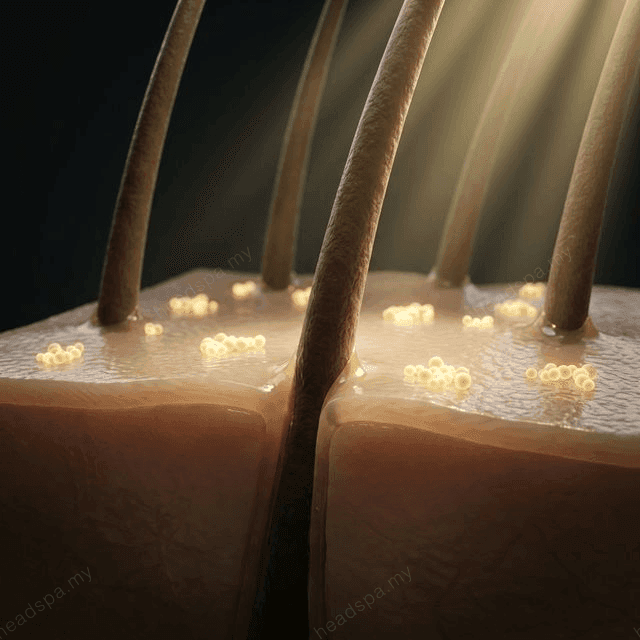
When professionals working in Kuala Lumpur or Johor Bahru complain of sudden, aggressive hair thinning, the conversation invariably turns toward the stress of the urban grind. However, "stress" is often dismissed as a vague, unavoidable emotional state. Clinically, stress is not an emotion; it is an aggressively physical, endocrine event.
When you combine chronic psychological pressure with severe, systemic sleep deprivation, you are forcing your body into a permanent state of biological emergency. This state systematically shuts down the hair follicle's ability to regenerate. Understanding the biological pathway spanning from the brain to the hair bulb is critical to stopping stress-induced hair fallout in Malaysia.
How Does the HPA Axis Connect Stress to Your Hair?
The physiological response to stress is governed primarily by the Hypothalamic-Pituitary-Adrenal (HPA) axis. When a commuter engages in the daily, unpredictable 75-minute drive traversing the Klang Valley or waiting out the Causeway congestion, the brain's hypothalamus detects constant, low-level threat.
It responds by releasing Corticotropin-Releasing Hormone (CRH), which signals the pituitary gland to release adrenocorticotropic hormone (ACTH), which finally signals the adrenal glands to dump massive volumes of cortisol into the bloodstream. This is the "fight or flight" mechanism. It evolved to help humans survive acute physical danger by rapid energy mobilization. It was not designed to remain continuously activated from 6:00 AM to 9:00 PM.
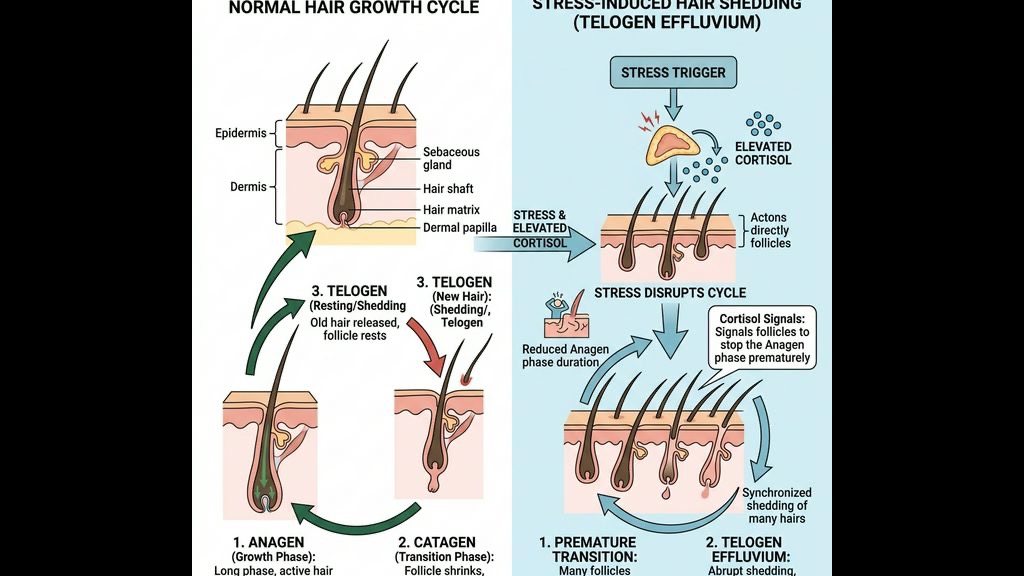
The human hair follicle is uniquely, devastatingly sensitive to this cortisol load. Research confirms that hair follicles possess their own localized HPA-axis capability. When systemic cortisol spikes, it physically binds to glucocorticoid receptors directly on the dermal papilla (the root of the hair). This binding event acts as a hard "stop" signal to the follicle's stem cells.
Cortisol specifically suppresses the synthesis of crucial proteoglycans—large structural molecules required to anchor the growing hair shaft firmly into the dermis. Furthermore, cortisol heavily downregulates hyaluronan, rapidly drying out the internal dermal tissue. The result? The follicle prematurely aborts the Anagen (growing) phase and immediately shifts into the Telogen (shedding) phase. Two to three months after a massive period of prolonged work stress, the patient begins losing clumps of hair in the shower. This mechanism is universally diagnosed as Telogen Effluvium.
Why is Sleep the Ultimate Hair Growth Window?
Rebuilding a hair shaft is one of the most metabolically expensive physiological processes in the human body. To execute this massive cellular division, the body relies heavily on human Growth Hormone (GH).
Growth Hormone acts directly on the dermal papilla, stimulating the massive cell proliferation required to build thick, terminal hair shafts. However, Growth Hormone is not secreted continuously throughout the day. In adults, over 70% of total daily GH is secreted in massive pulsatile bursts that occur almost exclusively during the first few cycles of deep, slow-wave sleep.
This biological reality clashes violently with the modern Malaysian lifestyle. A 2019 study published by Universiti Malaya indicated that 68% of Malaysian urban professionals suffer from significant sleep disruption (scoring >5 on the Pittsburgh Sleep Quality Index). More critically, the average sleep duration in Malaysia currently sits around 6.1 hours per night, radically falling short of the required 7–9 hour clinical threshold.
When you sleep only 6.1 hours—or if that sleep is heavily fragmented by anxiety, screen light, or ambient heat—you never accumulate enough slow-wave sleep to hit the necessary GH secretion threshold. Your body physically lacks the chemical command necessary to build new hair. You are shedding rapidly due to cortisol, and you cannot replace the lost strands because you lack the Growth Hormone. This toxic combination inevitably guarantees progressive thinning.
What is the Bidirectional Stress-Scalp Cycle?
The physiological damage caused by stress does not stop at hair fall. The elevated cortisol simultaneously binds to androgen receptors on your sebaceous glands. Cortisol forces these glands into overdrive, compelling them to dramatically increase sebum production.
You wake up exhausted, stressed, and shedding hair, only to find your scalp is also aggressively oily within two hours of washing. This excess oil immediately feeds opportunistic *Malassezia* fungi, sparking an intense, burning neurogenic itch.
The sensation of a terribly itchy, greasy scalp, combined with visible chunks of hair falling out, creates intense secondary psychological panic. This panic fundamentally drives the HPA axis back into overdrive, dumping a fresh wave of cortisol into the bloodstream, destroying more follicles, and producing more oil. The neurogenic inflammation caused by the itch physically releases Substance P, which further stops hair growth.
This is the Bidirectional Stress-Scalp Cycle. It is entirely self-sustaining. Using a stronger supermarket "hair fall" shampoo will not break this cycle because the root engine is not the shampoo; the root engine is your autonomic nervous system.
How Can Vagus Nerve Stimulation Reset the System?
If you are trapped in a cortisol-driven hair shedding cycle, traditional topical treatments are entirely insufficient. To stop the shedding, you must chemically shut off the "alarm" signal within the body.
The most potent, evolutionarily hardwired "off switch" to the fight-or-flight sympathetic nervous system is the Vagus Nerve. This massive cranial nerve (cranial nerve X) originates in the medulla oblongata and wanders throughout the body. It is the core commander of the parasympathetic ("rest and digest") nervous system. When the vagus nerve is activated, it chemically forces the brain to shut down the HPA axis, halting the production of cortisol and lowering the heart rate immediately.
Recognizing this absolute biological requirement, the TTE Elephant clinical protocol goes far beyond superficial washing. Our core intervention for Poor Sleep & Stress involves integrated, mechanically-mediated non-invasive Vagus Nerve Stimulation (nVNS).
During the Sleep Healing Headspa protocol, our specialists apply sustained, highly specific static pressure variations along the occipital ridge (the base of the skull) and the cervical spine. These localized mechanoreceptors connect directly to the trigemino-cervical complex and feed afferent signals squarely into the vagus nerve nuclei.
This is not simply a "relaxing massage." It is a targeted neurological intervention designed to forcibly rip your body out of sympathetic overdrive. For many KL professionals, this 90-minute session is the single physiological moment in an entire week where their cortisol drops back to baseline.
By mechanically lowering the systemic cortisol load, we directly protect the hair follicles from further biological suppression. Concurrently, by thoroughly dissolving the oxidized sebum and unblocking the follicle ostia, we secure the external environment. This dual-pronged attack—shutting down the internal stress engine while optimizing the external scalp barrier—is the only viable clinical pathway back to dense, healthy hair in a high-stress urban reality.
Frequently Asked Questions
Q: Can a head spa really improve my sleep quality? A: Yes, if the protocol utilizes vagus nerve stimulation. By mechanically targeting the occipital ridge, a clinical head spa actively shifts your autonomic nervous system from sympathetic (stressed) to parasympathetic (relaxed) dominance. This physical reduction in circulating cortisol significantly lowers your sleep latency (how quickly you fall asleep) and increases the likelihood of reaching restorative deep slow-wave sleep.
Q: How long after a stressful event will my hair start falling out? A: Stress-induced hair loss (Telogen Effluvium) usually begins 2 to 4 months *after* the severe stressor. It takes time for the cortisol to force the hair follicle to stop growing, and then another 100 days for the stopped hair to actually detach and fall out.
Q: If I'm stressed at work in KL every day, will I go completely bald? A: Stress-induced shedding (Telogen Effluvium) causes profound, diffuse thinning across the entire scalp, but it very rarely causes complete, total baldness like Alopecia Totalis. However, if left completely unmanaged, the chronic high cortisol will indefinitely prevent your hair from ever returning to its original density.
Q: Why does my scalp get so oily when I'm stressed? A: High stress means high cortisol. Cortisol binds to your sebaceous glands and physically forces them to pump out significantly more sebum. The oily scalp is a direct physiological symptom of your unmanaged anxiety, not necessarily a hygiene issue.
***
References
- Thom, E. (2016). *Stress and the Hair Growth Cycle: Cortisol-Induced Hair Growth Disruption*. Journal of Clinical and Investigative Dermatology, 4(1), 1-6.
- Peters, E. M., Liotiri, S., Bodó, E., Hagen, E., Lang, T., Fessing, M. Y., ... & Paus, R. (2007). *Probing the effects of stress mediators on the human hair follicle*. Brain, Behavior, and Immunity, 21(5), 716-727.
- Steinhoff, M., Ständer, S., Seeliger, S., Ansel, J. C., Schmelz, M., & Luger, T. (2003). *Modern aspects of cutaneous neurogenic inflammation*. Archives of Dermatology, 139(11), 1479-1488.
- Chrousos, G. P. (2009). *Stress and disorders of the stress system*. Nature Reviews Endocrinology, 5(7), 374-381.