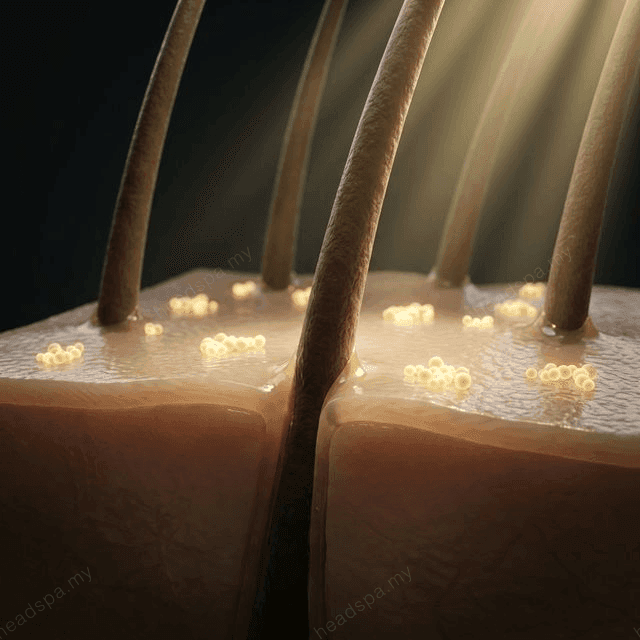
Most Malaysians who present with scalp flaking describe it as "dandruff" and reach for an OTC anti-dandruff shampoo. For a subset of these patients — those with seborrheic dermatitis — this self-treatment manages symptoms superficially while the underlying inflammatory cascade continues unchecked. The distinction matters clinically because seborrheic dermatitis is not a hygiene problem or a simple fungal overgrowth. It is a chronic, relapsing inflammatory skin disease with a defined immunological mechanism that requires structured treatment — not just a medicated shampoo used sporadically.
In Malaysia's tropical climate, the biological drivers of seborrheic dermatitis are chronically amplified. Understanding why begins at the follicle surface, where a lipophilic yeast and the immune system are in continuous negotiation.
Seborrheic Dermatitis vs Regular Dandruff
The term "dandruff" (pityriasis capitis) refers to mild scalp flaking without significant inflammation. Seborrheic dermatitis represents the clinical escalation of this process — the same Malassezia trigger, but with an exaggerated and sustained immune response that transforms the scalp into an active inflammatory site.
| Feature | Regular Dandruff | Seborrheic Dermatitis |
|---|---|---|
| Distribution | Scalp only | Scalp + face (nasolabial folds, eyebrows, behind ears) |
| Flake appearance | Fine, white, dry | Greasy, yellow-white, adherent |
| Erythema | Absent | Present — pink to red scalp base |
| Itch severity | Mild, intermittent | Moderate to severe, persistent |
| Treatment required | OTC anti-dandruff shampoo | Clinical-grade antifungal + anti-inflammatory |
| Relapse pattern | Seasonal, manageable | Chronic relapsing; requires maintenance protocol |
| Response to moisturiser | Mild improvement | Worsens — feeds Malassezia lipase activity |
If your "dandruff" involves facial involvement, persistent erythema, or greasy adherent scale that returns within days of washing, you are likely managing seborrheic dermatitis — not pityriasis capitis.
The Immunological Mechanism
Seborrheic dermatitis is driven by three converging biological events: Malassezia colonisation, sebum substrate provision, and a host immune hyper-response.
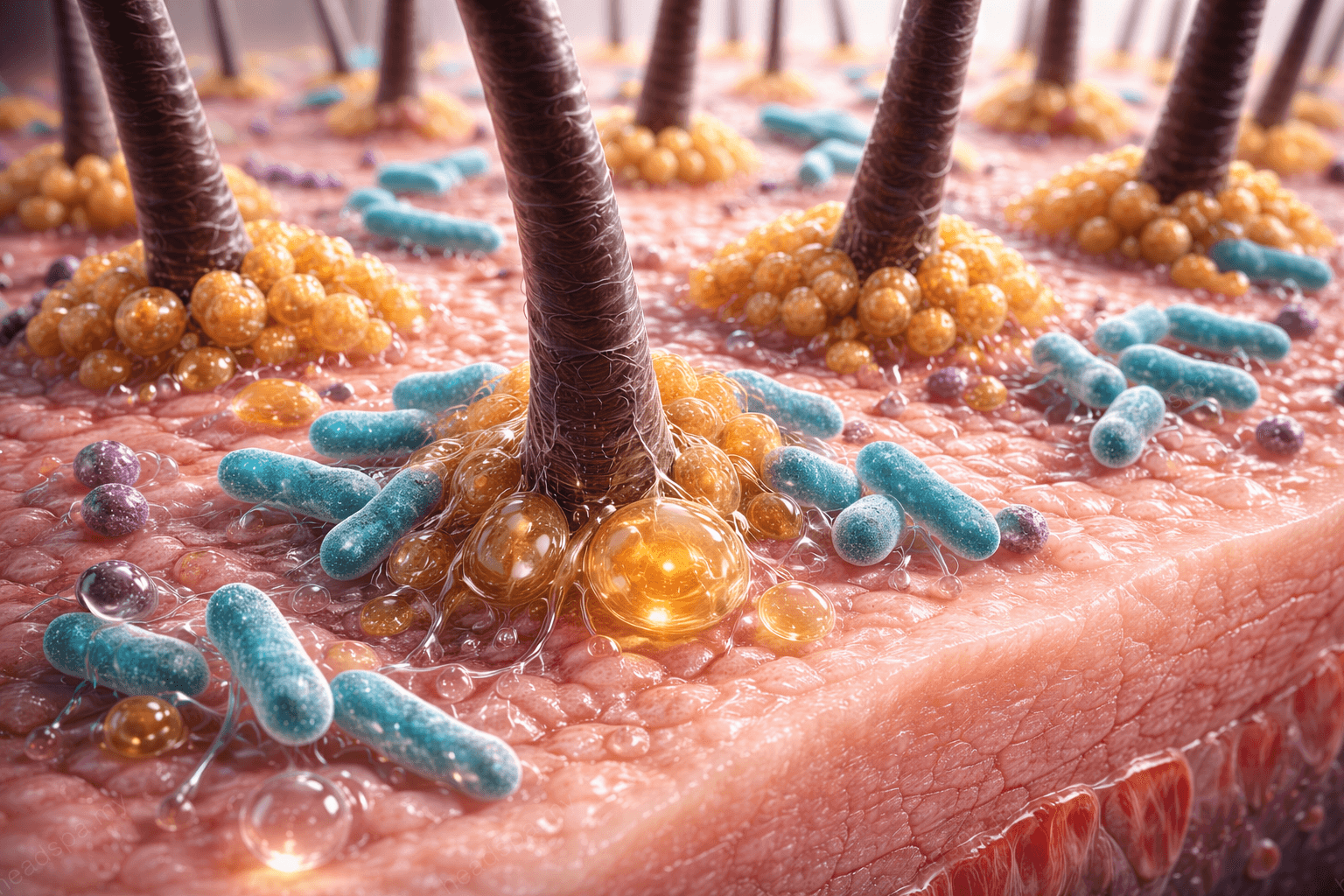
Step 1: Malassezia metabolises scalp sebum Malassezia globosa and Malassezia restricta are lipophilic yeasts that colonise every human scalp as part of the normal microbiome. In individuals with seborrheic dermatitis, they proliferate beyond their commensal threshold, facilitated by elevated sebum production. Malassezia secretes lipase enzymes that cleave sebum triglycerides into fatty acids — including oleic acid, a specific inflammatory trigger.
Step 2: Oleic acid breaches the epidermal barrier Free oleic acid penetrates the stratum corneum, disrupting tight junctions and triggering keratinocyte-mediated danger signalling. This activates the innate immune response — specifically the Th17 pathway, with upregulation of IL-17 and IL-22.
Step 3: Th17-driven keratinocyte hyperproliferation IL-17 and IL-22 drive keratinocyte proliferation at a rate that outpaces normal desquamation. Corneocytes clump rather than shedding as individual cells, producing the visible greasy yellow-white scale. TNF-α amplifies perivascular inflammation in the dermis, producing the erythema. The inflammatory cycle sustains itself — barrier disruption increases penetration of further Malassezia metabolites, maintaining immune activation chronically.
This self-reinforcing loop explains why seborrheic dermatitis is classified as a chronic relapsing condition rather than a curable infection. The Malassezia is not eliminated; it is managed at a sub-threshold level that the host immune system can tolerate.
Malaysian Trigger Factors
Seborrheic dermatitis follows a global prevalence of approximately 3–5% in the general adult population, but several environmental conditions endemic to Malaysia chronically elevate this risk.
Tropical humidity accelerates Malassezia proliferation. Malassezia thrives in warm, humid environments. Malaysia's average relative humidity of 70–90% creates near-optimal growth conditions year-round, unlike temperate climates where winter cold limits yeast replication. There is no low-Malassezia season in KL or JB.
Stress elevates sebum via cortisol-driven sebaceous activity. The hypothalamic-pituitary-adrenal axis response to stress upregulates androgen receptor sensitivity in sebaceous glands, increasing sebum output. This provides more lipid substrate for Malassezia lipase activity. Urban stress profiles in KL — traffic density, extended working hours, financial pressure — create a chronically elevated sebum environment.
Air-conditioning cycling disrupts the epidermal barrier. Repeated transitions between outdoor heat/humidity and heavily air-conditioned indoor environments create osmotic stress on the stratum corneum. The barrier function fluctuates, allowing Malassezia metabolite penetration to rise during each transition. This AC-cycling effect is specific to equatorial urban environments and disproportionately affects Malaysian scalps relative to temperate populations. See also /blog/ketombe-rawatan-malaysia for the Malaysian dandruff context.
The Treatment Pyramid
Seborrheic dermatitis management follows a stepwise protocol based on severity and response.
| Level | Intervention | Mechanism |
|---|---|---|
| OTC Level 1 | Ketoconazole 2% shampoo (3× weekly) | Inhibits Malassezia ergosterol synthesis |
| OTC Level 2 | Selenium sulfide 2.5% or zinc pyrithione | Anti-Malassezia + antiproliferative |
| Prescription Level 1 | Ciclopirox olamine 1% shampoo | Broad-spectrum antifungal; less resistance than azoles |
| Prescription Level 2 | Hydrocortisone 1% topical (short-term) | Reduces IL-17/IL-22 driven erythema; not for long-term use |
| Clinical Protocol | TTE scalp detox + microbiome rebalancing + barrier restoration | Addresses all three pathological axes simultaneously |
Critical protocol note: OTC antifungals should be used consistently (3× weekly) for a minimum of 4 weeks before assessing response. Sporadic use maintains Malassezia at sub-symptomatic levels temporarily but does not address barrier dysfunction or immune sensitisation.
Maintenance vs Remission
Seborrheic dermatitis does not have a permanent cure in the classical sense. The goal of treatment is to achieve and sustain remission — defined as absence of visible scale, erythema, and itch — through an ongoing maintenance protocol.
Active treatment phase (4–8 weeks): Clinical-grade antifungal at therapeutic frequency, barrier-restoring adjuncts, elimination of known triggers (stress management, styling product rationalisation, dietary sebum modulators).
Maintenance phase (indefinite): Transition to once-weekly antifungal shampoo use to prevent Malassezia proliferation above threshold. Increase frequency during known high-stress periods or seasonal humidity peaks.
Remission surveillance: Reintroduction of the full active treatment protocol at the first sign of scale recurrence — before the inflammatory cascade re-establishes. Waiting until symptoms are severe before retreating allows the Th17 response to amplify, extending the time required to achieve remission again.
TTE Elephant's clinical scalp protocol targets seborrheic dermatitis at all three axes: antifungal to reduce Malassezia load, anti-inflammatory botanical actives to interrupt the Th17 cascade, and barrier-restorative treatment to reduce oleic acid penetration. Book a trichoscopy and microbiome assessment at /headspa-kl.
FAQ
Q: My dandruff keeps coming back after one or two weeks. Is this seborrheic dermatitis? A: Rapid recurrence after treatment cessation is characteristic of seborrheic dermatitis. Regular dandruff (pityriasis capitis) typically remains manageable with occasional OTC shampoo use. If you require constant medicated shampoo to suppress symptoms, you are likely managing a chronic inflammatory condition requiring a structured maintenance protocol, not an acute fungal infection.
Q: Can seborrheic dermatitis spread to the face? A: Yes. This is one of the defining features distinguishing it from simple dandruff. Seborrheic dermatitis characteristically affects sebaceous-rich facial zones — the nasolabial folds, eyebrows, glabella, and the skin behind the ears. Facial involvement with greasy yellow scale in these zones alongside scalp symptoms is a reliable clinical indicator.
Q: I've been using ketoconazole shampoo for months and it's not working. What next? A: Ketoconazole resistance in Malassezia is documented, though uncommon. More frequently, incomplete response indicates that barrier dysfunction and immune sensitisation — not just fungal load — are driving symptoms. This requires a two-axis approach: antifungal plus barrier restoration. Ciclopirox, which has a different mechanism and lower resistance profile, is the appropriate prescription-level step, combined with clinical scalp barrier treatment.
Q: Does diet affect seborrheic dermatitis? A: Dietary influence is modest but clinically relevant. High glycaemic diets increase systemic insulin-like growth factor, which stimulates sebaceous gland activity and elevates sebum output. Diets high in processed sugars and refined carbohydrates may therefore worsen the Malassezia substrate environment. There is emerging evidence that probiotic supplementation (specifically Lactobacillus strains) reduces Th17 reactivity in seborrheic dermatitis, though clinical guidelines have not yet incorporated dietary protocols as primary interventions.
Q: Is seborrheic dermatitis linked to hair loss? A: Yes. Chronic scalp inflammation from seborrheic dermatitis elevates perifollicular IL-17 and TNF-α, which disrupt the anagen phase and accelerate catagen entry. Patients with long-standing, undertreated seborrheic dermatitis frequently develop diffuse telogen effluvium superimposed on the dermatitis. Treating the dermatitis typically reverses the hair loss, distinguishing it from androgenetic alopecia. See /concerns/dandruff-dry-scalp for the full scalp condition overview.