White flakes on a dark shirt are the reason most people first suspect a scalp problem. But the flaking scalp is a symptom — not a diagnosis — and the two most common causes, dandruff and scalp psoriasis, have fundamentally different origins, different biological mechanisms, and treatments that do not overlap. Applying a dandruff shampoo to psoriatic plaques does not fail gradually — it fails immediately, while active autoimmune inflammation continues to damage the scalp barrier.
In Malaysia, delayed differentiation between these two conditions is common. Both are widespread; both produce flaking and itch; and both are frequently self-treated with over-the-counter antifungal or anti-dandruff shampoos before any clinical assessment occurs. For the majority of dandruff cases, this approach is reasonable. For psoriasis, it can mean months of inadequate management while the condition progresses or spreads.
Side-by-Side Comparison
| Feature | Dandruff (Seborrhoeic Dermatitis) | Scalp Psoriasis |
|---|---|---|
| Underlying cause | Malassezia yeast overgrowth → oleic acid → immune response | T-cell immune dysregulation → IL-17, IL-23 → keratinocyte hyperproliferation |
| Flake appearance | Fine, greasy, yellowish-white; may clump in oily areas | Thick, silvery-white, dry, well-defined plaques; flakes are larger and scale-like |
| Distribution | Follows seborrheic zones: scalp, eyebrows, nasolabial folds, ears | Confined to scalp but with sharply defined borders; may extend beyond hairline onto forehead or nape |
| Itch quality | Diffuse, moderate itch; worse in humid conditions | Intense itch; sometimes burning; itch can be disproportionate to visible scale |
| Associated signs | Oily skin, facial seborrhoeic dermatitis, mild redness | Nail pitting, nail dystrophy (in ~50% of psoriasis patients); possible joint involvement (psoriatic arthritis) |
| Triggers | Stress, hormonal changes, humidity, immune suppression | Stress, streptococcal infection, certain medications (beta-blockers, lithium), skin trauma (Koebner phenomenon) |
| Response to antifungal | Responds well to ketoconazole, zinc pyrithione, selenium sulfide | Minimal or no response to antifungal treatment |
| Prevalence in Malaysia | ~50% of adults affected at some point | ~1–3% of population; underdiagnosed |
The Biology of Dandruff
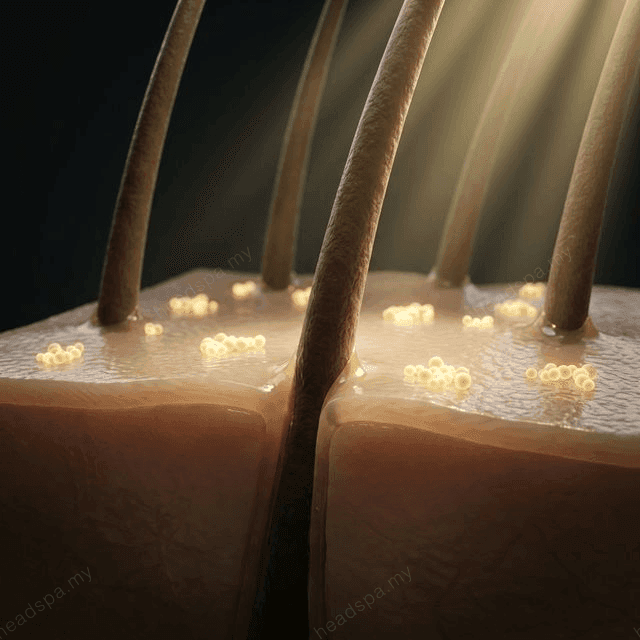
Dandruff is the inflammatory response to Malassezia — a lipophilic yeast that is a normal resident of the scalp microbiome. In susceptible individuals, Malassezia metabolises scalp sebum and releases oleic acid as a byproduct. Oleic acid penetrates the stratum corneum and triggers an innate immune response, disrupting the skin barrier and accelerating keratinocyte turnover. The result is visible shedding of large clumps of corneocytes — what is recognised as dandruff flake.
Malaysia's warm, humid climate is permissive for Malassezia proliferation. High sebum output — itself amplified by heat — provides an abundant substrate. This is why dandruff is particularly prevalent in tropical populations and tends to worsen in Malaysia's wet season when relative humidity rises further.
Antifungal shampoos (ketoconazole 1–2%, zinc pyrithione, selenium sulfide) reduce Malassezia population density and typically produce visible improvement within two to four weeks of consistent use. When dandruff is genuinely fungal in origin, this response is reliable.
The Biology of Scalp Psoriasis
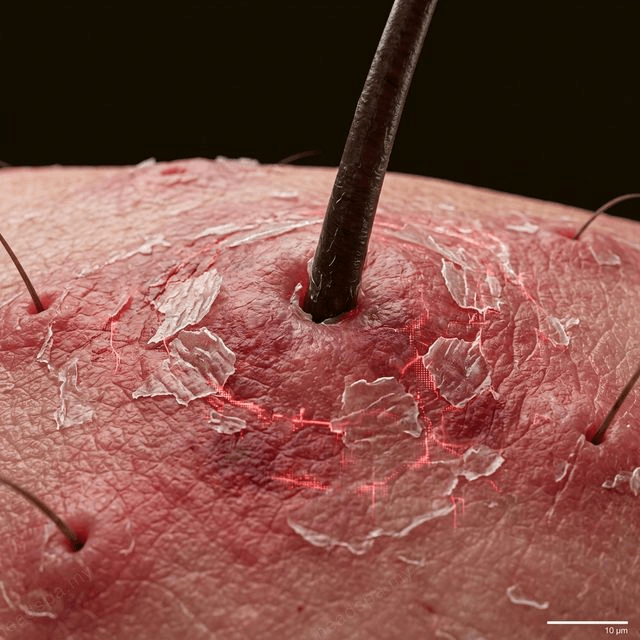
Psoriasis is not a fungal condition. It is an immune-mediated inflammatory disease in which dysregulated T-cells (specifically Th17 and Th1 subtypes) produce elevated levels of interleukin-17 (IL-17) and interleukin-23 (IL-23). These cytokines signal keratinocytes — the skin's structural cells — to proliferate at a dramatically accelerated rate. Normal keratinocyte turnover is approximately 28 days; in active psoriasis, this compresses to 3–4 days. The result is incomplete maturation and mass shedding of keratinocytes in thick, silvery plaques that do not resemble the fine, greasy flaking of dandruff.
As Griffiths and Barker (2007) established, psoriasis is a systemic inflammatory disease with cutaneous manifestations — not a skin disease with coincidental systemic features. This distinction is clinically important: scalp psoriasis may coexist with psoriatic arthritis, cardiovascular risk, and metabolic syndrome. A client presenting with scalp plaques and joint pain deserves urgent dermatology referral, not a scalp detox appointment.
Malaysian Triggers for Psoriasis Flares
Psoriasis flares in Malaysia are frequently precipitated by streptococcal throat infections (particularly in younger patients presenting with guttate psoriasis), psychological stress — an HPA axis effect on the inflammatory cascade — and certain medications prescribed for common Malaysian health conditions: beta-blockers for hypertension and lithium for mood disorders both have documented psoriasis-exacerbating profiles. Skin trauma, including vigorous scalp scratching or improper scalp massage performed over active plaques, can trigger the Koebner phenomenon — new psoriatic lesions forming at sites of mechanical injury.
The Role of Head Spa: Where TTE Can and Cannot Help
Dandruff — across its full spectrum from mild flaking to moderate seborrhoeic dermatitis — is within the clinical scope of TTE Elephant's head spa protocol. Microbiome-rebalancing treatments, sebum regulation, scalp barrier restoration, and stress reduction (cortisol reduction via neuro-relaxation massage may reduce dandruff severity by lowering the inflammatory response) can all be delivered as part of a structured treatment plan.
Scalp psoriasis is different. TTE can provide adjunctive value — cortisol reduction through vagal stimulation may reduce flare frequency, and gentle moisturisation can manage scalp comfort during remission. However, TTE does not and cannot treat active psoriatic plaques. Any client presenting with features consistent with psoriasis — thick silver plaques, sharp demarcation extending beyond the hairline, nail changes, or associated joint symptoms — is referred to a dermatologist before proceeding with clinical treatment.
When to see a dermatologist, not a head spa: nail pitting, joint pain, plaques that extend onto the forehead or ears, no response to two rounds of antifungal shampoo, or any scalp condition causing sleep disruption from itch.
Related reading: Scalp Microbiome and Malassezia | TTE Elephant Head Spa KL | TTE Elephant Head Spa JB
---
Frequently Asked Questions
Q: The flakes from my scalp are very thick and silvery. Is that psoriasis or severe dandruff?
A: Thick, silvery, dry plaques with sharp borders are the hallmark of psoriasis rather than dandruff. Dandruff flakes are typically finer, greasier, and yellowish-white, and they shed without forming adherent plaques. Silvery scale that sits on the scalp surface in defined patches, particularly if it extends to the forehead or behind the ears, should be assessed by a dermatologist or trichologist rather than self-treated. Using antifungal shampoo on psoriasis will not worsen it acutely, but it will not address the autoimmune process and delays appropriate treatment.
Q: Can stress cause both dandruff and psoriasis?
A: Yes, through different mechanisms. Stress elevates cortisol, which suppresses certain immune regulatory pathways and alters the scalp microbiome composition — contributing to Malassezia overgrowth and dandruff flaring. In psoriasis, psychological stress activates the HPA axis and triggers pro-inflammatory cytokine release, which directly exacerbates T-cell–mediated plaques. Nestle et al. (2009) noted stress as one of the most consistently reported psoriasis triggers. Neuro-relaxation-focused treatments, including TTE's vagal stimulation protocols, address the cortisol pathway and may reduce flare frequency in both conditions, though psoriasis requires concurrent dermatological management.
Q: Can I have both dandruff and psoriasis at the same time?
A: Yes. Co-occurrence is documented and can make diagnosis more complex. A psoriatic patient can also have Malassezia-driven seborrhoeic dermatitis layered on top of their psoriatic plaques — a condition sometimes called sebopsoriasis. Clinical differentiation requires trichoscopy or dermatoscopy in combination with clinical assessment; laboratory tests or biopsy may occasionally be needed for definitive diagnosis.
Q: How quickly should psoriasis respond to treatment?
A: Prescription-grade topical treatments — corticosteroids, vitamin D analogues (calcipotriol), or combinations — typically produce visible improvement within 4–8 weeks. Biologic treatments for moderate-to-severe psoriasis (anti-IL-17 or anti-IL-23 agents, now available in Malaysia through dermatology centres) can achieve clear or near-clear skin within 12–16 weeks. Antifungal shampoos alone will not produce a psoriasis response within any timeframe; absence of improvement after 4 weeks of antifungal treatment should prompt clinical reassessment of the diagnosis.