Scalp itch without dandruff is caused by neurogenic inflammation — a stress-driven process where peripheral nerve endings in the scalp release Substance P, triggering histamine from mast cells without any fungal involvement. Standard anti-dandruff shampoos do not treat this condition and typically worsen it by stripping the epidermal barrier.
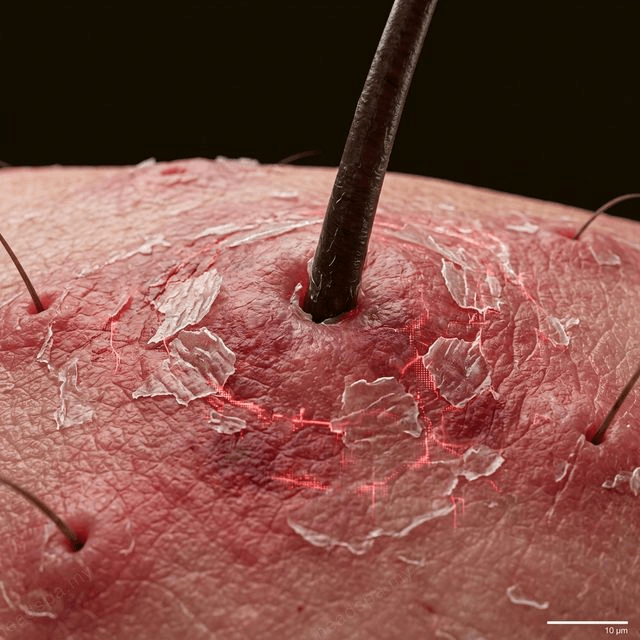
Is Scalp Itch Without Dandruff Serious? !3D inflamed scalp barrier showing Substance P neurogenic itch pathway without fungal involvement
When most people experience an itchy scalp, the immediate assumption points to dandruff. However, treating an invisible fungal condition with aggressive chemical shampoos is not only ineffective but biologically counterproductive. If you are experiencing persistent scalp pruritus without visible scaling or flaking, you are likely suffering from Sensitive Scalp Syndrome (SSS).
Sensitive Scalp Syndrome affects approximately 44% of women and 28% of men globally (Misery et al., 2008, Contact Dermatitis), with prevalence rising sharply in populations exposed to high urban pollution loads. It is a sensory hyper-reactivity of the cutaneous nervous system. Unlike seborrhoeic dermatitis, which is driven by the Malassezia yeast metabolising sebum on the skin's surface, a flake-free itch is generated internally by your peripheral nervous system.
This condition is clinically significant because it marks a breakdown in two distinct biological systems: the physical stratum corneum barrier and the autonomic stress response. Left unaddressed, chronic neurogenic inflammation accelerates follicular miniaturisation through cytokine-driven tissue damage, frequently progressing into stress-induced hair shedding over subsequent months.
What Happens During Neurogenic Scalp Inflammation?
The scalp possesses an exceptionally high density of cutaneous nerve endings, all positioned millimetres beneath the epidermal surface. Under normal circumstances, the stratum corneum (the outermost layer of dead keratinocytes embedded in a lipid matrix) forms a physical shield, insulating these nerves from external stimuli.
When you experience physiological or psychological stress, the body’s HPA (hypothalamic-pituitary-adrenal) axis releases systemic cortisol. Elevated cortisol levels suppress immune function and directly impair the epidermis's ability to synthesise ceramides, the primary lipids responsible for barrier integrity.
With a compromised lipid barrier, previously benign stimuli — a minor shift in temperature, a gentle breeze, or standard grooming — physically reach the hyper-sensitised C-nerve fibres. These nerve endings violently depolarise, releasing a neuropeptide called Substance P directly into the surrounding dermis.
Substance P then binds to neurokinin-1 (NK1) receptors on local mast cells, triggering sudden, massive degranulation. The mast cells release histamine, interleukins (IL-1, IL-6), and tumor necrosis factor-alpha (TNF-α). This creates an intense, burning itch sensation independent of any fungal or bacterial presence. Standard scalp concerns protocols targeting Malassezia simply cannot disrupt this neurological cascade, because the cause is hormonal and structural rather than microbial.
Understanding Scalp Biology is essential. Applying a zinc pyrithione shampoo to a neurogenic itch is akin to using antibiotics to treat a migraine — it is the wrong biochemical tool for the target mechanism.
Why Does Scalp Itch Get Worse Under Air Conditioning?
The environment you inhabit determines the severity of the barrier breakdown. In Kuala Lumpur, the transition from 33°C outdoor heat into 19°C air-conditioned offices — repeated 2–4 times daily — creates a dramatic humidity and temperature swing that disrupts the scalp's acid mantle continuously.
Kuala Lumpur's ambient environment averages 80–90% relative humidity. When you enter a mechanically cooled office, the ambient humidity artificially drops to 40–50%. This sudden gradient forces water to rapidly evaporate from the scalp surface—a mechanism known as Transepidermal Water Loss (TEWL).
The rapid TEWL shock dehydrates the stratum corneum, causing the microscopic keratinocyte "tiles" of your skin to contract and crack. This physically exposes the underlying nerve endings. Consequently, residents seeking a head spa in Kuala Lumpur frequently report that their scalp itch spikes aggressively mid-afternoon while sitting stationary at their office desk. The itch is not caused by the air itself, but by the physical micro-fissures opening in the skin barrier as the moisture is aggressively extracted by the HVAC system. This is a purely architectural collapse of the scalp surface.
How Does Urban Commuter Stress Trigger Scalp Itch?
Beyond the thermal shock, the urban commute directly drives the hormonal axis of the condition. For professionals navigating the Klang Valley gridlock or enduring the unpredictable border crossings to Singapore, the commute represents a distinct biological stressor: uncontrollable, repetitive, and high in anticipatory anxiety.
Such chronic daily stress generates sustained cortisol dysregulation. As cortisol levels remain elevated above baseline (exceeding the standard 15 µg/dL morning peak), the parasympathetic nervous system is perpetually suppressed. Given this continuous stress load, the body remains in a sympathetic "fight or flight" dominance, leaving the mast cells in a state of hyper-arousal and primed to degranulate at the slightest provocation.
This dual-environment stress — the psychological load of the commute combined with the physical desiccation of the office — explains why the Malaysian urban scalp ages differently and requires more sophisticated intervention than standard cosmetic ranges provide.
Can Standard Shampoos Cure Neurogenic Itch?
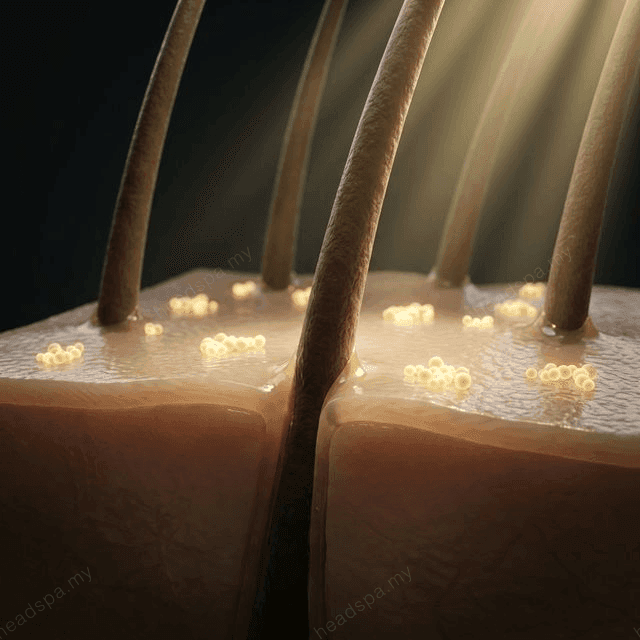
The vast majority of commercial and therapeutic shampoos are formulated with alkaline or neutral pH levels (pH 6.0–7.5) and rely on anionic sulfate surfactants to remove sebum.
The healthy scalp acid mantle requires an environment between pH 4.5 and 5.5 to function optimally. In Kuala Lumpur, the moderately hard municipal tap water already presents an alkaline challenge (pH 7.0–8.0). When you apply a sulfate-based shampoo to a scalp suffering from neurogenic itch, the surfactant heavily denatures the remaining surface lipids.
Instead of repairing the micro-cracks exposing the nerve endings, the shampoo strips away the protective lipid mortar. The immediate sensation may be one of temporary cleanliness, but within hours, the exposed C-nerve fibres begin transmitting severe pruritus signals as the barrier is left entirely undefended. Treating sensitive scalp syndrome requires actively depositing ceramides and regulating the pH back to an acidic state, not aggressively degreasing the surface.
How Is Neurogenic Scalp Itch Treated Clinically?
Intervening in neurogenic inflammation requires interrupting the condition at both ends of the biological pathway: structurally repairing the stratum corneum barrier and neurologically suppressing the Substance P release.
TTE Elephant approaches this clinically. Because the root cause of neurogenic inflammation involves autonomic dysregulation, topical solutions alone are insufficient. The Sleep Healing Headspa protocol engages the parasympathetic nervous system directly via the greater occipital nerve. By applying targeted pressure to occipital pathways that share neuroanatomical connectivity with the vagal nucleus, the treatment suppresses systemic cortisol production.
Measurable cortisol reduction directly lowers the activation threshold of the peripheral nerve endings, halting the release of Substance P and preventing further mast cell degranulation. Simultaneously, the clinical formulations used throughout the protocol focus on lipid barrier restoration using ceramide-rich, pH-calibrated amino acid cleansing systems.
This dual-action approach — calming the structural barrier while down-regulating the stress axis — is why the Sleep Healing Headspa protocol begins with an autonomic nervous system assessment, not just a topical treatment. Clinical scalp health requires treating the entire neuro-biological system.
Frequently Asked Questions
Q: Why does my scalp itch but I have no dandruff? A: Scalp itch without dandruff is caused by neurogenic inflammation. When the scalp barrier is compromised by stress, alkaline water, or air conditioning, hyper-sensitised nerve endings release Substance P. This triggers mast cells to release histamine, causing an intense itch entirely unassociated with fungal infections or flaking.
Q: Can stress cause scalp itching without dandruff? A: Yes. Psychological stress elevates systemic cortisol, which impairs the scalp's lipid barrier synthesis and lowers the activation threshold of peripheral nerves. Sustained urban stress directly primes the mast cells in your scalp to degranulate, resulting in a severe, burning itch whenever you encounter minor environmental shifts.
Q: Does office air conditioning cause an itchy scalp? A: Air conditioning drops indoor humidity to 40-50%. The transition from Malaysia's 80% outdoor humidity into dry, cooled offices causes rapid transepidermal water loss. This thermal shock cracks the scalp's outer barrier, exposing sensitive nerve endings to the air and triggering an immediate neurogenic itch response.
Q: What is the best treatment for neurogenic scalp itch in Malaysia? A: Standard shampoos worsen the condition by stripping the lipid barrier. The clinical solution requires repairing the barrier with ceramide treatments and reducing the cortisol load driving the inflammation. TTE Elephant’s head spa protocols address both mechanisms simultaneously via targeted vagus nerve stimulation and pH-calibrated surface repair.