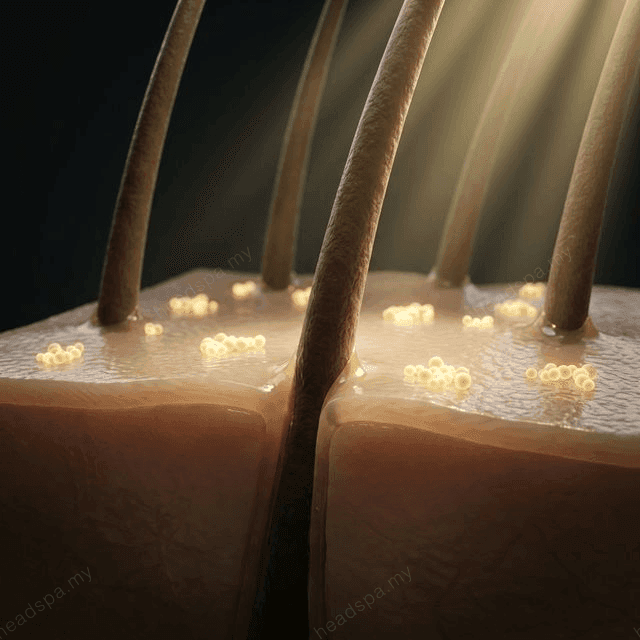
Dandruff in Malaysia requires treatment that targets Malassezia globosa—a lipophilic fungus whose proliferation is accelerated 3× by the tropical 80–90% ambient humidity. Standard anti-dandruff shampoos often fail long-term because their highly alkaline pH disrupts the epidermal barrier, triggering rebound sebum production and a worsening cycle of fungal overgrowth instead of actual microbiome restoration.
What is the Difference Between Dandruff and Dry Scalp?
Many Malaysian professionals self-diagnose any visible white flakes as "dandruff." However, there is a fundamental clinical distinction between true dandruff (Pityriasis Capitis) and a compromised, excessively dry scalp. Misdiagnosing one for the other often leads to treatments that exacerbate the underlying condition.
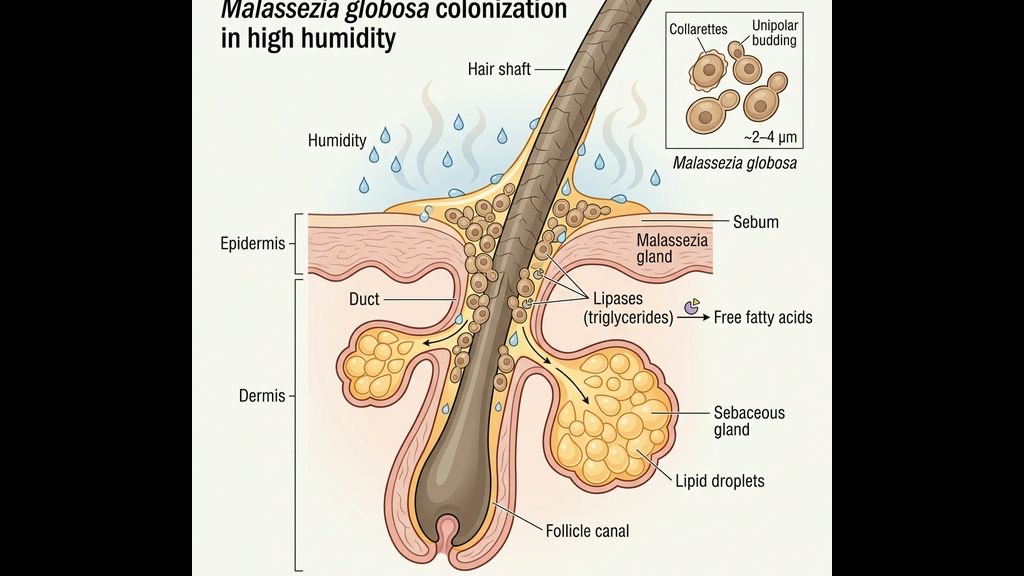
True dandruff is a mild manifestation on the seborrheic dermatitis spectrum. It is fundamentally an inflammatory response to the metabolic byproducts of to an overgrowth of the *Malassezia* genus—specifically *Malassezia globosa* and *Malassezia restricta*. These yeast-like opportunistic fungi are a normal part of the human scalp microbiome. They lack the ability to synthesize their own lipids, so they feed on human sebum. In the process, they secrete lipases that break down triglycerides in sebum into saturated and unsaturated fatty acids (like oleic acid). For about 50% of the population, oleic acid acts as a profound irritant that penetrates the stratum corneum, accelerating the epidermal cell turnover rate from a healthy 21–28 days to an erratic 7–14 days. This rapid turnover physically forces cells to clump together and shed as large, often yellowish and oily flakes.
Conversely, a dry scalp is a purely structural issue of a compromised skin barrier. When the stratum corneum lacks structural lipids (ceramides, cholesterol, free fatty acids) and Natural Moisturizing Factors (NMFs), transepidermal water loss (TEWL) increases. The scalp literally dries out, leading to microscopic shedding. The flakes in a dry scalp scenario are typically very fine, stark white, and not accompanied by significant erythema (redness) or excessive sebum. The fundamental distinction is crucial: using harsh antifungal zinc pyrithione shampoos on an already compromised, dry epidermal barrier will severely worsen TEWL and trigger intense neurogenic itch.
Why Does Malaysia’s Tropical Climate Accelerate Malassezia Proliferation?
To understand why dandruff is so stubborn in Kuala Lumpur, we must analyze the environmental incubator that is the Malaysian climate. The average relative humidity (RH) in the Klang Valley year-round sits between 80% and 90%, paired with an average ambient temperature of 32–34°C.
Microbiological studies on *Malassezia* ecology reveal that these lipophilic fungi have a thermal optimum precisely mimicking the humid human body surface. However, when ambient humidity crosses the 80% threshold, the fungal proliferation rate increases up to 3× compared to temperate climates. In essence, the Malaysian climate provides the ultimate Petri dish for fungal overgrowth.
Furthermore, the 32–34°C ambient temperature reduces the viscosity of scalp sebum. Liquid sebum spreads more rapidly along the hair shaft and across the scalp surface, providing an expanded, readily accessible nutrient pool for *Malassezia*. When an urban professional transitions from this outdoor tropical heat into an 18–22°C, heavily air-conditioned office environment, the sudden drop in temperature and ambient humidity (often crashing to 40-50% RH) induces a severe "humidity swing." This transition physically shocks the stratum corneum, causing micro-fissures in the barrier. The compromised barrier is then significantly more permeable to the irritating oleic acid produced by the *Malassezia* when the individual steps back outside.
This is the core reason why patients who never experienced dandruff while studying or living in temperate regions like the UK or Australia suddenly develop severe, intractable flaking within months of returning to Malaysia.
Why Do Standard Anti-Dandruff Shampoos Fail Long-Term?
The overwhelming majority of commercial anti-dandruff shampoos rely on active fungistatic agents such as Zinc Pyrithione (ZPT), Ketoconazole, or Selenium Sulfide. While these agents are highly effective at acutely reducing the *Malassezia* load, their long-term efficacy is compromised by the vehicle in which they are delivered—namely, highly alkaline surfactant bases.
The healthy human scalp maintains a naturally acidic mantle with a pH ranging between 4.5 and 5.5. This acidic environment is critical for activating the enzymes responsible for synthesizing ceramides (the "mortar" holding skin cells together) and for naturally inhibiting opportunistic pathogens.
Unfortunately, to stabilize agents like ZPT, commercial shampoos are formulated at a much higher, alkaline pH (often 7.0 to 8.5). While they kill the fungus in the short term, they simultaneously obliterate the acidic mantle in the long term. This repeated alkaline shock creates a rebound effect. The scalp, sensing its stripped barrier, commands the sebaceous glands into overdrive to compensate. This surge in fresh sebum is immediately colonized by the surviving *Malassezia* spores.
Additionally, chronic use of single-agent fungistatics can lead to fungal adaptation. The *Malassezia* biofilm structure fortifies itself, requiring higher and harsher concentrations of the active ingredient to penetrate. This creates a vicious cycle: strip the barrier, temporary relief, massive rebound sebum, fortified fungal return, requiring even harsher stripping. This cycle perfectly explains why many Malaysians cycle through dozens of commercial brands, finding relief for only the first few weeks before the flaking aggressively returns.
What is the Clinical Protocol for Long-Term Scalp Restoration?
Breaking the vicious cycle of recurrent dandruff requires a shift from a "strip and kill" mentality to a "clinical microbiome regulation" protocol. The objective is not sterility—it is impossible and unhealthy to completely eradicate *Malassezia*. The objective is to restore the scalp's chemical balance so the fungus naturally limits its own population.
At TTE Elephant Head Spa, our approach to resolving Dandruff & Dry Scalp is rooted in biological restoration, divided into three precise clinical phases.
### Phase 1: Trichoscopy Diagnosis
Before any active ingredient touches the scalp, a high-magnification trichoscopic evaluation is mandatory. Operating at 60x to 200x magnification, trichoscopy allows the specialist to visually differentiate between the large, oily, yellowish scales characteristic of seborrheic dermatitis, and the fine, dry white scales indicative of barrier disruption. Crucially, trichoscopy can identify perifollicular erythema (inflammation around the hair base) and the presence of underlying bacterial folliculitis, which dictates a completely different treatment pathway.
### Phase 2: Targeted Antifungal Clearance and Barrier Decalcification
Once true flaking is confirmed, the immediate goal is to safely dismantle the *Malassezia* biofilm and unblock the follicle ostia without alkaline shock. We utilize precise, pH-calibrated micro-exfoliants that gently dissolve the oxidized lipid peroxide bonds holding the dead skin cells together.
Instead of relying on harsh sulfates, our clinical protocol integrates botanical fungistatic agents—such as high-grade natural Melaleuca Alternifolia (Tea Tree) isolates and piroctone olamine, which offer excellent anti-fungal efficacy at a skin-compatible pH. This clears the accumulated crust without triggering the rebound sebum response.
### Phase 3: Microbiome Restore and Acid Mantle Re-Acidification
The final, most critical step is the long-term restoration of the scalp's ecological defense system. This involves physically supplementing the barrier with bio-identical ceramides and NMFs to prevent transepidermal water loss. Furthermore, precise pH-balancing formulations are applied to immediately drag the epidermal pH back down to the optimal 4.5–5.5 range.
By restoring the acidic environment, the scalp naturally downregulates *Malassezia* proliferation. We also focus on downregulating systemic stress and cortisol—which directly influences sebum production—through physically mediated vagus nerve stimulation during the treatment. The result is a fundamentally reinforced scalp defense mechanism capable of withstanding the Malaysian humidity without chemical dependency.
Frequently Asked Questions
Q: Is it okay to use an anti-dandruff shampoo every day in Malaysia? A: No, daily use of commercial alkaline anti-dandruff shampoos strips the crucial acidic mantle of the scalp. While it may provide temporary relief by washing away loose flakes and reducing fungus acutely, it triggers a massive rebound sebum production, which ultimately feeds more *Malassezia* and worsens the long-term condition.
Q: Can stress cause my dandruff to come back? A: Yes, absolutely. Psychological stress triggers the release of cortisol and neurogenic inflammatory markers like Substance P. Cortisol directly stimulates the sebaceous glands to overproduce sebum, providing an immediate food source for *Malassezia*. Effective treatment must manage both the fungal load on the outside and the stress response internally.
Q: How does a head spa treat dandruff differently than clinic medicine? A: While a dermatologist may prescribe potent steroid lotions to immediately halt severe inflammation, the head spa protocol focuses on long-term ecological restoration. We perform deep follicle clearing to remove built-up sebum and dead skin, re-acidify the scalp to its optimal pH, and incorporate nervous system relaxation. This multi-modal approach creates an environment where fungus cannot overpopulate, breaking the cycle of dependency on harsh medical shampoos.
***
References
- Schwartz, J. R., Messenger, A. G., Tosti, A., Todd, G., Hordinsky, M., Hay, R. J., ... & Dawson, T. L. (2013). *A comprehensive pathophysiology of dandruff and seborrheic dermatitis - towards a more precise definition of scalp health*. Acta Dermato-Venereologica, 93(2), 131-137.
- Ranganathan, S., & Mukhopadhyay, T. (2010). *Dandruff: the most commercially exploited skin disease*. Indian Journal of Dermatology, 55(2), 130-134.
- Borda, L. J., & Wikramanayake, T. C. (2015). *Seborrheic Dermatitis and Dandruff: A Comprehensive Review*. Journal of Clinical and Investigative Dermatology, 3(2), 10-18.
- DeAngelis, Y. M., Gemmer, C. M., Kaczvinsky, J. R., Kenneally, D. C., Schwartz, J. R., & Dawson, T. L. (2005). *Three etiologic facets of dandruff and seborrheic dermatitis: Malassezia fungi, sebaceous lipids, and individual sensitivity*. Journal of Investigative Dermatology Symposium Proceedings, 10(3), 295-297.