
That sudden scalp itch at age 38 might not be a fungal dandruff infection. As natural sebum production drops in your late 30s, the scalp's protective acid mantle weakens, leaving your skin severely vulnerable to the dry air-conditioning of Kuala Lumpur offices.
Why Your Scalp Suddenly Starts Itching at 35+
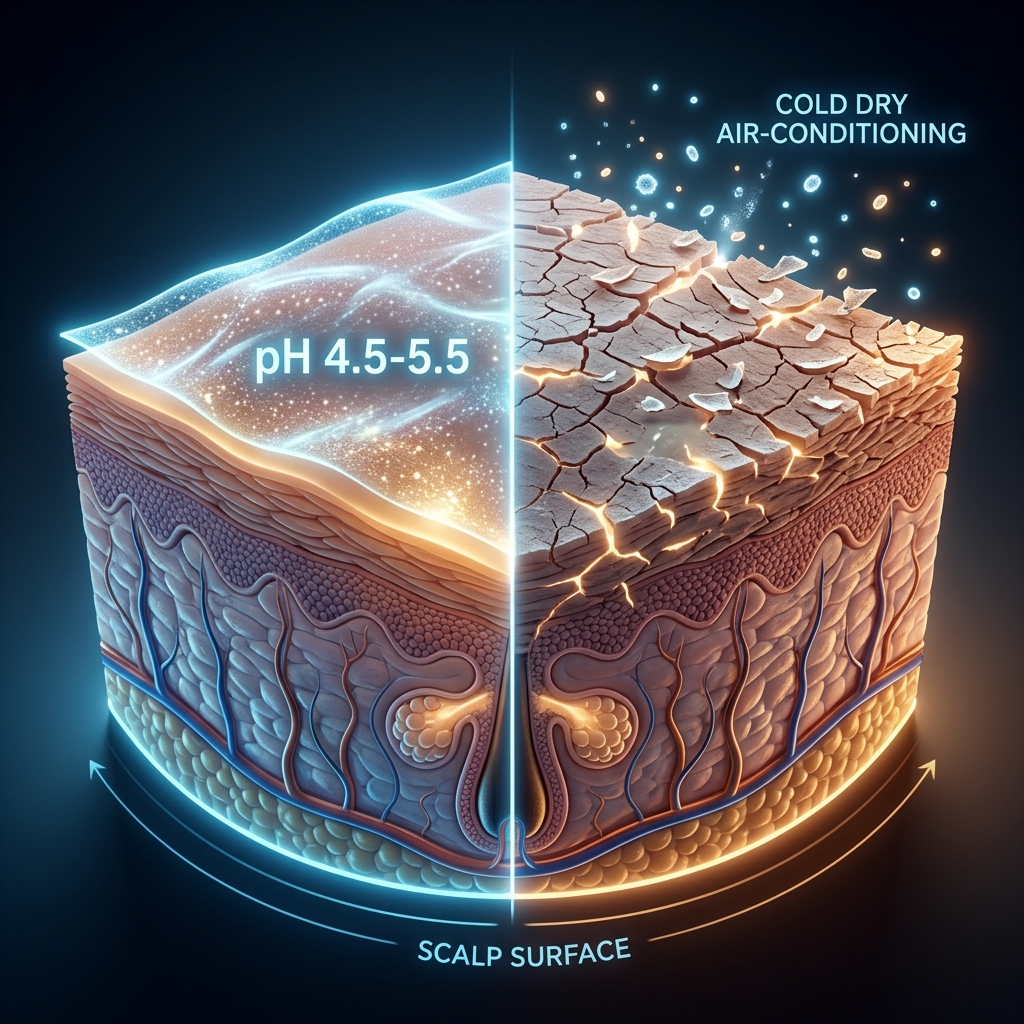
For years, your sebaceous glands have worked tirelessly to pump out oil (sebum), lubricating the hair shaft and creating a waterproof, slightly acidic film across the scalp called the acid mantle. This barrier maintains an optimal pH of 4.5–5.5, keeping out irritants and locking in hydration.
However, clinical dermatology shows a sharp inflection point. Sometime in your late 30s, as estrogen and corresponding androgen ratios shift, sebaceous gland activity begins to steadily downregulate. You produce measurably less oil. While you might enjoy having to wash your hair less frequently, your scalp is quietly losing its primary defensive layer.
When the acid mantle is compromised, microscopic fissures form in the stratum corneum (the outermost layer of the skin). Moisture evaporates rapidly — a process called Trans-Epidermal Water Loss (TEWL). Without its lipid shield, the scalp becomes visibly dry, tight, and highly reactive to environmental changes. This is clinically classified as Sensitive Scalp Syndrome, which affects roughly 44% of women globally (Misery et al., 2008, Contact Dermatitis).
What Happens in the Epidermis — The Neurogenic Pathway
When those micro-fissures open, the nerve endings lying just beneath the epidermis become exposed. This leads to neurogenic inflammation.
Peripheral nerve endings in the scalp release a neuropeptide called Substance P in response to this barrier shock. Substance P directly triggers mast cells to release histamine, causing an intense, prickling itch. But structurally, there is no fungus, no Malassezia overgrowth, and no infection. It is purely a mechanical and neurological physical response to dryness and barrier failure.
Because the symptoms (flaking and itching) perfectly mimic dandruff, most women in their late 30s mistakenly reach for aggressive anti-dandruff shampoos. These products strip away whatever trace amounts of sebum are left, plunging the scalp into a vicious cycle of deeper damage and worse itching.
The Malaysian Factor: Why Office Air-Conditioning is the Trigger
If you work in an urban centre like Kuala Lumpur, your late-30s scalp is subjected to extreme environmental whiplash. 1. The Humidity Swing: Walking from 34°C, 90% outdoor humidity into a 19°C air-conditioned office with 40% humidity causes a massive osmotic shock to the skin. The dry, freezing air rapidly pulls water out of the already-weakened stratum corneum. 2. Hard Water Washing: KL's tap water is moderately hard (alkaline). Washing a dry, lipid-depleted scalp with highly alkaline water permanently disrupts the pH, destroying the acid mantle faster than the diminishing sebaceous glands can rebuild it.
This daily KL commute — stepping from sweating heat to freezing air-con — is exactly why Inflamed & Sensitive Scalp cases spike dramatically among professional women aged 35–45.
How Dry Scalp Is Treated Clinically
You cannot treat a failing lipid barrier with harsh detergents. The clinical protocol for late-30s dry scalp focuses entirely on barrier repair and neuro-calming techniques.
At TTE Elephant, we first use trichoscopy to differentiate true Malassezia dandruff from dry scalp flaking. If the diagnosis is barrier compromise, our protocol deploys bio-mimetic ceramides and targeted botanical hydration to artificially reconstruct the acid mantle. We utilise precise ultrasonic atomisation to drive moisture past the stratum corneum, instantly soothing the exposed nerve endings and halting the Substance P itch-cascade.
This deeply restorative approach is not a standard salon wash. It requires proper clinical treatment in Kuala Lumpur that respects the shifting biology of the aging female scalp.
Frequently Asked Questions
Q: How can I tell if my itch is dandruff or just a dry scalp? A: True dandruff (seborrheic dermatitis) produces oily, yellowish flakes that stick to the scalp. A dry scalp produces small, dry, white flakes that fall easily, and the scalp feels tight after washing. Trichoscopy is the only way to be 100% certain.
Q: Can stress cause scalp itching without dandruff? A: Yes. Chronic stress over-activates your nervous system, amplifying neurogenic inflammation. The nerve endings become hyper-sensitised, releasing inflammatory neuropeptides that cause itching with no fungal cause.
Q: Should I wash my hair less if my scalp is dry? A: Washing frequency should be determined by your lifestyle and sweat levels, but you must switch to a pH-balanced, sulfate-free cleanser. Harsh shampoos strip the aging scalp's diminishing lipids.
Q: What is the best treatment for neurogenic scalp itch in Malaysia? A: The most effective approach is barrier restoration. At TTE Elephant, our bespoke Headspa therapies bypass generic washing algorithms, delivering deep epidermal hydration and neural calming to permanently soothe the neurogenic itch.