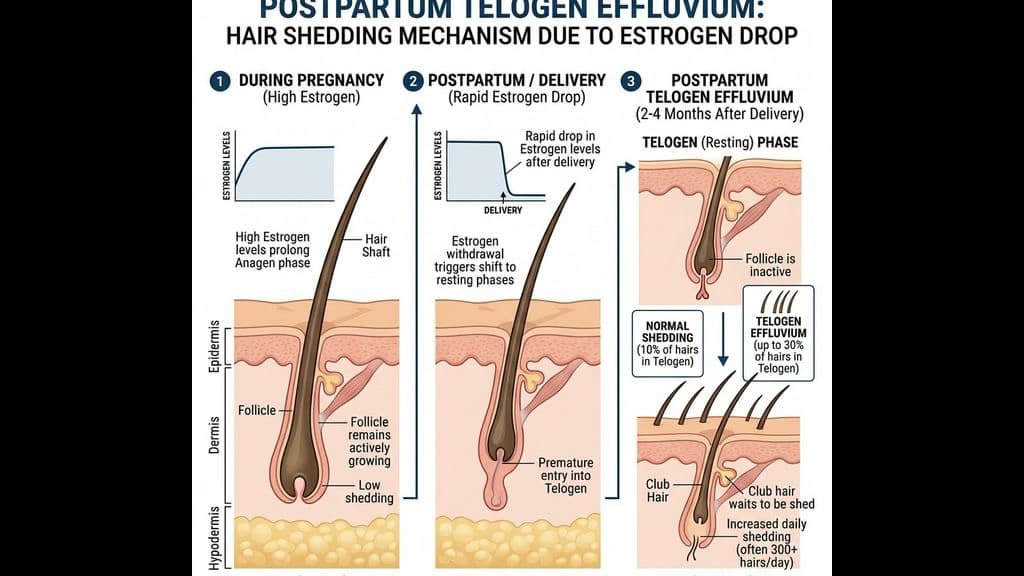
If you are 3–4 months postpartum and noticing clumps of hair in the shower drain every morning, you are not losing all your hair. What you are experiencing is called telogen effluvium — a predictable, hormonal, and largely reversible response to giving birth. Between 40–50% of new mothers experience it. The question is not whether it will happen, but how quickly you can recover.
The Biology: Why Your Hair Falls Out After Delivery
During pregnancy, elevated oestrogen extends the anagen (growth) phase of the hair cycle — which is why many women notice their hair becoming thicker and fuller while pregnant. When oestrogen drops sharply after delivery, the follicles that were held in extended growth simultaneously exit into the telogen (resting) phase. This synchronised mass transition is telogen effluvium.
The shedding begins 3–6 months after delivery, not immediately, because follicles spend roughly 100 days in telogen before they shed the hair shaft. The peak shedding window — the point most women find most alarming — is typically months 4 to 6 postpartum.
Without intervention, telogen effluvium naturally resolves within 6–12 months as follicles return to anagen phase. With the right scalp protocol, this recovery timeline can be compressed significantly.
The Malaysian Context: Why It's Often Worse Here
Telogen effluvium is a universal postpartum experience. But Malaysian new mothers face two compounding factors that intensify scalp stress:
1. Tropical humidity and heat. KL's year-round humidity of 78–82% creates an environment where scalp temperature runs 1–2°C higher than in temperate climates. Elevated scalp temperature stimulates sebaceous gland output, feeding the Malassezia fungus that drives dandruff and scalp inflammation. A compromised scalp barrier during the postpartum period is harder to recover from.
2. Postpartum sleep deprivation and cortisol elevation. Cortisol — the primary stress hormone — directly suppresses follicle stem cell activity in the bulge region and extends the telogen phase. Malaysian new mothers, particularly those without extended family support networks, often experience months of fragmented sleep that maintains a chronically elevated cortisol baseline. This compounds the hormonal shedding and extends the recovery window.
What Doesn't Work
Before getting to what actually helps, it is worth being direct about what doesn't:
Generic anti-hairfall shampoos treat the hair shaft, not the follicle. They cannot restart the anagen phase, reduce scalp inflammation, or address the hormonal mechanism driving shedding. They make hair look better temporarily but don't accelerate follicle recovery.
Biotin supplements alone address a nutritional deficiency — which is a legitimate cause of hair loss, but not the primary mechanism in postpartum telogen effluvium. Taking biotin when your follicles are in hormonally-triggered telogen is like adding petrol to a car with a flat tyre.
What Actually Works
The intervention target is the follicle environment, not the hair shaft. Three evidence-backed approaches:
Scalp microcirculation therapy. Structured scalp massage has been shown to increase dermal papilla blood flow by up to 30%, delivering the oxygen and growth factors that dormant follicles need to re-enter anagen phase. A 2016 study in *ePlasty* found that 4 minutes of daily standardised scalp massage over 24 weeks produced measurably increased hair thickness — a proxy for follicle reactivation.
Botanical follicle actives. Centella asiatica (pegaga) stimulates collagen synthesis around the follicle bulge, supporting the structural environment for anagen re-entry. Red clover isoflavones act as phytooestrogens — partially compensating the oestrogen signal that maintained extended anagen during pregnancy.
Cortisol reduction. Addressing the stress-cortisol axis that compounds telogen effluvium is not optional — it is mechanistically necessary. Vagus nerve stimulation through targeted scalp massage and parasympathetic-activating pressure techniques measurably reduces cortisol and creates the hormonal conditions for follicle reactivation.
When to Start Treatment
The optimal window is 3–9 months postpartum — after the initial hormonal shift has stabilised but while follicles are still in early telogen and responsive to reactivation signals. Earlier than 3 months and the hormonal environment is still too unstable; later than 12 months and some follicles may have progressed toward miniaturisation.
If you are breastfeeding, TTE Elephant's botanical actives are formulated without alcohol or contraindicated ingredients — the treatment is safe throughout the breastfeeding period.
Q: Is postpartum hair loss permanent? A: No. Postpartum hair loss (telogen effluvium) is a hormonal response to the oestrogen drop after delivery — not a sign of permanent follicle damage. Without intervention, most women see natural recovery within 6–12 months. With targeted scalp microcirculation therapy and follicle-stimulating actives, this recovery window can be compressed significantly.
Q: When is the best time to start scalp treatment after giving birth? A: The optimal window is 3–9 months postpartum — after the initial hormonal shift has stabilised but while follicles are still in early telogen and highly responsive to reactivation. Earlier than 3 months and the hormonal environment is too unstable; after 12 months some follicles may have progressed toward miniaturisation.
<a href="/postpartum-hair-loss-treatment-malaysia" style="color:#C9A96E">→ Find out more about Postnatal Scalp Recovery Treatment at TTE Elephant</a>