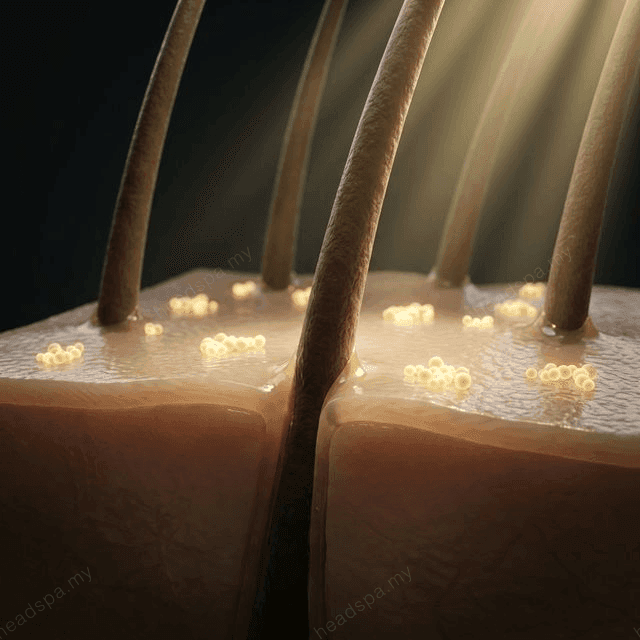
If your scalp feels greasy within hours of washing, you are not failing at hygiene. You are experiencing a measurable biological process — sebum overproduction — that is driven by hormones, temperature, stress chemistry, and diet, all of which are amplified by Malaysia's specific climate and lifestyle conditions.
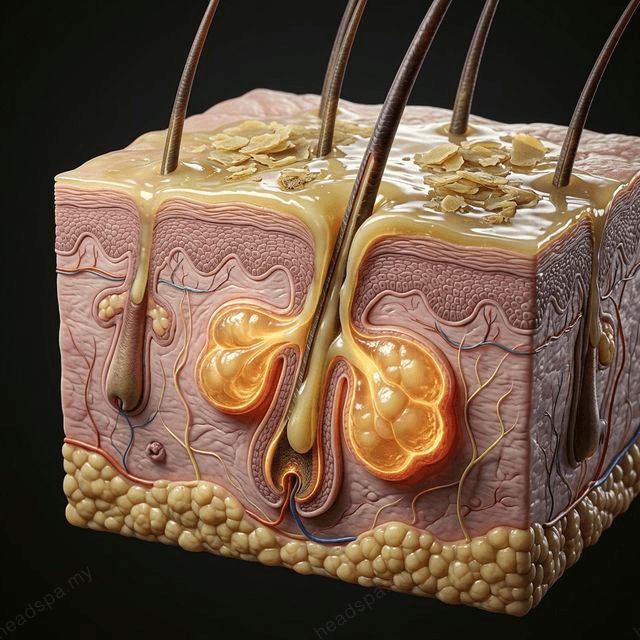
Sebum is produced by sebaceous glands attached to every hair follicle. At the correct volume, it maintains the scalp's acid mantle (pH 4.5–5.5), lubricates the hair shaft, and provides antimicrobial protection. Overproduction collapses this balance: excess sebum feeds Malassezia yeast, occludes follicles, and creates the substrate for dandruff, scalp acne, and inflammation. Understanding the exact driver behind your sebum excess is the prerequisite for correcting it.
The 6 Biological Drivers of Excess Sebum
| Driver | Biological Mechanism | Malaysian Amplifier | Clinical Correction |
|---|---|---|---|
| DHT (Dihydrotestosterone) | Binds androgen receptors in sebaceous glands → gland enlargement → increased sebum output | Higher androgen sensitivity in Asian populations; puberty, PCOS, androgenic alopecia | Scalp sebum regulation; trichoscopy-guided treatment; dermatologist referral for severe androgenic cases |
| Tropical Heat (33°C average KL) | Elevated ambient temperature liquefies sebum and increases gland secretion rate | Year-round exposure — no seasonal remission; commuting in un-airconditioned transport | Clinical scalp cooling protocols; sebum-regulating botanical actives; frequency adjustment of in-clinic treatment |
| Cortisol (Stress Hormone) | Corticotropin-releasing hormone (CRH) directly stimulates sebaceous glands via CRH receptors | Urban KL stress load: traffic, cost of living, work culture; SG–JB commuter fatigue | Neuro-relaxation protocols targeting cortisol reduction; vagus nerve stimulation; TTE Elephant Head Spa KL |
| Diet: High GI / Sugar / Dairy | Insulin spike → elevated IGF-1 → sebocyte proliferation and androgen receptor upregulation | Raya season high-GI foods; teh tarik culture; frequent mamak visits | Dietary modification; glycaemic index awareness; refer to nutritionist for persistent cases |
| Product Buildup | Silicone, mineral oil, and wax residues from styling products coat the follicular opening → trap sebum beneath surface | Heavy styling product use in humid climate to manage frizz; insufficient rinsing | Professional scalp detox; chelating or clarifying treatments; product audit |
| Overwashing | Strips the acid mantle → sebaceous glands detect deficit → compensatory hypersecretion | Belief that daily washing controls oiliness → worsens the cycle | Frequency reduction with professional guidance; pH-balanced cleansers; structured wash intervals |
DHT: The Root-Level Driver
Dihydrotestosterone is the most clinically significant sebum driver. Converted from testosterone by the enzyme 5-alpha reductase (5αR) within sebocytes, DHT binds androgen receptors and triggers both sebaceous gland enlargement and increased lipid synthesis per gland. Zouboulis (2004) established that sebum excretion rate correlates directly with androgen receptor activity — not simply with circulating testosterone levels. This explains why two individuals with identical hormone panels can have vastly different oiliness profiles.
For women with PCOS, perimenopause, or post-OCP withdrawal, DHT-driven sebum spikes are a primary scalp complaint. For men experiencing androgenic alopecia, sebum overproduction at the follicle mouth accelerates miniaturisation by contributing to follicular inflammation.
Heat as a Physical Amplifier
Sebum viscosity decreases as temperature rises. At Kuala Lumpur's average outdoor temperature of 33°C, sebum flows from the gland to the scalp surface faster and spreads more broadly across the scalp than it would in a temperate climate. This is not a pathological process — it is thermodynamics — but the effect is clinically meaningful: sebum that spreads rapidly across the scalp creates a continuous feeding substrate for Malassezia yeast, increasing the likelihood of dandruff and scalp odour even in individuals with normal sebum production rates.
There is no seasonal relief in Malaysia. Temperate-climate research showing sebum normalisation in winter months does not apply here.
The Cortisol–Sebum Axis
Psychological and physiological stress activates the HPA (hypothalamic-pituitary-adrenal) axis, raising circulating cortisol. Sebaceous glands express CRH receptors and respond to elevated cortisol by increasing lipid output. This mechanism is independent of androgen activity — stress alone can produce measurable sebum elevation within 24 to 48 hours.
For clients in KL's professional sector — long hours, commute stress, high workload — cortisol-driven sebum excess frequently presents as a cycle that worsens through the working week and marginally improves over weekends. This temporal pattern is a diagnostic signal. Neuro-relaxation-focused head spa treatment in KL addresses this through vagal activation protocols that reduce cortisol acutely and, with repeated sessions, lower baseline HPA reactivity.
When to Seek Clinical Assessment
If oiliness is accompanied by hair thinning, visible follicle inflammation, scalp odour unresponsive to cleansing, or significant dandruff, a trichoscopy assessment is indicated. TTE Elephant's clinical team uses trichoscopy to assess sebaceous gland size, follicular cast accumulation, and microbiome imbalance — enabling a treatment protocol matched to the actual driver rather than a generic "oily scalp" protocol.
For cases with suspected androgenic involvement, referral to a trichologist or dermatologist for androgen panel bloodwork is recommended before initiating any suppressive treatment.
Related reading: Why Your Scalp Gets Oilier After Sugar — A Raya Season Guide | Oily Scalp Symptom Profile
---
Frequently Asked Questions
Q: Is it true that washing your hair every day makes oily scalp worse?
A: In many cases, yes. Daily use of detergent-based shampoos strips the scalp's acid mantle, triggering a compensatory rebound from the sebaceous glands that can exceed baseline sebum output within 24 hours. The correction is not simply to wash less, but to transition to pH-balanced cleansers while reducing frequency gradually — a structured process that a clinical scalp therapist can guide you through.
Q: Can diet changes actually reduce scalp oiliness?
A: The mechanism is well-established. High-glycaemic foods raise insulin and IGF-1, which upregulates sebocyte proliferation and androgen receptor sensitivity. Smith and Thiboutot (2008) demonstrated that sebaceous lipid synthesis responds to insulin-like growth factor signalling. Reducing refined sugar, high-GI carbohydrates, and dairy intake — particularly skim milk, which has a disproportionate IGF-1 effect — has clinical support as a sebum-reduction strategy. Dietary changes alone are rarely sufficient for severe sebum overproduction but consistently provide measurable improvement when combined with topical treatment.
Q: How does TTE Elephant's head spa treatment address oily scalp?
A: TTE's protocol begins with trichoscopy to identify the specific driver — androgenic, cortisol-mediated, microbiome-related, or product-induced. Treatment is then selected accordingly: sebum-regulating botanical actives for glandular overactivity, chelating detox for product-origin occlusion, and neuro-relaxation massage for cortisol-driven cases. Visit our KL clinic or JB clinic for an assessment.
Q: At what temperature does Malaysia's heat start affecting sebum production?
A: Research suggests measurable increases in sebum flow rate above ambient temperatures of approximately 30°C. KL's year-round average of 33°C, with frequent exposure to direct sun pushing surface skin temperatures above 40°C during outdoor commutes, places the scalp in continuous elevated-secretion conditions. This is why oiliness in Malaysia rarely has a "better season" — the thermal amplifier is constant.