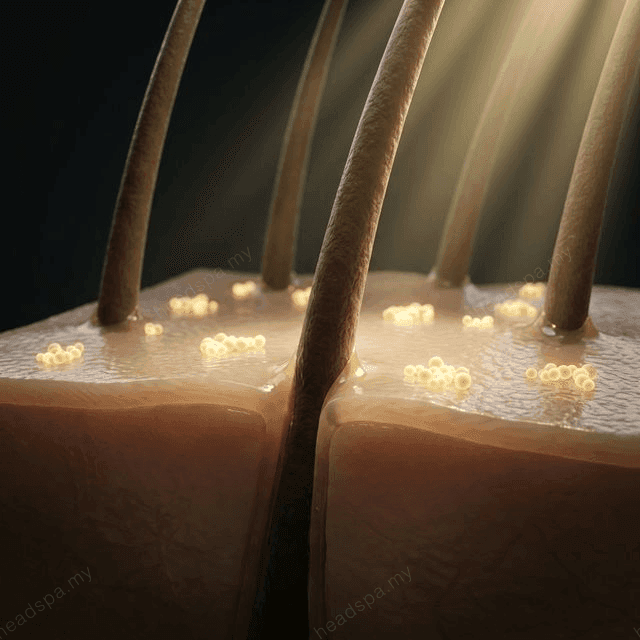
Oily scalp is one of the most frustrating, chronic dermatological complaints among Malaysian professionals. The rapid return of grease within hours of washing is not necessarily a reflection of poor hygiene; rather, it is a complex intersection of individual endocrinology and the extreme environmental stress inherent to living in a tropical climate.
When the average outdoor temperature holds steady between 32–34°C, accompanied by 80–90% humidity, human sebaceous glands operate under distinctly amplified parameters compared to temperate zones. Treating this condition requires transitioning from a harsh, daily "strip-and-rebound" routine to a clinical, biological regulation.
What is Sebum and How Does the Sebaceous Gland Function?
To correctly approach an oily scalp, one must first understand what "oil" actually is in a dermatological context. The human scalp is exceptionally dense with sebaceous glands, averaging between 300 to 900 glands per square centimeter.
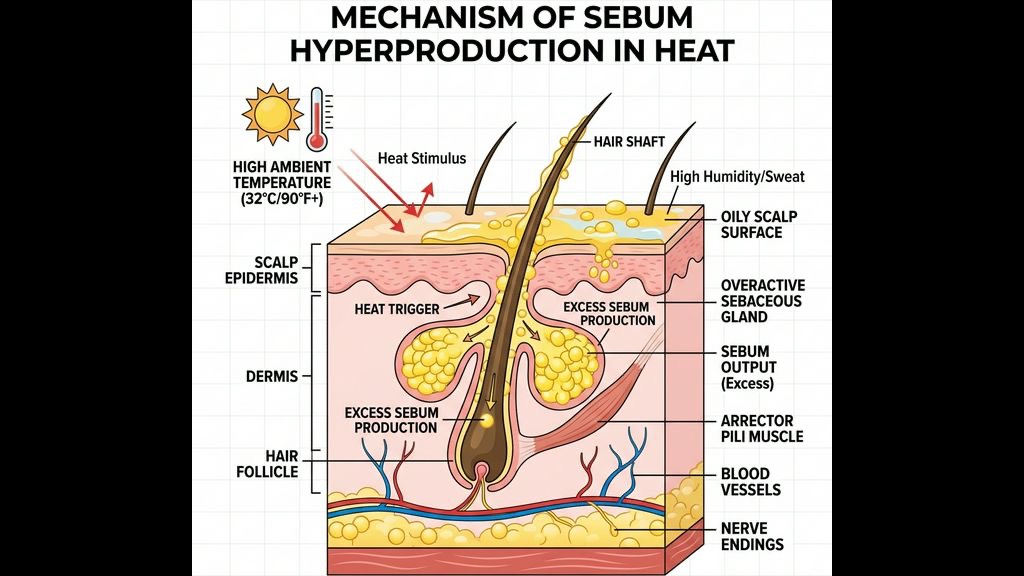
These holocrine glands produce sebum, a complex bio-fluid composed of triglycerides, wax esters, squalene, and free fatty acids. In optimal conditions, sebum is not the enemy. It is a vital evolutionary adaptation designed to coat the hair shaft for waterproofing, provide antioxidant protection (primarily through squalene), and form the crucial acidic mantle that defends against pathogenic microbes.
The sebaceous gland is highly androgen-dependent. Specific receptors on the sebocytes (the cells making up the gland) actively bind to circulating androgens—most notably Dihydrotestosterone (DHT) and testosterone. When androgens bind to these receptors, they signal the sebocytes to rapidly proliferate and ultimately rupture, releasing their lipid contents into the follicular canal and onto the scalp surface. This is why sebum production peaks significantly during puberty and why individuals with genetic sensitivities to DHT often struggle concurrently with hyper-seborrhea and androgenetic alopecia.
Why Does Malaysia’s Climate Accelerate Sebum Production and Oxidation?
The ambient environment plays a profound role in how sebum behaves physically. Research indicates that the sebum excretion rate increases by roughly 10% for every 1°C rise in temperature. Thus, a professional navigating the 32–34°C ambient heat of Kuala Lumpur or Johor Bahru is physiologically primed for massive lipid output compared to someone in an 18°C environment.
Beyond sheer volume, heat critically alters the physical state of the lipids. Specifically, high temperatures drastically reduce the viscosity of sebum. Rather than remaining as a protective, semi-solid wax coating near the base of the hair, the heated, liquified sebum spreads rapidly along the hair shaft and coats the entire scalp surface. This creates the characteristic limp, flat, and aggressively "greasy" appearance mere hours after the morning shower.
Furthermore, this liquified lipid layer is highly unstable. When exposed to the intense UV radiation and elevated urban PM2.5 pollution characteristic of the Klang Valley, the squalene in the sebum rapidly oxidizes into squalene peroxide. Squalene peroxide is highly comedogenic and pro-inflammatory. It physically hardens within the follicular follicle, creating deep-seated plugs that standard shampoos cannot dissolve. This oxidized lipid plug acts as an ischemic barrier, depriving the hair bulb of oxygen and accelerating miniaturisation and hair fall.
This rapidly spreading, oxidized lipid soup also provides an essentially infinite food source for *Malassezia* fungi, linking the intense tropical heat directly to secondary complications like severe dandruff and seborrheic dermatitis.
Why Does Over-Washing Create a Vicious "Strip-and-Rebound" Cycle?
The intuitive, immediate response to an oily scalp in Malaysia is to wash it more frequently—often twice or even three times a day using strongly astringent, sulfate-heavy shampoos. This approach provides immediate, satisfying relief, but profoundly worsens the condition long-term through a process known as reactive seborrhea.
The scalp epidermis relies on a delicate balance of lipids and water to maintain its barrier integrity. When a harsh anionic surfactant (like Sodium Laureth Sulfate) is rigorously scrubbed into the scalp, it does not just remove the excess, oxidized surface sebum. It aggressively strips the intercellular structural lipids (ceramides) and demolishes the protective acidic mantle.
The skin's neurological sensors immediately detect this sudden, catastrophic loss of barrier integrity and the resulting spike in transepidermal water loss (TEWL). Believing the skin is under attack and rapidly drying out, the endocrine system issues an emergency signal to the sebocytes. The sebaceous glands go into systemic overdrive, rapidly pumping out a fresh, excessive surge of sebum to repair the "damage."
By stripping the scalp entirely bare at 7:00 AM, the individual ensures that their sebaceous glands will aggressively overcompensate by 1:00 PM. Thus begins the vicious cycle: wash, strip, rebound, panic, wash again. If you've been trapped in this cycle, professional intervention is necessary to safely exit.
How Can Sebum Production Be Clinically Regulated?
At TTE Elephant Head Spa, we understand that brute-forcing the sebaceous gland with harsh chemicals is a failing strategy. Resolving an oily scalp requires a systematic, biological approach that clears the dangerous oxidized buildup without triggering the rebound mechanism.
The clinical protocol for Oily Scalp involves:
### 1. Removing Oxidized Squalene Peroxide The first step is performing a deep follicular decalcification. Unlike daily sulfate shampoos, our micro-exfoliant complexes target the hardened lipid peroxide bonds deep within the follicle ostia without stripping the surface ceramides.
### 2. Acid Mantle Restoration Immediately following the clearing phase, the scalp must be rigorously re-acidified. By applying pH-calibrated botanical tonics that mirror the natural 4.5–5.5 pH of a healthy acid mantle, we signal to the scalp's neural sensors that the barrier is intact and secure. This actively down-regulates the emergency sebum hyper-production signal.
### 3. Temperature Regulation and Autonomic Calming Recognising the dual triggers of heat and cortisol, our protocol physically integrates structural cooling therapies. Lowering the localized scalp temperature naturally increases sebum viscosity, preventing the rapid spread of oil. Moreover, applying targeted pressure to the vagus nerve afferents shifts the body out of sympathetic dominance, lowering the cortisol spikes that additionally aggravate sebaceous output through the HPA-axis.
Breaking the oily scalp cycle requires patience. The sebaceous glands must be retrained to operate securely. A guided clinical intervention ensures you are not just wiping away today's oil, but modulating tomorrow's production.
Frequently Asked Questions
Q: Should I wash my hair twice a day if I live in KL? A: No, washing twice a day with conventional supermarket shampoos severely strips the scalp's acidic mantle. This triggers a massive compensatory rebound of sebum. It is better to wash once effectively with a balancing, pH-appropriate cleanser, and rely on clinical deep cleansing weekly or bi-weekly to manage oxidized buildup.
Q: Can stress make my hair more greasy? A: Yes. Psychological stress elevates cortisol, which drives the adrenal glands to produce more androgens. These hormones bind directly to your sebaceous glands, ordering them to produce significantly more sebum. Stress management is a crucial, often overlooked, component of treating an oily scalp.
Q: How do you treat an oily scalp differently than just using strong shampoo? A: A strong shampoo only acts superficially to strip surface oil, triggering a rebound. TTE’s clinical protocol removes the hardened, oxidized oil deep inside the follicle without stripping the barrier. We then immediately re-acidify and hydrate the scalp to signal the sebaceous glands to calm down and stop overproducing.
Q: Does diet affect how much oil my scalp produces? A: Certain dietary components, particularly high glycemic index foods and dairy, strongly stimulate Insulin-Like Growth Factor 1 (IGF-1). Increased IGF-1 aggressively upregulates sebaceous gland proliferation, leading to more sebum. A cleaner, low-sugar diet supports a less greasy scalp.
***
References
- Pappas, A., Johnsen, S., Liu, J. C., & Eisinger, M. (2009). *Sebum analysis of individuals with and without acne*. Dermato-Endocrinology, 1(3), 157-161.
- Zouboulis, C. C. (2004). *Acne and sebaceous gland function*. Clinics in Dermatology, 22(5), 360-366.
- Borda, L. J., & Wikramanayake, T. C. (2015). *Seborrheic Dermatitis and Dandruff: A Comprehensive Review*. Journal of Clinical and Investigative Dermatology, 3(2), 10-18.
- Piérard-Franchimont, C., & Piérard, G. E. (2002). *Hair-care products vs seborrhoea and dandruff*. Clinics in Dermatology, 20(4), 438-444.