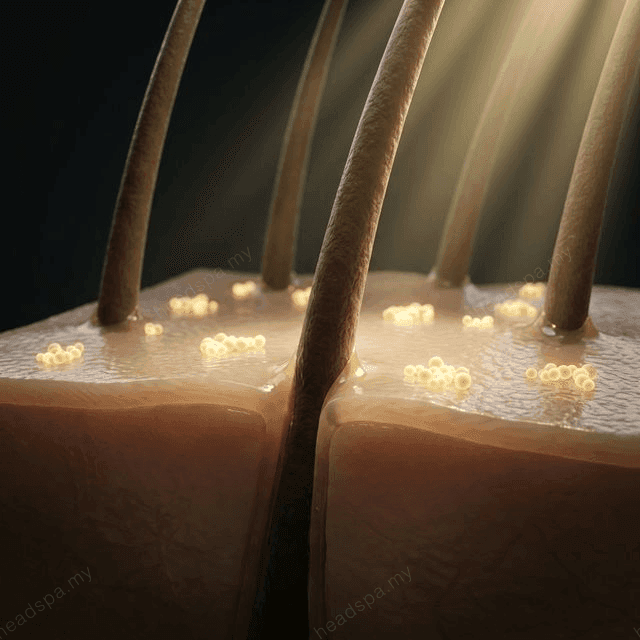
Mont Kiara's expatriate population is estimated at over 30,000 foreign residents — one of the highest concentrations in Southeast Asia outside Singapore. The majority arrive from Europe, Northeast Asia, and temperate parts of North America, bringing with them skin and scalp microbiomes calibrated to climates that bear no resemblance to Malaysia's tropical equatorial environment.
The transition is not cosmetically inconvenient. It is a genuine biological disruption.
Microbiome Acclimatisation: The 3–6 Month Window
The scalp microbiome is a community of bacteria, fungi, and archaea whose composition is shaped over years by climate, water quality, UV exposure, and diet. The dominant fungal species, *Malassezia globosa* and *M. restricta*, maintain stable population ratios in temperate climates — but research by Grice and Segre (2011) in *Nature Reviews Microbiology* established that microbiome composition is highly sensitive to environmental perturbation.
When a European or Korean professional relocates to Mont Kiara, three simultaneous environmental stressors hit the scalp microbiome within weeks. First, relative humidity jumps from 40–60% to 78–85%, creating ideal conditions for Malassezia lipase activity and oleic acid production. Second, UV-B irradiance at 3°N latitude is approximately 3× higher than London at peak hours — accelerating sebum oxidation and generating reactive oxygen species that destabilise the lipid barrier. Third, KL's tap water hardness averages 150–200 mg/L calcium carbonate — significantly harder than many European municipal supplies — and Kataoka (2019) demonstrated that hard water disrupts the scalp's acid mantle (optimal pH 4.5–5.5) by ion exchange, impairing the antimicrobial function that keeps commensal populations balanced.
The combined effect is dysbiosis: an imbalanced microbiome that has lost its temperate-adapted homeostasis but has not yet established a tropical equilibrium. This window — typically 3–6 months post-relocation — is when expats experience the most acute symptoms: oily scalp with simultaneous flaking, unusual hair texture changes, and accelerated shedding.
The Mont Kiara Commute Stress Overlay
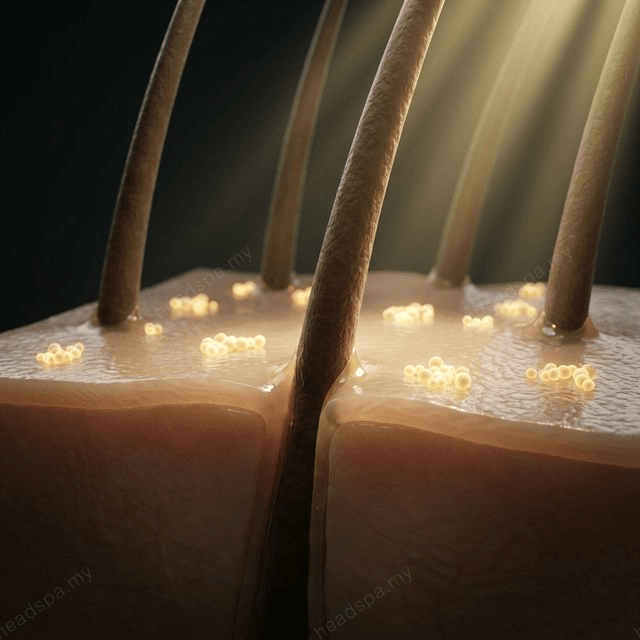
Most Mont Kiara expats are employed in demanding corporate or finance roles — regional headquarters, investment banks, multinational FMCG, and consulting firms with Asia-Pacific mandates. The Sprint Highway and Penchala Link corridor connecting Mont Kiara to KL Sentral, KLCC, and Bangsar is among the most congested in the Klang Valley during peak hours, with average commute times of 45–75 minutes in each direction.
This commute stress adds a cortisol dimension to what is already a microbiome-level disruption. Elevated cortisol suppresses antimicrobial peptide (AMP) synthesis in the epidermis — the chemical first line of defence that limits pathogenic overgrowth on the scalp surface. An expat under high occupational stress with a disrupted microbiome has both a compromised microbial community and a suppressed innate immune response at the scalp — a compounding vulnerability.
Diet Transition: Sebum Production Changes
Malaysian cuisine involves significantly higher levels of refined carbohydrates, spicier food, and coconut-oil-based cooking than most temperate diets. A diet shift toward higher glycaemic load increases insulin-like growth factor-1 (IGF-1) and androgen sensitivity in sebaceous glands, temporarily elevating sebum production. For expats in the first 2–3 months, this dietary transition overlaps with the microbiome disruption window, producing a particularly oily scalp environment that accelerates Malassezia proliferation.
| Environmental Factor | Mont Kiara Expat Context | Scalp Impact |
|---|---|---|
| Humidity: 78–85% RH | Year-round vs 40–60% in home country | Malassezia lipase activity ↑ |
| UV-B: 3× higher than London | Daily exposure, especially on open terraces | Sebum oxidation, lipid barrier damage |
| Water hardness: 150–200 mg/L CaCO₃ | KL municipal supply vs European soft water | Acid mantle disruption (pH ↑ to 6.5+) |
| Sprint/Penchala commute stress | 45–75 min peak hour each way | Cortisol ↑, AMP synthesis ↓ |
| Dietary transition | Higher glycaemic load, coconut-based cooking | Sebum production ↑ transiently |
What Clinical Support Looks Like
Over-the-counter anti-dandruff products formulated for temperate climate microbiomes are largely ineffective for expat dysbiosis in Malaysia. They address *Malassezia* load in isolation without correcting the pH environment, barrier function, or sebum oxidation rate — the underlying drivers.
TTE Elephant at Mid Valley is approximately 15 minutes from Mont Kiara via the Penchala Link. The initial consultation includes trichoscopy mapping — a dermoscopic assessment of follicle density, sebum distribution, and microbiome load indicators — which produces a clinical baseline specific to each client's skin profile. For expat clients, the protocol is adapted to address acid mantle restoration (low-pH botanical serums), Malassezia load reduction (antifungal botanical complex), and barrier lipid replenishment.
Most expat clients who begin treatment within the first three months of relocation complete the acclimatisation process in 6–8 weeks rather than the unassisted 3–6 month window. Regular monthly maintenance thereafter maps microbiome stability as the scalp adapts to the Malaysian environment.
For more on the science of scalp adaptation, read our guides on KL humidity and scalp inflammation and scalp pH in Malaysia, or book a trichoscopy assessment at our Mont Kiara–accessible location.
---
FAQ
Q: How do I know if my scalp problems are from the climate change or from something else? A: The clearest indicator is timing: if scalp symptoms (oiliness, flaking, unusual shedding) appeared or significantly worsened within 2–4 months of relocating to Malaysia, climate-driven microbiome disruption is the primary suspect. A trichoscopy assessment can confirm by mapping your sebum distribution pattern and follicle health markers — both of which shift in characteristic ways during environmental acclimatisation.
Q: Does the hard water in KL permanently damage the scalp? A: Hard water causes reversible acid mantle disruption, not permanent damage. The acid mantle naturally restores to pH 4.5–5.5 when the ionic load is removed — which is why filtered water rinses and pH-correcting serums produce rapid improvement. The concern is sustained hard-water exposure over months without intervention, which can establish a chronically elevated scalp pH that enables *Malassezia* and *Staphylococcus* overgrowth patterns that become harder to reverse.
Q: Is a head spa treatment at TTE Elephant suitable as a first step, or do I need a dermatologist? A: For expat scalp dysbiosis without scarring or severe inflammatory lesions, trichoscopy-guided head spa treatment is an appropriate first intervention. TTE Elephant's clinical advisory panel reviews cases where the presentation suggests underlying inflammatory dermatosis (seborrhoeic dermatitis graded beyond mild) and refers to dermatology partners when indicated. If you are experiencing painful lesions, significant crusting, or rapid hair density loss, a dermatology consultation should run in parallel.