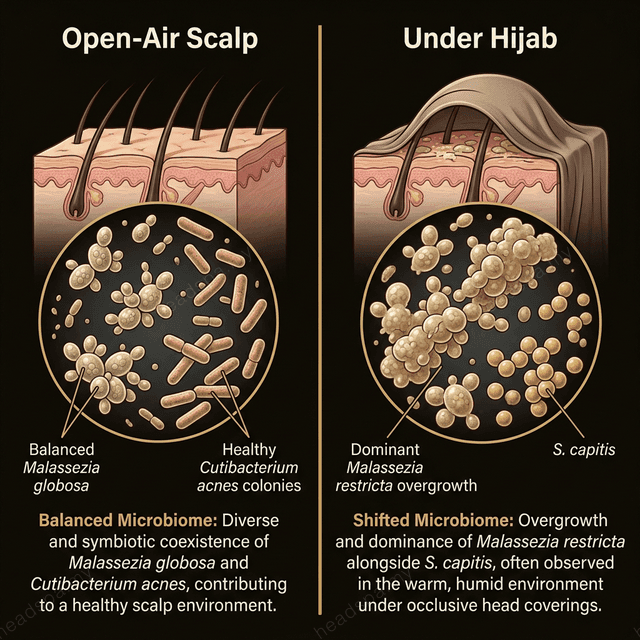
Kuala Lumpur sits at 3°N latitude with average annual humidity of 78–82%. For your scalp, this is not a comfort issue — it is a clinical environment.
The Malassezia Mechanism
Malassezia globosa and restricta are commensal yeasts present on every human scalp. In balanced conditions they are harmless. In high-humidity environments, they proliferate beyond threshold levels, producing lipases that break sebum triglycerides into oleic acid — an inflammatory fatty acid that penetrates the stratum corneum and triggers mast cell degranulation.
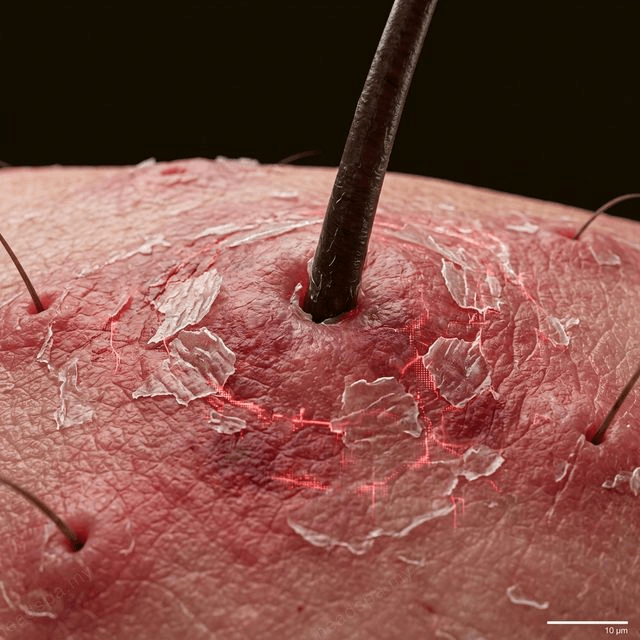
The result: the characteristic scalp itch, flaking, and redness that most KL residents attribute to "dandruff shampoo not working."
Sebum Production Under Humidity Load
Humidity does not reduce sebum secretion — the mechanism is the opposite. High ambient moisture reduces transepidermal water loss (TEWL), signalling the sebaceous gland that the skin is hydrated. But the gland's output regulation is based on lipid saturation signals from the dermis, not surface humidity. The net effect: excess sebum accumulates on the scalp surface without the evaporative regulation that occurs in drier climates.
The Inflammation Cascade
Excess sebum + Malassezia proliferation → oleic acid production → IL-1α, IL-8, and TNF-α cytokine release → follicular inflammation → accelerated shedding of affected hairs.
This cascade explains why many KL residents experience intermittent hair fall that doesn't respond to conventional shampoos: the intervention point is the follicular environment, not the hair shaft.
What Resolves It
Clinical intervention requires antifungal normalisation of the scalp microbiome combined with sebum regulation at the follicular level. Professional head spa protocols with targeted azole-class botanical extracts (Melaleuca alternifolia, Eucalyptus globulus) and enzymatic detox outperform any shampoo because they penetrate the infundibulum — the upper follicle channel where Malassezia colonies establish.