Male hair loss is typically framed as inevitable — a genetic lottery you either win or lose. This framing is both partially true and deeply unhelpful, because it obscures the biological window during which intervention is effective and the environmental factors that accelerate the timeline.
In Malaysia, the combination of equatorial heat, chronic cortisol from high-pressure work culture, and dietary patterns that elevate DHT activity means that many Malaysian men see significant thinning in their mid-20s to early 30s — a decade earlier than the population averages quoted in Western medical literature.
The DHT Mechanism: What's Actually Happening at the Follicle
Androgenetic alopecia — the clinical name for male pattern hair loss — is not caused by testosterone. It's caused by dihydrotestosterone (DHT), a testosterone metabolite produced by the enzyme 5-alpha reductase (5-AR) in scalp tissue.
DHT binds to androgen receptors in genetically susceptible follicles. Over repeated binding cycles, the follicle miniaturises: each hair growth cycle produces a slightly shorter, thinner hair shaft until the follicle eventually produces vellus (fine, colourless) hairs and then becomes non-functional.
- Scalp temperature: Higher scalp temperature upregulates 5-AR activity — more DHT conversion. In Malaysia's 32–36°C ambient temperatures, scalp surface temperatures can reach 36–40°C.
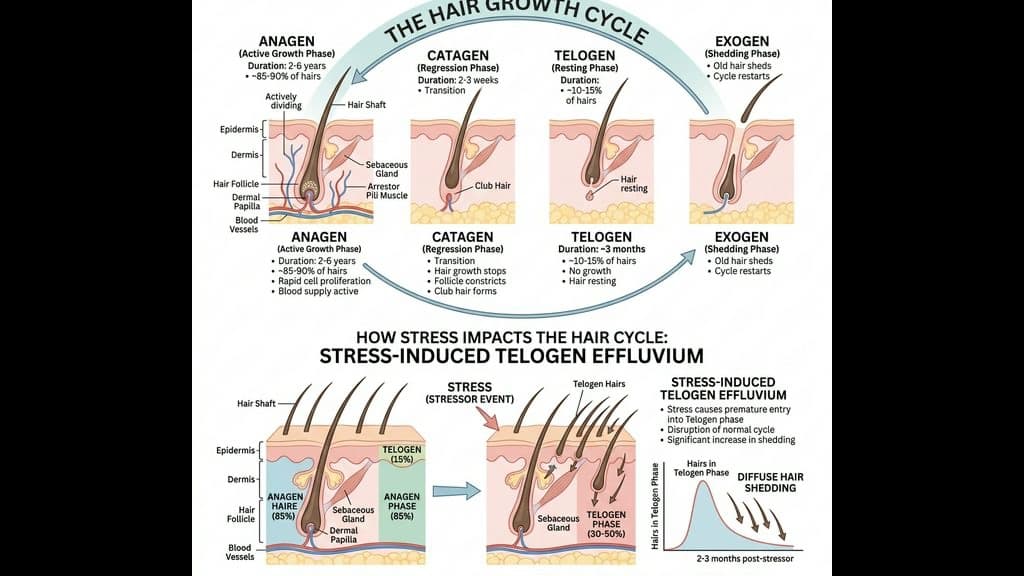
- Cortisol: Chronic stress elevates cortisol, which upregulates 5-AR expression — directly accelerating DHT production in follicles.
- Sebum overproduction: Excess sebum creates a lipid-rich follicle microenvironment that increases Malassezia colonisation — and the inflammation from Malassezia further sensitises follicles to DHT.
The Early Intervention Window
The most critical fact about androgenetic alopecia: you can slow miniaturisation and extend follicle viability, but you cannot reverse it once the follicle becomes non-functional. The intervention window is real — and it's measured in years, not decades.
AI trichoscopy can detect follicle miniaturisation — measurable reduction in hair shaft diameter — before it's visible to the naked eye. This early detection allows intervention while follicles are still in the "miniaturising" phase (recoverable) rather than the "non-functional" phase (not recoverable without transplant).
What Works Biologically (and What Doesn't)
- Minoxidil (topical 5% or oral low-dose): increases follicle blood supply, extends anagen phase. Effective for maintaining existing follicles, not regrowing lost ones.
- 5-alpha reductase inhibitors (finasteride, dutasteride): block DHT production directly. Most effective pharmaceutical intervention. Requires dermatological prescription.
- Rosemary extract (standardised rosmarinus officinalis): RCT-level evidence showing equivalent efficacy to 2% minoxidil at 6 months for diffuse hair loss. Mechanism: improved scalp microcirculation.
- Scalp massage (standardised protocol): 4 minutes daily shown to increase hair shaft diameter measurably at 24 weeks. Mechanism: mechanical stimulation of follicle dermal papilla cells.
Not evidence-based: Most "DHT blocking" supplements and "hair vitamins" lack RCT-level evidence for androgenetic alopecia specifically.
The Scalp Health Foundation
Independent of pharmacological DHT management, optimising the follicle microenvironment creates the best possible conditions for retaining functional follicles:
- Scalp inflammation management (Malassezia control, pH balance)
- Cortisol reduction through nervous system regulation
- Scalp microcirculation improvement
- Sebum normalisation to reduce DHT-amplifying lipid microenvironment
TTE Elephant's hair fall protocol addresses all four biologically — beginning with AI trichoscopy to assess miniaturisation stage and designing the protocol to your specific follicle state.
Book a men's scalp assessment at TTE Elephant KL or JB. Read more in our hair fall condition guide.