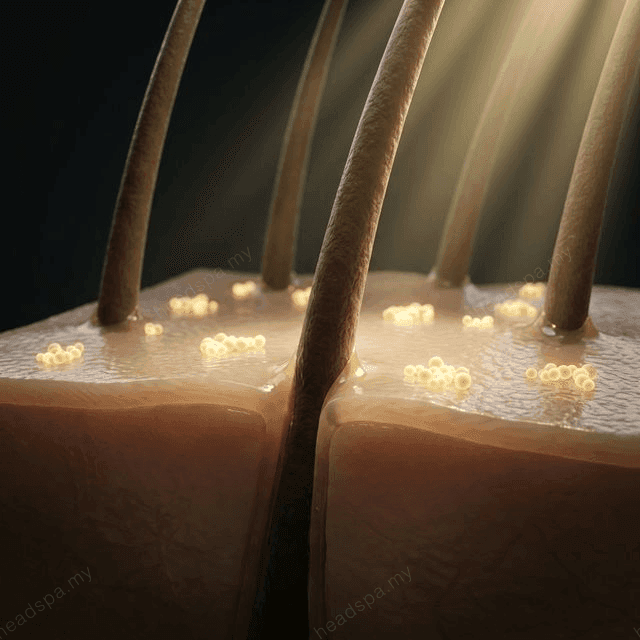
The 2.3-hour daily average commute across the Johor-Singapore Causeway doesn't just cost you time and sleep. It forces your autonomic nervous system into a chronic state of "fight-or-flight," triggering a physiological cascade that ends abruptly at your hair follicle. If you commute from JB to SG and are noticing increased hair fall, you are experiencing the biological reality of the Causeway Cortisol Spike.
The Biology of Commuter Stress !3D cortisol pathway diagram — JB customs anticipatory stress and follicle suppression mechanism
For the hundreds of thousands of Malaysians commuting to Singapore daily, the morning routine is not merely a journey; it is an endurance event of anticipatory anxiety. The unpredictable flow at the CIQ (Customs, Immigration, and Quarantine complex), the rush for the bus link, and the physical pressure of the crowds all stimulate the sympathetic nervous system.
When the sympathetic nervous system is engaged, the hypothalamus signals the adrenal glands to release cortisol. Cortisol is a survival hormone. In short evolutionary bursts, it is highly useful — it diverts energy away from "non-essential" functions (like digestion, immune repair, and hair growth) and redirects it toward muscle readiness and acute alertness.
However, the human body is not evolved to sustain cortisol spikes for 2.3 hours every morning and evening. When the commute becomes a daily baseline, the temporary survival state becomes a chronic physiological condition.
Cortisol and the Hair Follicle Switch
Why does chronic stress make your hair fall out? The connection is not metaphorical; it is a direct biochemical pathway heavily documented in dermatological literature.
Hair growth occurs in cycles. The active growth phase (anagen) is maintained by stem cells in the dermal papilla at the base of the follicle. For these stem cells to activate, they require a specific protein signal called GAS6.
A landmark 2021 study published in *Nature* (Choi et al.) proved that elevated circulating cortisol directly binds to receptors on the dermal papilla, actively inhibiting the production of GAS6. Without this protein signal, the hair follicle stem cells are forced into quiescence (a dormant state).
The hair abruptly shifts from the growth phase into the shedding phase (telogen). This condition is known clinically as Telogen Effluvium. The hair you see accumulating on your shower drain or pillow in your JB apartment did not fall out because you used the wrong shampoo; it fell out because your commuting lifestyle bathed your follicles in a hormone that signaled them to stop growing.
The JB-SG Dual-Environment Trap
The commuter faces a secondary threat beyond cortisol: the extreme environmental transition.
You leave your air-conditioned JB apartment, join the high-heat, high-humidity outdoor queue at the Causeway, board a heavily air-conditioned transit bus, and arrive in a climate-controlled Singaporean office. This creates severe thermal shock on the scalp.
The radical swings in humidity disrupt the scalp's acid mantle. When the barrier breaks down, the sebaceous glands overproduce oil (rebound seborrhea) to compensate for the sudden dryness. This is why JB commuters frequently complain of a scalp that is simultaneously tight, itchy, and aggressively oily by 3 PM.
The Vagal Nerve Reset Protocol
You cannot quit your job in Singapore, and you cannot dismantle the Causeway. But you can biochemically reset the autonomic nervous system that the commute disrupts.
Topical serums and standard salon hair washes do not lower systemic cortisol. To stop stress-driven hair fall, the intervention must reach the nervous system.
At our Eco Botanic head spa in Johor Bahru, specifically accessible to cross-border commuters, the Sleep Healing Headspa protocol targets the exact mechanism of commuter hair loss. By applying sustained, calibrated pressure to the greater occipital nerve at the base of the skull, the protocol stimulates the vagus nerve.
Vagal nerve stimulation acts as the biological brake pedal to the sympathetic "fight-or-flight" state. It forces the body into parasympathetic dominance. Heart rate variability improves, and system-wide cortisol production drops immediately (Bonaz et al., 2018).
Simultaneously, the protocol uses pH 4.5–5.5 amino acid cleansers to rebuild the acid mantle broken by the commute's thermal shock.
Reclaiming Your Biology
The Causeway takes a toll on your biology, but that toll does not have to be permanent. By utilizing targeted vagal nerve stimulation and clinical barrier repair, JB commuters can artificially lower their cortisol load and keep their hair follicles in the active growth phase, despite the demands of the border crossing.
Frequently Asked Questions
Q: Can stress from daily commuting really cause hair loss? A: Yes. Chronic stress elevates systemic cortisol. Cortisol binds to the dermal papilla of the hair follicle and suppresses the GAS6 protein necessary for stem cell activation. This forces the hair prematurely into the shedding phase (Telogen Effluvium).
Q: Why is my scalp so oily after commuting to Singapore? A: The rapid transition between high outdoor humidity at the Causeway and extreme indoor air conditioning causes "thermal shock," which strips your scalp's protective acid mantle. Your body reacts by emergency-overproducing oil (rebound seborrhea) to protect the exposed skin.
Q: Can a head spa fix stress-induced hair loss? A: A cosmetic head spa cannot. A clinical head spa utilizing vagal nerve stimulation (via occipital pressure) can measurably lower systemic cortisol, removing the hormonal block that prevents your hair from growing, while simultaneously clearing the follicular environment.