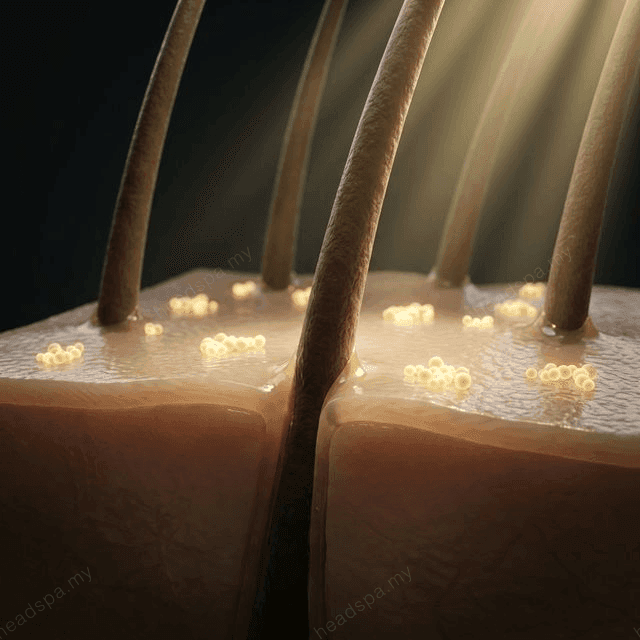
An 8-hour drive on the PLUS highway floods the body with cortisol. This acute stress load triggers neurogenic inflammation, causing the scalp to become highly sensitive, tight, and intensely itchy upon arrival. Standard anti-dandruff remedies are biologically useless against an itch driven entirely by your nervous system.
The Biological Cost of the Exodus !Causeway commuter cortisol stress pathway — 3D diagram of HPA axis activation and follicle suppression
The annual *Balik Kampung* migration is a cornerstone of Malaysian festive culture, but it is also one of the most acute, compressed stress events the human body endures year-round. Sitting stationary in gridlock traffic from Kuala Lumpur to Johor Bahru or Kota Bharu for lengths exceeding 8 to 12 hours places identical physiological demands on the body as a sustained physical threat.
In a clinical context, the primary issue is not just physical fatigue; it is severe autonomic dysregulation. Your body remains locked in a high-alert, sympathetic nervous system state ("fight-or-flight") for almost half a day. Anticipatory anxiety regarding traffic, erratic driving behavior, and managing confined passengers act as continuous triggers for the HPA (hypothalamic-pituitary-adrenal) axis, which relentlessly pumps cortisol and adrenaline into your bloodstream.
How Systemic Stress Translates to Scalp Itch
You arrive at your destination exhausted, but shortly after, you notice your scalp feels incredibly tight. It begins to burn or itch intensely across the crown and the nape of the neck. You run your fingers through your hair, but there are no flakes, no redness, and no signs of dandruff.
This specific sensation is clinically recognized as Sensitive Scalp Syndrome, and in this context, it is driven purely by neurogenic inflammation.
The human scalp has an exceptionally high density of cutaneous nerve endings located mere millimeters beneath the surface of the skin. When your systemic cortisol levels are sustained at peak levels for hours on the highway, cortisol directly lowers the activation threshold of these peripheral C-nerve fibres.
Simultaneously, the continuous flow of dry, recycled air-conditioning in the vehicle accelerates Transepidermal Water Loss (TEWL). The scalp's stratum corneum (the uppermost lipid barrier) dehydrates and develops microscopic fissures. This barrier compromise leaves the hyper-sensitized nerve endings physically exposed to the environment.
The Substance P Cascade
With the nervous system on high alert and the physical barrier breached, the exposed nerve endings violently depolarize. They release a powerful neuropeptide known as Substance P directly into the dense dermal tissue of the scalp.
Substance P bypasses standard immune pathways and binds directly to NK1 receptors on local mast cells in the skin. This binding triggers sudden, massive degranulation. The mast cells rapidly dump histamines, interleukins, and pro-inflammatory cytokines into the surrounding tissue.
The result is a severe, localized pruritus (itch) that originates not from a fungus or bacteria, but as a biochemical echo of the stress you just endured on the highway. Because the fundamental trigger is neurological, attempting to treat this condition with a standard zinc pyrithione or ketoconazole shampoo is not merely ineffective—the harsh surfactants will actively worsen the pain by further stripping the compromised lipid barrier.
From Acute Flare-Up to Chronic Shedding
Understanding the timeline of neurogenic inflammation is vital. If the systemic stress load is not down-regulated, the inflammatory cytokines released by the mast cells (such as TNF-α) begin directly attacking the hair follicle's dermal papilla.
These cytokines create localized oxidative stress that forces the follicle stem cells to arrest their growth cycle. A scalp that begins as tight and itchy during the *Balik Kampung* drive frequently progresses into noticeable stress-induced shedding (Telogen Effluvium) within two to three months as the damaged follicles prematurely eject their hair shafts.
Consequently, clients visiting a head spa in Johor Bahru after navigating the causeway or the PLUS highway must not ignore a tight, 'crawling' sensation on their scalp. It is the leading clinical indicator of imminent follicular distress.
Clinical Down-Regulation of the Nervous System
Intervening in neurogenic scalp itch requires treating the autonomic nervous system, not just the epidermal surface. You must physically brake the HPA axis to stop the release of Substance P.
This is the physiological foundation of TTE Elephant's clinical protocols. The Sleep Healing Headspa intervention focuses on direct parasympathetic activation. By applying deep, sustained, and highly specific pressure to the greater occipital nerve pathways — which share significant anatomical crossover with the vagus nerve system — the treatment forces the body out of sympathetic dominance.
Vagal nerve stimulation measurably reduces the production of systemic cortisol. As cortisol drops, the threshold for peripheral nerve activation normalizes, thereby halting the inflammatory cascade at its neurological source. Simultaneously, customized formulations rich in bio-identical ceramides and low-molecular hyaluronic acid are applied via nano-mist infusion to physically repair the micro-fissures in the stratum corneum, shielding the nerve endings from further environmental triggers.
Addressing commuter stress requires a sophisticated understanding of both neuro-anatomy and scalp biology. True relief comes from commanding the nervous system to stand down.
Frequently Asked Questions
Q: Why does my scalp feel tight and itchy after a long drive? A: Long drives cause acute anticipatory stress, locking your body into a "fight-or-flight" state that produces high levels of cortisol. This stress lowers the activation threshold of the nerve endings in your scalp. Combined with the drying effect of car air-conditioning, these hyper-sensitive nerves release inflammatory neuropeptides, causing intense, flake-free itching (neurogenic inflammation).
Q: Can commuter stress actually make my hair fall out? A: Yes. The inflammatory cytokines released during chronic neurogenic scalp itch actively damage the hair follicle's dermal papilla. This hostile localized environment stunts the growth cycle, forcing follicles to prematurely enter the resting phase, leading to noticeable hair shedding (Telogen Effluvium) roughly 2 to 3 months later.
Q: Will an anti-dandruff shampoo stop a stress-itch? A: No. Standard anti-dandruff shampoos are formulated to kill *Malassezia* yeast. Scalp itch caused by stress has no fungal component; it is driven entirely by mast cells and histamines. The harsh sulfates in anti-dandruff formulas will actually strip your lipid barrier further, exposing the nerve endings and worsening the pain.
Q: How does a clinical head spa treat neurogenic scalp inflammation? A: TTE Elephant treats neurogenic inflammation by targeting the autonomic nervous system. Precision occipital massage stimulates the vagus nerve, which directly lowers systemic cortisol and stops the production of inflammatory neuropeptides. This is paired with ceramide-infusion therapy to physically rebuild the cracked scalp barrier.