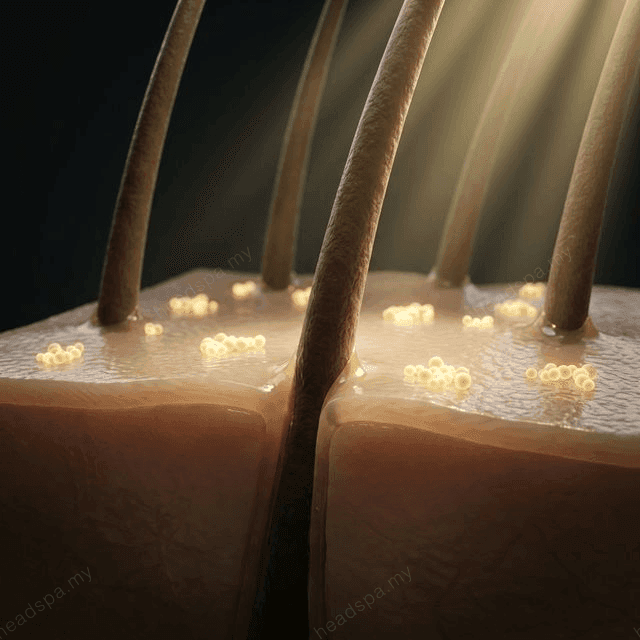
Scalp flaking in Malaysia is almost universally self-diagnosed as "dandruff" — and almost universally self-treated with anti-dandruff shampoo. This misclassification rate is consequential. A significant proportion of Malaysians presenting with scalp flaking have dry scalp, not dandruff. Treating dry scalp with ketoconazole or selenium sulfide strips the already-deficient lipid barrier further, accelerating the condition. Conversely, treating dandruff with moisturising scalp oils provides the lipid substrate that Malassezia requires to proliferate — directly worsening the fungal overgrowth.
Two conditions with near-identical visible symptoms have diametrically opposed treatment requirements. Getting the diagnosis correct the first time is not a minor clinical detail — it is the entire treatment strategy.
Side-by-Side Comparison
The following table presents the discriminating clinical features. No single feature is pathognomonic in isolation — use the pattern across multiple variables to reach a working diagnosis before beginning treatment.
| Feature | Dandruff (Pityriasis Capitis / Seborrheic Dermatitis) | Dry Scalp |
|---|---|---|
| Flake size | Larger, irregular, greasy, yellowish | Smaller, fine, uniform, white |
| Flake texture | Oily, adherent — clumps on hair shaft | Dry, powdery — falls freely from scalp |
| Scalp appearance | Oily, possibly erythematous | Dry, tight-feeling, sometimes slightly red |
| Itch quality | Intense, persistent, burning quality | Mild-moderate, dry, tight sensation |
| Seasonal pattern | Often worse in winter/dry season; can persist year-round | Worse with prolonged air conditioning or low humidity exposure |
| Response to moisturising treatment | Worsens — lipid substrate feeds Malassezia | Improves — barrier repair reduces TEWL |
| Response to antifungal shampoo | Improves — Malassezia load reduced | Worsens — strips already-deficient barrier lipids |
| Scalp oiliness | High — sebaceous hypersecretion is part of the pathology | Low — sebum output is normal or reduced |
| Body sites affected | Scalp + face (nasolabial folds, eyebrows) possible | Scalp only; may co-occur with dry skin elsewhere |
The Biology of Dandruff
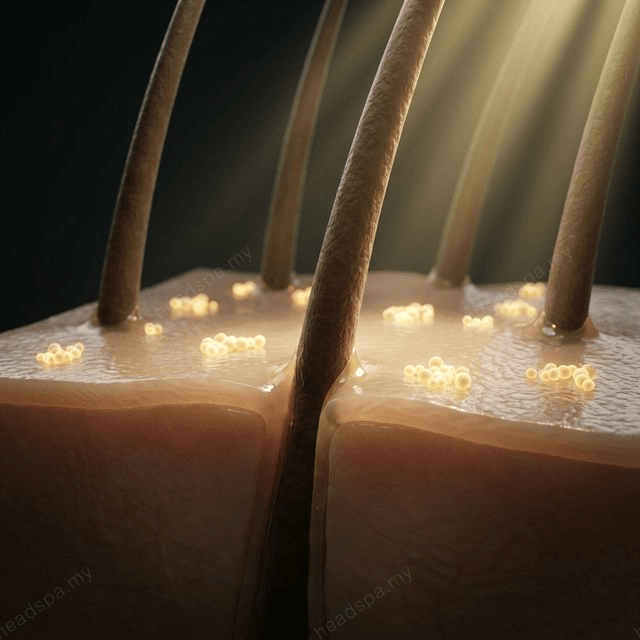
Dandruff is the symptomatic expression of Malassezia activity on a scalp with sufficient sebum substrate and some degree of host immune reactivity. The mechanism, as described by Borda and Wikramanayake (2015), operates through lipase-mediated oleic acid production.
Malassezia globosa secretes a lipase enzyme (MGLI) that cleaves sebum triglycerides into free fatty acids. Oleic acid — one of these cleavage products — penetrates the stratum corneum, disrupting tight junctions and triggering keratinocyte proliferation. This produces the characteristic clumped corneocyte scale. The immune response to Malassezia metabolites involves IgE sensitisation in atopic individuals, explaining why dandruff severity tracks with systemic stress and allergic sensitisation states.
Critically, a dandruff scalp is an *oily* scalp. Malassezia is a lipophilic organism — it requires fat to survive. If your scalp is flaking and oily simultaneously, Malassezia is the more probable driver. If your scalp is flaking and dry, tight, and non-oily, look to the epidermal barrier instead.
The Biology of Dry Scalp
Dry scalp is a primary epidermal barrier dysfunction — specifically, elevated transepidermal water loss (TEWL) from a compromised stratum corneum. Per Elias (2005), the stratum corneum's barrier function depends on its intercellular lipid matrix: a structured arrangement of ceramides, free fatty acids, and cholesterol that regulates water flux and excludes external irritants.
When this lipid matrix is depleted — by over-washing, harsh surfactants, prolonged air-conditioning exposure, or genetic ceramide synthesis deficiency — water evaporates from the skin surface faster than the epidermis can replenish it. The stratum corneum dehydrates, corneocytes lose flexibility, and the surface cracks and flakes. Unlike dandruff, this flaking is not driven by fungal activity or immune reactivity. It is a mechanical failure of the skin's waterproofing system.
There is no inflammatory cascade, no Th17 upregulation, no Malassezia involvement. Treating dry scalp with antifungal actives removes surface lipids that are already critically depleted — the treatment accelerates the pathology.
Why Malaysia's Air Conditioning Problem Is Unique
In temperate climates, dry scalp presents as a seasonal condition driven by winter heating and low outdoor humidity. Malaysia's version of this problem is structural, not seasonal: the country's pervasive air-conditioning infrastructure creates a year-round cycle of barrier disruption.
A Malaysian in KL may move through six or more humidity transitions in a single day — office AC (45–55% RH), outdoor humid air (75–90% RH), commuter train AC, outdoor exposure, shopping mall AC, and residential AC. Each transition imposes an osmotic adjustment on the stratum corneum. Repeated dehydration-rehydration cycling degrades the intercellular lipid matrix cumulatively, even in individuals without genetic barrier weakness. This is a population-level scalp health driver that has no equivalent in non-tropical markets.
Dry scalp from AC exposure is therefore not a minor inconvenience — it is a chronic barrier compromise requiring active maintenance in the Malaysian urban environment.
The Misdiagnosis Cost
The clinical cost of misdiagnosis compounds over time:
Treating dandruff as dry scalp: Applying emollient scalp oils increases lipid substrate availability for Malassezia. Oleic acid production escalates. Flaking worsens. Patients frequently report that their "dandruff got much worse" after using coconut or argan oil on the scalp — this is the precise mechanism, not an allergic response.
Treating dry scalp as dandruff: Ketoconazole and selenium sulfide shampoos are surfactant-based systems with significant barrier-stripping action. Applied to an already-deficient ceramide matrix, they remove remaining surface lipids, dramatically increasing TEWL. Patients report their scalp feeling "even drier and itchier" after anti-dandruff shampoo — correct, and mechanistically expected.
Six months of the wrong treatment will worsen both conditions. The correct diagnosis saves this cost entirely.
At-Home Differential Test
A simple observational test narrows the diagnosis before clinical assessment:
- The oil test: 24 hours after washing, observe the scalp at the part line and temples. If the scalp appears shiny and the hair roots are visibly oily, this is consistent with dandruff (sebaceous hypersecretion + Malassezia). If the scalp appears dry, dull, and non-oily, this is consistent with dry scalp.
- The flake adhesion test: Gently press a piece of dark fabric against the scalp. Dandruff flakes are typically greasy and do not fall freely — they cling to the hair. Dry scalp flakes are powdery and fall freely when the hair is disturbed.
- The moisturiser response test: Apply a ceramide-rich, fragrance-free scalp serum to one half of the scalp for three days. If that half improves significantly while the untreated half remains unchanged, the barrier deficiency model is supported. If there is no improvement or the treated half worsens, fungal activity is the more probable driver.
This self-test narrows the diagnosis but does not replace trichoscopy. See /concerns/dandruff-dry-scalp for the full clinical symptom profile.
Trichoscopy Eliminates the Guesswork
TTE Elephant's trichoscopy assessment identifies the following in a single session:
- Sebum distribution and scalp surface oiliness at follicular resolution
- Presence or absence of Malassezia-associated perifollicular scaling pattern
- Stratum corneum integrity — barrier-deficient scalps display a characteristic inter-follicular crack pattern under dermoscopy
- Erythema and its distribution (generalised vs perifollicular)
This eliminates months of trial-and-error self-treatment. Book a scalp assessment at /headspa-kl (Kuala Lumpur) or /headspa-jb (Johor Bahru). For the related treatment article on managing chronic dandruff in the Malaysian context, see /blog/ketombe-rawatan-malaysia.
FAQ
Q: Can I have both dandruff and dry scalp at the same time? A: Yes, though it requires a specific mechanism. A patient with seborrheic dermatitis can develop a secondary dry scalp condition from over-treating with harsh antifungal shampoos — stripping the barrier while fungal load is reduced. The result is residual barrier dysfunction superimposed on a partially treated fungal condition. This mixed state is best managed with a clinical protocol that addresses both axes simultaneously rather than alternating between incompatible treatments.
Q: I only get flaking in certain areas — what does that mean? A: Localised flaking is more consistent with seborrheic dermatitis, which follows the distribution of sebaceous gland density: crown, vertex, and the frontal hairline. Dry scalp tends to be more diffuse across the scalp surface. If your flaking is concentrated at the crown or temples with oiliness, Malassezia activity is the more likely driver.
Q: Does stress cause dandruff or dry scalp? A: Primarily dandruff. Cortisol elevates androgen receptor sensitivity in sebaceous glands, increasing sebum production — which provides more lipid substrate for Malassezia. Stress also modulates the Th2/Th17 immune balance, increasing reactivity to Malassezia metabolites. Dry scalp is driven by environmental and mechanical factors rather than the neuroendocrine stress pathway. However, stress-induced scratching behaviour can damage the stratum corneum and secondarily worsen a dry scalp condition.
Q: My child has scalp flaking — is it dandruff or dry scalp? A: In children under 12, seborrheic dermatitis is uncommon outside of infancy (cradle cap). Scalp flaking in school-age children is most often dry scalp from frequent washing with adult shampoos containing harsh surfactants, or scalp psoriasis — a distinct condition with thicker silvery-white adherent scale. Antifungal shampoos are not the appropriate first-line treatment in paediatric scalp flaking and should not be used without clinical assessment.
Q: How long does it take to resolve dry scalp with the correct treatment? A: A ceramide-focused barrier repair protocol typically produces visible improvement within 2–3 weeks. Full barrier restoration — as measured by normalised TEWL — takes 4–6 weeks with consistent treatment. In contrast to dandruff, dry scalp does not require ongoing maintenance treatment once the barrier is repaired, provided the trigger (harsh shampoos, excessive AC exposure) is modified. Recurrence is driven by re-exposure to the causative factor rather than the chronic relapsing biology of seborrheic dermatitis.