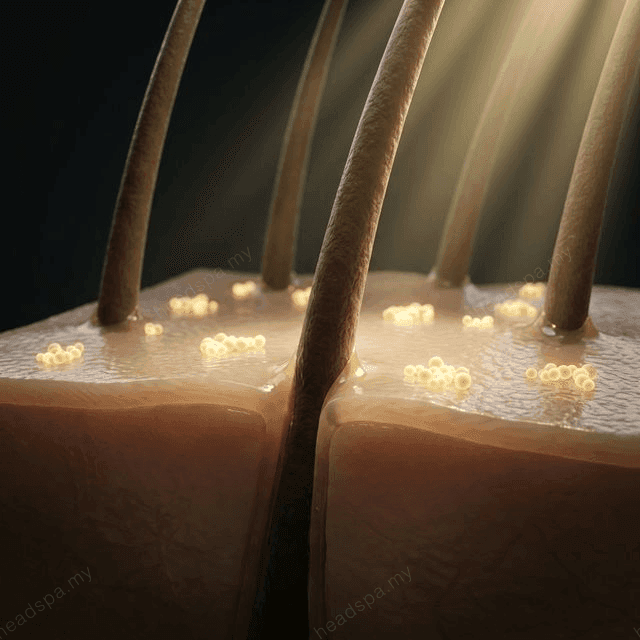
Scalp itch without dandruff is caused by neurogenic inflammation—a stress-driven process where peripheral nerve endings in the scalp release Substance P, triggering histamine from mast cells without any fungal involvement. Standard anti-dandruff shampoos do not treat this condition and typically worsen it by aggressively stripping the epidermal barrier.
Is Scalp Itch Without Dandruff Serious?
When Malaysian professionals experience a chronically itchy, sensitive, or burning scalp but cannot locate any visible flakes, they often feel dismissed by standard dermatological advice that assumes all itch is fungal (dandruff). This specific presentation—pruritus sine materia (itch without a rash or flaking)—is increasingly recognized clinically as Sensitive Scalp Syndrome. It affects approximately 44% of women and 28% of men globally (Misery et al., 2008, Contact Dermatitis), with prevalence rising sharply in populations exposed to high urban pollution loads and chronic psychological stress, such as in Kuala Lumpur.
Treating this condition requires abandoning antifungal shampoos, which will only cause further pain. Instead, we must categorize the inflammation into one of three distinct biological pathways: Neurogenic, Allergic Contact, or Environmental.
What is Neurogenic Inflammation and Why Do Antihistamines Underperform?
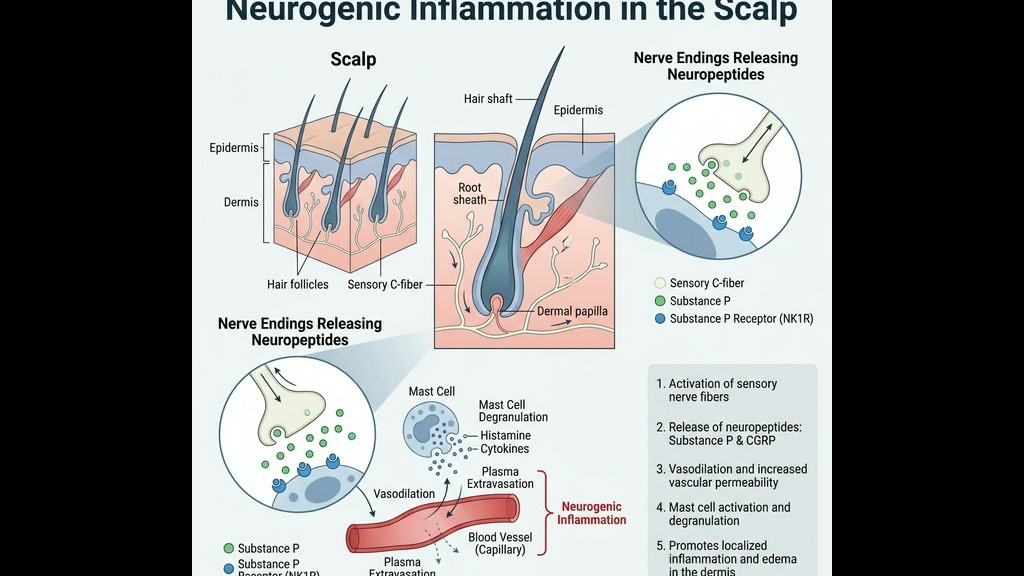
The most complex, yet increasingly common, cause of sensitive scalp in urban Malaysia is neurogenic inflammation. The scalp is densely innervated by a massive network of sensory C-fibers. Under conditions of high psychological stress—such as the daily 75-minute KL commute or navigating relentless corporate deadlines—the autonomic nervous system remains locked in sympathetic ("fight or flight") overdrive.
This chronic systemic stress causes the localized sensory nerves in the scalp to malfunction. The nerve endings spontaneously depolarize and release powerful vasoactive neuropeptides, most notably Substance P (SP) and Calcitonin Gene-Related Peptide (CGRP).
When Substance P is released directly into the scalp tissue, it binds to neurokinin-1 (NK-1) receptors on local mast cells, forcing them to degranulate and dump massive amounts of histamine and pro-inflammatory cytokines (IL-4, TNF-alpha) into the surrounding skin. This creates immediate, intense itching, redness, and a burning sensation.
Crucially, because the histamine release is being forcefully driven entirely by the nervous system (Substance P) rather than a true external allergen, standard over-the-counter oral antihistamines often severely underperform in providing relief. The root mechanism is neurological, not immunological. Attempting to scratch the itch only exacerbates the condition: scratching physically damages the epidermal barrier and mechanically stimulates the C-fibers to release even *more* Substance P, creating a devastating itch-scratch-neuropeptide cycle.
How Does Air Conditioning and PM2.5 Cause Environmental Scalp Shock?
The second major pathway of scalp inflammation in Malaysia is purely environmental, driven by the aggressive transition between outdoor and indoor climates.
Kuala Lumpur's ambient environment features an average temperature of 33°C and a very high relative humidity (RH) of 80–90%. This keeps the stratum corneum (the outermost layer of the skin) naturally hyper-hydrated, swelling the corneocytes. However, when a professional walks into a heavily air-conditioned office tower, the temperature plummets to 18–20°C, and the ambient humidity abruptly crashes to 40–50% RH.
This rapid, extreme shift is known clinically as "humidity shock." The sudden lack of ambient moisture causes the water trapped inside the hyper-hydrated skin cells to rapidly evaporate (a massive spike in transepidermal water loss). The corneocytes shrink violently, causing microscopic fissures—actual physical cracks—in the scalp's protective lipid barrier. When an individual repeats this outdoor-to-indoor transition 2–4 times a day, the barrier never fully repairs.
Once the barrier is fractured, the scalp becomes highly permeable to urban pollutants. The KL Air Quality Index frequently exceeds 100, indicating high levels of PM2.5 (fine particulate matter). PM2.5 is small enough to penetrate these micro-fissures in the scalp barrier. Once inside, the heavy metals and polycyclic aromatic hydrocarbons (PAHs) attached to the PM2.5 trigger severe oxidative stress, recruiting immune cells to the site and initiating a profound inflammatory cascade. The scalp literally becomes inflamed from trying to defend against the polluted air it is now absorbing.
What is Allergic Contact Dermatitis on the Scalp?
The third pathway is iatrogenic—caused by the very products intended to treat the hair. Allergic Contact Dermatitis (ACD) occurs when the scalp develops a delayed type IV hypersensitivity reaction to specific chemical compounds.
- PPD (Paraphenylenediamine): Found in almost all permanent hair dyes, particularly dark shades. It is a highly potent allergen capable of causing severe blistering, weeping eczema, and hair loss.
- Methylisothiazolinone (MI): A common preservative heavily used in "natural" or "botanical" shampoos and conditioners.
- Fragrance Mixes: Synthetic fragrances, even those masking the chemical smell of smoothing treatments, are major triggers for compromised scalps.
When the scalp barrier is already weakened by the environmental humidity shock mentioned above, it is significantly more susceptible to developing these chemical allergies. A chemical that was tolerated for years can suddenly trigger a massive allergic response once the physical barrier breaks down.
How Does the TTE Neuro-Calming Protocol Resolve Inflamed Scalps?
Recognizing that sensitive scalps are fundamentally compromised barriers often driven by hyperactive nerves, TTE Elephant Head Spa approaches Inflamed & Sensitive Scalp treatments with extreme clinical caution. Standard head massage techniques, which rely on vigorous friction, are strictly contraindicated as they will mechanically stimulate the release of more Substance P.
Our neuro-calming protocol operates on three synergistic principles:
- Immediate Barrier Shielding and Decalcification
- Neuro-Receptor Downregulation
- Vagus Nerve Meditated Systemic Calming
Frequently Asked Questions
Q: Why does my scalp itch get worse under air conditioning? A: Air conditioning strips moisture from the air, dropping ambient humidity from Malaysia's natural 90% down to 40%. This rapid humidity crash violently pulls water out of your scalp (transepidermal water loss), cracking the protective epidermal barrier and exposing highly sensitive nerve endings to the air, triggering intense itch.
Q: Can stress cause scalp itching without dandruff? A: Yes, this is called neurogenic inflammation. High stress causes your scalp's nerve endings to release a neuropeptide called Substance P. This chemical forces local mast cells to dump histamine into your skin, creating a severe burning itch even when no fungus or visible dandruff is present.
Q: What is the best treatment for neurogenic scalp itch in Malaysia? A: Treating neurogenic itch requires a dual approach: stopping the local nerve firing and lowering the systemic stress causing it. TTE's clinical protocol applies bio-mimetic lipids to repair the cracked barrier while using vagus nerve stimulation to shift your nervous system out of "fight or flight," effectively halting the release of itch-inducing neuropeptides.
Q: Why don't antihistamines stop my scalp from itching? A: If your itch is neurogenic (driven by Substance P from stress) rather than a true external allergy, the histamine release is being continuously forced by your nervous system. Standard antihistamines struggle to block this massive, continuous internal signaling, which is why neurological calming therapies are required.
***
References
- Misery, L., Sibaud, V., Ambonati, M., Macy, G., Boussetta, S., & Taieb, C. (2008). *Sensitive scalp: does this condition exist? An epidemiological study*. Contact Dermatitis, 58(4), 234-238.
- Steinhoff, M., Ständer, S., Seeliger, S., Ansel, J. C., Schmelz, M., & Luger, T. (2003). *Modern aspects of cutaneous neurogenic inflammation*. Archives of Dermatology, 139(11), 1479-1488.
- Rawlings, A. V., & Harding, C. R. (2004). *Moisturization and skin barrier function*. Dermatologic Therapy, 17(s1), 43-48.
- Denda, M., Sato, K., Masuda, Y., Ohtsubo, T., Suzuki, M., & Kumamoto, J. (1998). *Exposure to a dry environment enhances epidermal permeability barrier function*. Journal of Investigative Dermatology, 111(5), 858-863.