If you delivered in the last 6 months and are watching clumps of hair come out in the shower, you're experiencing one of the most poorly understood postpartum conditions. The internet offers two answers: "it's normal, it stops on its own" and "take these supplements." Both are partially true. Neither explains what's actually happening or what you can do about it.
The Biology of Postpartum Hair Loss
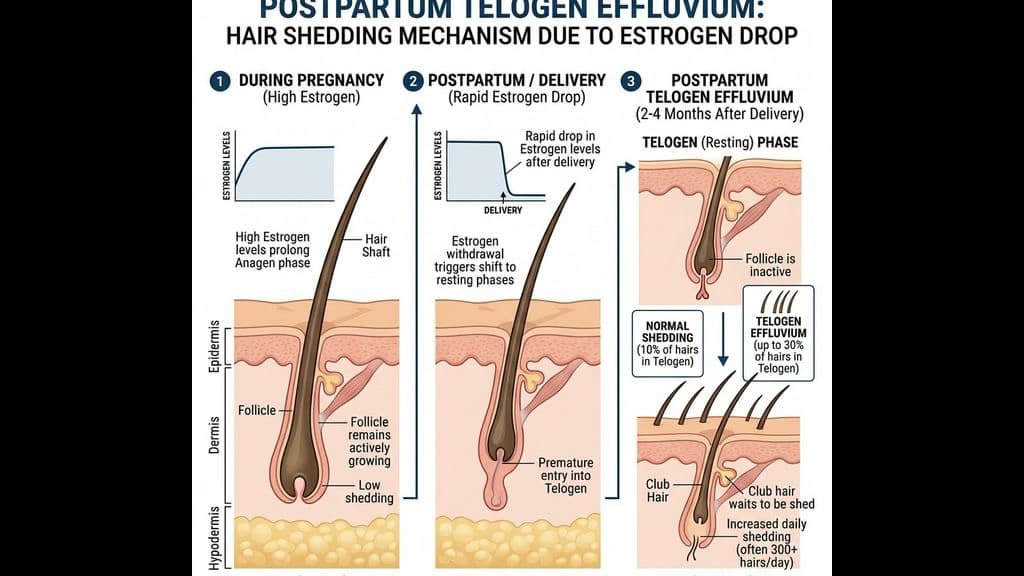
During pregnancy, elevated oestrogen levels extend the anagen (growth) phase of the hair cycle and suppress the natural telogen (resting/shedding) phase. The result: less hair falling out during pregnancy, often giving the impression of "thicker" hair.
After delivery, oestrogen and progesterone levels drop sharply — often by 70–80% within the first week. The follicles that were held artificially in the growth phase now enter telogen simultaneously, creating a synchronised shed event known as telogen effluvium.
The peak shedding period is typically 3–4 months postpartum — the lag reflects the 60–90 day telogen phase duration before the follicles actually shed. Most women see recovery begin around 6 months, with full restoration by 12 months — but this timeline assumes no compounding biological stressors.
Why JB's Environment Extends Recovery Time
Several factors common in the Johor / Iskandar Puteri context can extend or worsen postpartum hair loss:
Nutritional depletion: Breastfeeding requires approximately 500 additional kcal/day and draws heavily on iron, zinc, biotin, and vitamin D stores. In Malaysia, where dietary iron from red meat may be lower in certain communities, postpartum iron deficiency anaemia is more common than typically diagnosed. Low ferritin (<30 ng/mL) is one of the most under-tested causes of prolonged postpartum hair loss.
Cortisol from new-parent stress: The first months of parenthood — especially for families in Iskandar Puteri commuting to Singapore for work — involve severe sleep fragmentation and chronic cortisol elevation. Cortisol directly competes with follicle growth factors, extending the telogen phase and delaying re-entry into anagen.
Humidity and sebum: JB's climate creates the same Malassezia-sebum overgrowth conditions that affect non-pregnant women, but postpartum scalps are additionally compromised by lower oestrogen (which normally has anti-inflammatory effects on the scalp). The result: more inflammation, more dandruff, and a slower follicle recovery environment.
What Actually Accelerates Recovery
Ferritin testing first. Before taking any supplement or starting any treatment, get your ferritin level tested (serum ferritin, not just haemoglobin). Ferritin <30 ng/mL strongly correlates with persistent telogen effluvium. Iron supplementation in genuinely deficient women produces measurable improvement in shed rate within 8–12 weeks.
Scalp circulation therapy. Blood flow to the scalp delivers the nutrient supply that follicles need to complete the anagen transition. Clinical scalp massage with follicle-activating botanical actives (including rosemary extract — studied at equivalent efficacy to 2% minoxidil in one RCT) significantly improves recovery velocity.
Stress-cortisol management. The vagus nerve stimulation protocol in TTE's Sleep Healing Head Spa directly reduces salivary cortisol levels — providing biological support for the follicle environment that nutritional supplementation alone can't achieve.
AI scalp monitoring. Trichoscopy at TTE Elephant provides an objective follicle density baseline — distinguishing between normal postpartum telogen effluvium (temporary, recovery expected) and underlying androgenetic alopecia that was masked during pregnancy (permanent, requires different intervention).
When to Be Concerned
Normal postpartum shed: diffuse thinning, no scalp visibility, recovery begins at 6 months.
See a doctor if: shedding continues past 12 months, you have patchy loss (not diffuse), you see significant scalp skin in bright light, or shedding accelerated rather than improved after 6 months.
Book a postpartum scalp assessment at TTE Elephant JB (Iskandar Puteri) or KL (Mid Valley). Read the full science in our postpartum hair loss guide.