
Hair thinning in your late 30s is driven by an unavoidable biological deceleration: estrogen levels begin to gradually decline. This hormone acts as the primary protector of your hair cycle. When estrogen drops, the active growth phase (anagen) shortens, while sensitivity to miniaturising androgens like DHT increases, causing diffuse thinning.
Why Does Hair Thinning Accelerate After 35?
For most women, their 20s are the peak of hair density and thickness. Oestradiol (the predominant form of estrogen) actively works to keep hair follicles in the anagen (growth) phase for 3 to 7 years. It also functions as a natural counter-balance to testosterone-derived androgens in the scalp.
As you cross age 35 and approach perimenopause, hormonal production in the ovaries subtly shifts. This is not early menopause — it is simply the natural aging axis beginning to tilt. The drop in circulating estrogen means the protective prolonged-growth effect is lost. Follicles that previously spent 5 years growing may now only grow for 3 years before entering the shedding phase (telogen).
Crucially, as estrogen retracts, the underlying androgens in your system are left "unmasked." If you have any genetic predisposition, the 5-alpha reductase enzyme in your scalp more aggressively converts testosterone into DHT (Dihydrotestosterone). DHT binds to the follicle, suffocating the blood supply and progressively shrinking the hair diameter — a process known as follicular miniaturization. A study published in the *International Journal of Molecular Sciences* (2020) demonstrated that this hormonal ratio shift is the primary catalyst for late-30s female diffuse thinning.
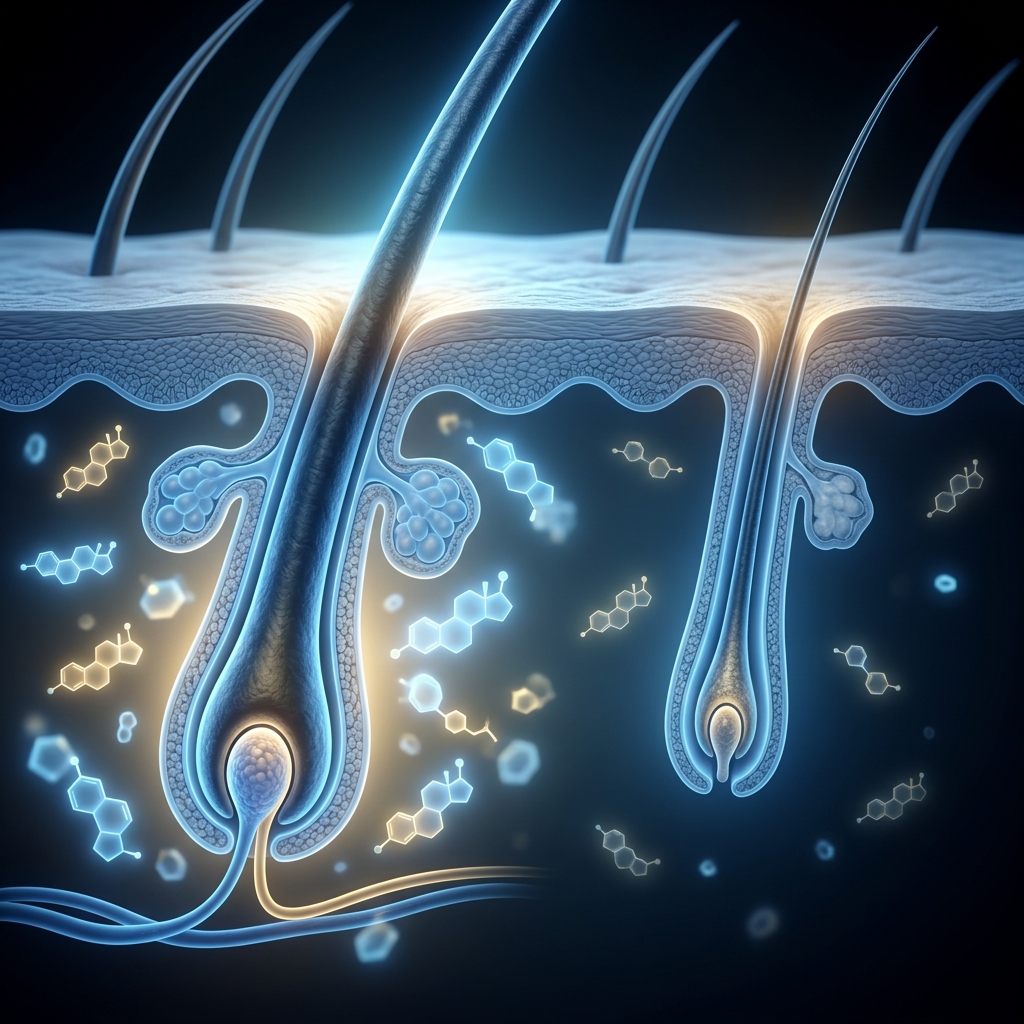
What Happens Inside the Follicle — The Biological Pathway
The architecture of your scalp also begins to age in parallel with your hormones. The dermal papilla — the vascular bundle at the base of the follicle that supplies nutrients — relies heavily on collagen network integrity.
Starting in your 30s, collagen production decreases by roughly 1% per year. The skin of the scalp physically thins. Without a robust dermal matrix, the blood vessels supplying the follicle micro-capillaries become compressed. Between the DHT-driven miniaturisation and the age-related reduction in blood flow, the newly produced hair strand emerges thinner, weaker, and more prone to breakage. What you notice isn't necessarily bald patches, but a widening part line and a ponytail that feels half as thick as it did five years ago.
The Malaysian Factor: Why Commuter Stress Accelerates the 30s Shift
If you live and work in the Klang Valley, your hormonal shift is compounded by severe environmental stressors. 1. The Cortisol Amplification: The average KL commuting professional spending 75 minutes in traffic daily operates under chronic, low-level stress. This continuously elevates cortisol. Cortisol forcefully redirects the body's resources away from non-essential functions (like hair growth) forcing up to 30% of follicles prematurely into the shedding phase. 2. Humidity & Inflammation: KL's constant 80-90% humidity causes continuous sweat and sebum oxidation on the scalp. If the scalp is experiencing inflammation from this oxidised buildup, the resulting immune response damages the follicle bulge, right where the stem cells needed for new hair generation reside.
When you combine a 35+ estrogen drop with corporate KL cortisol levels, diffuse shedding can happen with sudden severity. This is why Hair Fall & Thinning is the most frequent presentation at our head spa for professional women in this demographic.
How Hormonal Thinning is Treated Clinically
You cannot stop the biological clock, but you can alter the microenvironment of the scalp to extend the anagen phase independently of systemic hormones.
Clinical intervention at TTE Elephant begins with trichoscopy to objectively measure the miniaturization ratio. The treatment focuses on deep follicular circulation. Through clinically targeted occipital and temporal massage, we manually stimulate blood flow to the dermal papilla, compensating for the age-related collagen compression. Botanical vasodilators, specifically formulated to lower local scalp inflammation, are pushed securely down into the follicle port. Furthermore, our therapeutic neuro-calming techniques directly target the parasympathetic nervous system, actively down-regulating the stress-cortisol response that worsens shedding.
This is why masking the issue with styling products is not a solution. The root cause requires structural scalp rehabilitation, guided by the Korean headspa ritual methodology.
Frequently Asked Questions
Q: Is it normal to lose so much hair in my late 30s? A: Yes, it is highly common. Subtle drops in estrogen paired with age-related collagen loss cause diffuse thinning. Between 30-40% of women experience significant volume reduction during perimenopausal shifts.
Q: Can stress worsen hair thinning at this age? A: Absolutely. High cortisol from career and family stress disrupts the HPA axis, suppressing follicle stem cells. When combined with an estrogen drop, the shedding phase is dramatically accelerated.
Q: Will taking biotin supplements regrow my hair? A: Supplementation only works if you have a clinical deficiency. For hormonal thinning in your 30s, the issue is follicular miniaturization and shortened growth cycles, not a lack of biotin. You need topical scalp stimulation and inflammation control.
Q: What is the best treatment for late-30s hair thinning in Malaysia? A: A clinical approach that combines trichoscopy diagnostics with targeted dermal blood flow stimulation. At TTE Elephant, we focus on offsetting hormonal changes by improving the physical microenvironment of the follicle and reducing cortisol through our specialised protocols.