A salon head spa washes the hair shaft with aromatic products. A clinical head spa diagnoses the follicular environment with 200× trichoscopy before selecting a protocol. The biological difference between these two services determines whether your scalp actually heals or simply smells pleasant for 24 hours.
Why the Confusion Exists !Clinical trichoscopy scalp diagnosis — differentiating head spa protocol from standard salon treatment
The term "head spa" has entered the Malaysian wellness vocabulary rapidly. As of early 2026, over a dozen establishments in Kuala Lumpur alone now offer some version of a "head spa" service. The explosive popularity is driven largely by Korean beauty culture and TikTok aesthetics, but this rapid adoption has created a fundamental market confusion: the same label is being applied to radically different biological interventions.
At one end of the spectrum, a salon head spa is an extension of a standard shampoo-and-blow-dry service. The client reclines, a pleasant-smelling product is applied, the scalp is massaged for 15 to 20 minutes, the hair is rinsed and styled. The experience is enjoyable, the hair feels temporarily softer, and the client leaves satisfied with the sensory experience.
At the other end, a clinical head spa is a structured, multi-step diagnostic and treatment protocol. The scalp is examined under magnification before any product touches the skin. The treatment selection is determined by the diagnosis, not by the menu. The protocol targets the living root and the stratum corneum barrier, not the dead hair shaft.
Both are called "head spa." They are not the same service.
What a Salon Head Spa Actually Does to Your Scalp
To understand the limitation of the salon model, we must look at the biology of what occurs during a standard in-basin treatment.
When you sit in a salon shampoo chair and a therapist applies a conditioning mask or scalp serum, the product interacts almost exclusively with the hair shaft — the dead, keratinised protein strand projecting above the skin line. The cuticle layer of the shaft absorbs silicone-based conditioners, which coat the exterior surface and create temporary smoothness and shine by filling microscopic gaps between cuticle scales.
However, the hair shaft is dead tissue. It has no metabolic activity, no blood supply, and no capacity to regenerate. Any product applied to the shaft is a cosmetic coating, not a biological intervention. The moment the coating is washed away (typically within 2 to 3 washes), the shaft returns to its baseline damaged state.
The Follicular Funnel — Where Scalp Problems Actually Live
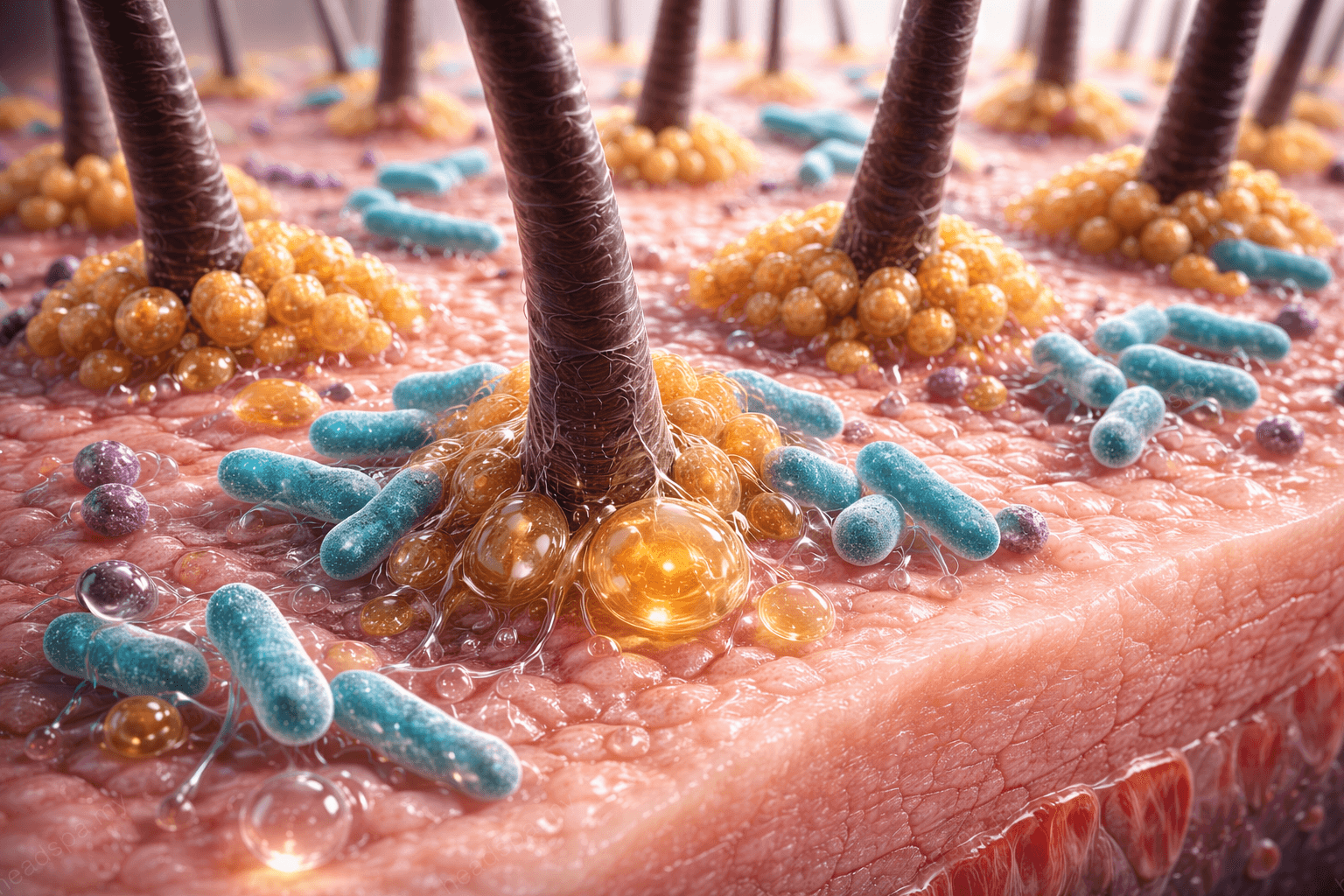
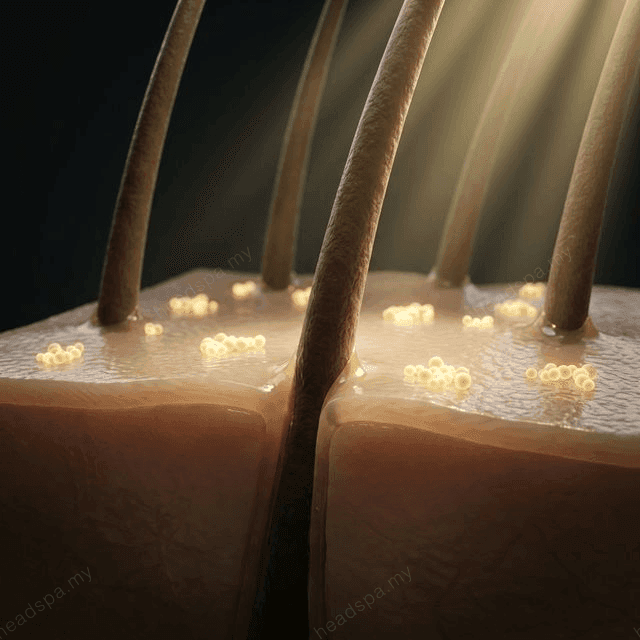
The actual biology generating your hair — and the origin of every scalp condition — exists below the skin surface, inside the follicular funnel. This is a microscopic channel extending approximately 4mm into the dermis, housing the sebaceous gland, the arrector pili muscle, and the dermal papilla (the stem cell reservoir that produces the hair).
Oxidized sebum (squalene peroxide), *Malassezia* biofilm, product residue, and dead stratum corneum cells accumulate inside this funnel over time. In Malaysia's 80–90% humidity environment, this accumulation is accelerated dramatically. These blockages are the direct cause of conditions like scalp concerns including follicular inflammation, hair miniaturisation, and rebound seborrhea.
A salon shampoo — regardless of how premium the product — cannot penetrate 4mm into a blocked follicular funnel. The surfactant sits on the surface, interacts with the exposed oil layer, and is rinsed away. The deep blockage remains entirely undisturbed.
Trichoscopy: The Diagnostic Foundation
This is the fundamental differentiator. A clinical head spa begins with 200× magnification trichoscopy — a non-invasive optical examination that visually maps the condition of your follicles across multiple zones of the scalp.
- Perifollicular scaling (indicating active *Malassezia* infection)
- Sebum plug density (the degree of follicular occlusion)
- Vascular patterns (erythema indicating active inflammation)
- Hair shaft diameter variation (early-stage miniaturisation from DHT)
- Follicular unit density (the number of active hairs per follicular opening)
This data determines the treatment protocol. A client presenting with dense perifollicular biofilm requires enzymatic dissolution; a client presenting with vascular erythema but no biofilm requires anti-inflammatory ceramide infusion. Applying the same "relaxing scalp mask" to both clients — as a salon model would — is biologically equivalent to prescribing the same medication for two entirely different diseases.
Why the Salon Model Creates a Dependency Loop
The salon model inadvertently creates a cycle of repeated visits without resolution. Here is the mechanism:
Most salon scalp products use anionic sulfate surfactants (Sodium Laureth Sulfate or similar) at pH levels between 6.0 and 7.5. These surfactants effectively strip the surface oil but also destroy the scalp's acid mantle (the thin, acidic lipid film that functions as the primary antimicrobial barrier).
The scalp's acid mantle operates optimally at pH 4.5–5.5. When it is stripped, two cascading failures occur. First, the sebaceous glands detect the absence of surface lipid and respond with emergency overproduction (rebound seborrhea), making the scalp oilier than before the wash within 24 to 48 hours. Second, the elevated pH allows *Malassezia* populations to proliferate more aggressively, worsening dandruff and itch.
The client perceives that the salon treatment "worked for a day but then the problem came back," prompting another booking. This cycle benefits the salon's revenue model but never addresses the root cause. Understanding Scalp Biology is the key to breaking this dependency.
The Clinical Head Spa Protocol
A clinical head spa inverts this model entirely. Treatment follows diagnosis, not menu selection.
At TTE Elephant, the protocol operates in distinct biological phases. After trichoscopic assessment identifies the specific follicular pathology, enzymatic exfoliants are applied to chemically dissolve the oxidized sebum plugs inside the follicular funnel. Unlike abrasive scrubs (which create micro-tears on already inflamed tissue), enzymatic formulations work biochemically — dissolving the intercellular lipid mortar binding the blockage without physical trauma.
Once the funnel is cleared, the scalp environment is reconditioned using pH-calibrated amino acid cleansers engineered at 4.5–5.5. This immediately restores the acid mantle, shutting down both rebound seborrhea and fungal proliferation. For residents seeking a head spa in Kuala Lumpur, this is the critical distinction: the scalp's defense system is rebuilt, not stripped.
Finally, the autonomic nervous system is addressed. Scalp conditions like neurogenic itch and cortisol-driven hair fall cannot be resolved topically. TTE's Sleep Healing Headspa incorporates targeted occipital pressure designed to stimulate the vagus nerve, measurably reducing systemic cortisol. This neural component is entirely absent from salon-model services, which focus exclusively on the epidermis.
The Test: How to Know Which Service You're Getting
Before your next booking, ask two questions:
- "Will you examine my scalp under magnification before selecting a treatment?" If the answer is no, you are receiving a cosmetic wash, not a diagnostic service.
- "What pH is the cleanser you use?" If the therapist cannot answer, or if the pH is above 6.0, the product will strip your acid mantle and trigger rebound oiliness.
A clinical head spa is defined by the process, not the price tag. The protocol begins with the question "What is biologically wrong?" — not "Which mask smells best?"
Frequently Asked Questions
Q: Is a head spa the same as a hair salon scalp treatment? A: No. A salon scalp treatment applies cosmetic products to the hair shaft and scalp surface, providing temporary relief. A clinical head spa uses trichoscopic diagnostics to examine the follicular environment at 200× magnification, then selects a treatment protocol based on the specific biological condition identified.
Q: Why does my scalp get oily again so fast after a salon wash? A: Most salon products use alkaline sulfate surfactants that strip the scalp's acid mantle. Your sebaceous glands detect the missing lipid layer and aggressively overproduce oil (rebound seborrhea) as a defense mechanism. A clinical head spa restores the acid mantle at pH 4.5–5.5, preventing this rebound cycle.
Q: What is trichoscopy and why does it matter? A: Trichoscopy is a non-invasive optical examination using 200× magnification to visualise follicular health, sebum plugs, microbial biofilm, inflammation patterns, and hair shaft diameter. It is the scalp equivalent of a blood test — it reveals the actual biological condition before treatment begins.
Q: Where can I find a clinical head spa in KL that uses diagnostics? A: TTE Elephant Head Spa uses mandatory 200× trichoscopy as the starting point for every session. The protocol maps follicular health across 10 scalp zones before selecting the specific enzymatic, pH-calibrated, or neuro-regulatory treatment required. No diagnosis, no treatment.