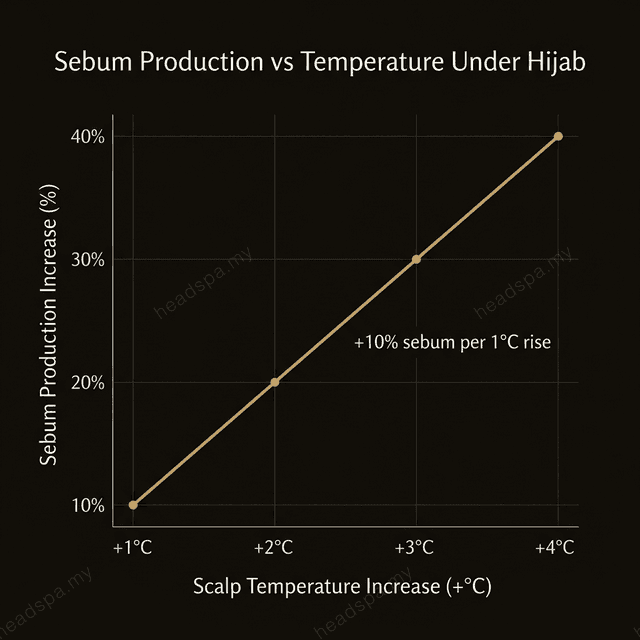
If you are a hijabi woman travelling to Malaysia from Saudi Arabia, the UAE, or Kuwait, there is a high probability your scalp will feel worse within 3–5 days of arrival. More dandruff. More itch. Possibly more odour. You have not changed your shampoo. You have not changed your habits. Your scalp has simply encountered a climate it has never experienced — and Malassezia yeast has taken advantage.
This is not an anecdote. It is a predictable consequence of humidity physics and scalp microbiome biology. Understanding it can prevent you from leaving Malaysia with a scalp problem you didn't arrive with.
The Gulf Scalp vs The Malaysian Climate
- Ambient temperature: 35–45°C (dry heat)
- Ambient humidity: 10–20%
- Hijab microclimate: approximately 33–37°C, 55–70% humidity
- Ambient temperature: 28–33°C (wet heat)
- Ambient humidity: 75–85% year-round
- Hijab microclimate under Malaysian conditions: approximately 36–40°C, 88–95% humidity
The hijab creates an enclosed microclimate regardless of climate. In the Gulf, the low ambient humidity means moisture can dissipate through fabric over time — the microclimate is warm but manageable. In Malaysia, high ambient humidity means there is no moisture gradient for evaporation. Humidity builds and stays.
Why This Triggers Malassezia Overgrowth
Malassezia is a lipid-dependent yeast naturally present on all human scalps. At normal levels, it is harmless. At elevated levels — triggered by warmth, humidity, and sebum availability — it produces oleic acid, which penetrates the scalp barrier, triggers inflammation, and causes the shedding we recognise as dandruff.
Malassezia proliferates optimally in warm, humid conditions: approximately 30°C and 60%+ humidity. Under a hijab in Malaysia, both thresholds are exceeded significantly and persistently. For a Gulf woman whose scalp microbiome has adapted to drier conditions, arriving in Malaysia's humidity is an acute disruption event.
The result within 3–7 days: increased flaking, scalp itch, potential odour from accelerated lipid oxidation, and visible sebum accumulation along the hairline.
This Is Not About Hygiene
This point is important because the symptoms are socially uncomfortable. Scalp odour and visible dandruff can be distressing, particularly when you are away from home. But these symptoms are a direct consequence of a biological microclimate shift — not poor hygiene, not the wrong shampoo, not anything you did incorrectly.
Gulf women who wear hijab daily are already managing a more challenging scalp environment than women in open-hair climates. When that environment collides with Malaysian humidity, the challenge intensifies.
What to Do When You Arrive in Malaysia
- If you have an existing dandruff tendency, consider a pre-trip antifungal shampoo cycle for 2 weeks before departure
- Bring a lightweight scalp toner spray (tea tree, salicylic acid, or zinc-based) for daily use under your hijab
- Wash your hair every 1–2 days rather than your usual Gulf schedule
- Never cover damp hair. In Malaysia's humidity, damp hair under a hijab creates near-ideal Malassezia conditions. Use a cool blow-dry completely before covering
- Wash your undercap daily during your trip — or bring disposable inner caps
- Avoid heavy oils or butters on the scalp during your visit. Malassezia feeds on lipids
The most effective intervention: Book a specialist scalp session at TTE Elephant during your visit. Our Muslimah Scalp Treatment includes an AI Scalp Diagnosis that identifies your Malassezia load, sebum levels, and inflammation markers before any product is applied. The treatment is then calibrated to your specific scalp state — not a generic protocol.
A single session mid-trip or at the end of your visit can reset your scalp microbiome and prevent you from carrying Malassezia overgrowth home.
What About After You Return to the Gulf?
Malassezia overgrowth acquired in a humid environment does not automatically resolve when you return to dry heat. The yeast population, once elevated, can persist for weeks without active intervention. If your scalp symptoms do not improve within 2 weeks of returning home, a dedicated antifungal shampoo protocol (ketoconazole or selenium sulphide, under dermatologist guidance) is worth pursuing.
The good news: your Gulf climate will work in your favour for resolution. Drier air means a less hospitable environment for Malassezia over time.
Why Most Spas in Malaysia Cannot Help
Standard Malaysian head spas — even premium ones — are designed for the local Malaysian scalp profile: a scalp already adapted to high humidity, with a microbiome equilibrated to local conditions. Their protocols are not calibrated for the acute humidity transition that Gulf visitors experience.
TTE Elephant's Muslimah protocol was built specifically around the biology of covered-hair scalps in Malaysian conditions. We see Gulf visitors presenting with acute Malassezia flare regularly, and our assessment-first approach means we treat what is actually happening on your scalp — not what a generic protocol assumes.