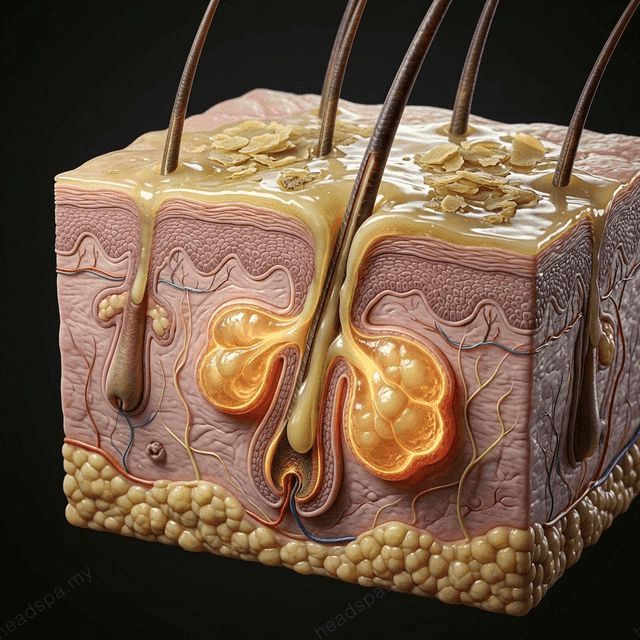
Your KL gym routine is stressing your scalp in ways your trainer has never mentioned. Exercise-induced sweat raises scalp pH from the optimal 4.5–5.5 into alkaline territory, disrupting the acid mantle, enabling fungal overgrowth, and triggering a sebum oxidation process that is chemically identical to rancid cooking oil. In Malaysia's 80–90% ambient humidity, post-workout scalp chemistry deteriorates faster than in any temperate climate — and the damage compounds daily if you don't understand the mechanism.
What Sweat Does to Your Scalp — The Chemistry
Sweat produced during exercise contains lactic acid, urea, ammonia, and sodium chloride. At low concentrations (light activity), lactic acid is mildly beneficial — it functions as a gentle natural exfoliant and supports the scalp's acid mantle. At high concentrations from intense training, the alkaline components (ammonia, urea) dominate, pushing scalp pH from its optimal 4.5–5.5 toward 6.5–7.0.
At pH above 6.0:
- The acid mantle is disrupted, removing the chemical barrier that prevents pathogen adhesion
- Malassezia globosa — the fungal species behind dandruff and seborrheic dermatitis — proliferates more aggressively. At neutral pH, Malassezia enzyme activity that breaks down scalp lipids into inflammatory oleic acid increases by 40–60% compared to optimal pH conditions
- The skin barrier protein filaggrin undergoes degradation, reducing the physical barrier between the environment and the dermis
Non-obvious insight #1: The "gym scalp" odour that develops after regular training is caused by the same biochemical process as rancid cooking oil. Sebum on the scalp is a lipid mixture — when exposed to heat (body temperature during training) and bacterial enzymes, it undergoes lipid oxidation, producing short-chain fatty acids with the same chemical profile as oxidised polyunsaturated fats. The smell is not hygiene-related. It is a chemistry problem.
The KL-Specific Amplification
In temperate climates, sweat evaporates quickly during and after exercise, limiting the contact time of alkaline sweat compounds on the scalp surface. In KL's 80–90% humidity environment, evaporation is severely reduced. Sweat does not evaporate — it sits on the scalp surface, concentrating the alkaline compounds and extending the pH disruption window significantly.
Additionally, KL's typical gym pattern intensifies the problem:
- Outdoor training zones (KLCC park runners, Bukit Kiara trail cyclists, Titiwangsa morning joggers) expose the sweating scalp to ambient humidity of 85–90% plus UV Index 10–12 — ultraviolet radiation on a compromised, alkaline-pH scalp accelerates lipid oxidation beyond what either factor produces alone
- Indoor air-conditioned gyms create a different problem: sweat produced in 23–24°C AC environments does not trigger the same evaporative cooling response, meaning sweating rate is often lower but the concentration of residual compounds on the scalp is higher when training stops
Non-obvious insight #2: The most damaging moment is not during training but in the 30–60 minutes after training before you shower. If you commute, take a coffee, or sit in a meeting before showering, the sweat-sebum mixture dries on the scalp, forming a salt-crystal and oxidised lipid film over the follicle opening. Each training session that ends without prompt scalp cleansing adds another layer to this accumulative deposit.
The Traction Problem: Gym Hair Styling × Scalp Inflammation
Tying hair into a ponytail, bun, or tight top-knot for training is nearly universal. The mechanical tension this creates on the follicle — traction — is the same mechanism behind traction alopecia. Under normal conditions, the follicle can tolerate this tension. Under conditions of active scalp inflammation from sweat-induced pH disruption, the combined mechanical and chemical stress at the follicle opening creates a significantly higher inflammatory load.
The elevated cortisol during high-intensity training (a normal hormonal response to exercise stress) adds a third layer: cortisol suppresses Gas6, the follicle stem cell activation protein, for 1–2 hours post-workout. During this window, follicles that are already under sweat-chemical stress and traction stress are also receiving the molecular signal to remain in quiescence.
Training with your hair tied tightly, in KL humidity, without prompt post-workout scalp cleansing, is applying three simultaneous stressors to your follicles at the moment they are most vulnerable.
The Counterintuitive Good News: Exercise Is Net Positive for Your Scalp
Despite the post-workout sweat problem, regular aerobic exercise is a net positive for scalp health — when the post-workout protocol is correct.
Non-obvious insight #3: Aerobic exercise (running, cycling, HIIT at moderate intensity) triggers a growth hormone and IGF-1 surge that peaks during and immediately after the workout. IGF-1 (insulin-like growth factor 1) is the primary anabolic signal for hair follicle stem cell activation — the same factor that declines with age and stress. Regular aerobic exercisers in KL with a correct post-workout protocol often have measurably better scalp vascularity and follicle density than sedentary peers, despite the sweat challenge.
The determining factor is not whether you exercise — it is what you do in the 60 minutes after training ends.
The Post-Workout Scalp Protocol for KL
Within 30 minutes of finishing training:
- Cool rinse first: A cold or cool water rinse (not full shampoo) immediately post-workout constricts scalp blood vessels and reduces the inflammatory cytokine delivery to follicles during the peak-stress window. This also rinses the majority of sweat compounds before they concentrate.
- pH-balanced cleanse within 60 minutes: A scalp shampoo with pH 4.5–5.5 (check label — most commercial shampoos are pH 5.5–7.0) restores the acid mantle. Avoid sulphate-heavy shampoos post-workout — they overly strip sebum from a scalp that is already lipid-depleted from the sweat session.
- Microfibre dry — not towel friction: The aggressive towel-rubbing commonly seen post-gym creates mechanical micro-abrasion on sweat-softened scalp skin. Microfibre absorption without friction is the correct technique.
- Loose hair after training: If the session is over, release the ponytail or bun immediately. Do not maintain tight styling through cooldown, commute, or any extended period post-training.
Non-obvious insight #4: Cold post-workout showers — popular in the KL fitness community for recovery — are specifically beneficial for scalp health, not just muscle recovery. Vasoconstriction reduces the delivery of inflammatory cytokines (IL-6, TNF-α elevated during intense training) to the scalp microcirculation, shortening the peak inflammation window at the follicle.
When Gym Scalp Becomes a Clinical Problem
Occasional gym-scalp chemistry disruption resolves with a correct post-workout protocol. The clinical presentation develops when the pattern is daily or near-daily training without adequate scalp intervention:
- Chronic seborrheic dermatitis flares concentrated at the hairline and crown (highest sweat density zones)
- Progressive oiliness that worsens with exercise frequency — the scalp is upregulating sebum production in response to chronic barrier disruption
- Hair shedding concentrated in the weeks after increased training intensity (the scalp inflammation spike reaching the follicle cycle 6–8 weeks later)
- Persistent scalp odour that does not resolve with daily shampooing — the lipid oxidation deposit has accumulated below the surface cleanable layer
Non-obvious insight #5: The follicle "fan effect" is observed in competitive endurance athletes. Long-distance runners who train 5+ times per week often have superior scalp blood flow density on trichoscopy compared to sedentary individuals — because the IGF-1 and VEGF released during sustained aerobic activity compensate for the sweat stressor, provided the post-workout cleansing is correct. Exercise itself is not the enemy. The chemistry it creates without intervention is.
TTE Elephant Head Spa's scalp detox protocol addresses the accumulated lipid oxidation deposit and Malassezia overgrowth that develops from repeated training sessions without adequate scalp restoration. The AI scalp scan at both Mid Valley KL and Eco Botanic JB identifies the specific follicle and microbiome state before designing the appropriate intervention. For the full science of sebum and scalp barrier function, see Oily Scalp & Sebum and Scalp Inflammation.
Frequently Asked Questions
Q: How often should I wash my hair if I train daily? A: Daily scalp cleansing is appropriate for daily trainers — but technique and product pH matter more than frequency. Use a pH-balanced (4.5–5.5) scalp shampoo, apply directly to the scalp (not the hair), and ensure the rinse reaches 30–37°C. Avoid hot water post-workout — it dilates blood vessels and extends the inflammatory cytokine delivery window.
Q: Is dandruff worse when I exercise more? A: Yes, and the mechanism is direct. Increased training frequency means more frequent scalp pH elevation events, creating a more favourable environment for Malassezia. If dandruff flares correlate with training intensity increases, the scalp microbiome is the primary target for treatment — not the fungus itself, but the pH and sebum conditions that allow it to overgrow.
Q: Does sweating cause hair loss? A: Sweat itself does not cause hair loss. The scalp chemistry disruption from concentrated alkaline sweat compounds — when left on the scalp surface for extended periods or repeated daily without adequate cleansing — creates perifollicular inflammation that can accelerate the telogen entry rate over weeks to months. The relationship is indirect but cumulative.
Q: What is the best scalp treatment for gym-goers in KL? A: A professional scalp detox that removes the accumulated lipid oxidation layer and restores microbiome balance, combined with a correct post-workout home protocol. TTE Elephant Head Spa at Mid Valley KL and Eco Botanic JB offers this as a targeted intervention for active clients, with AI scalp analysis to assess the current microbiome and barrier state.