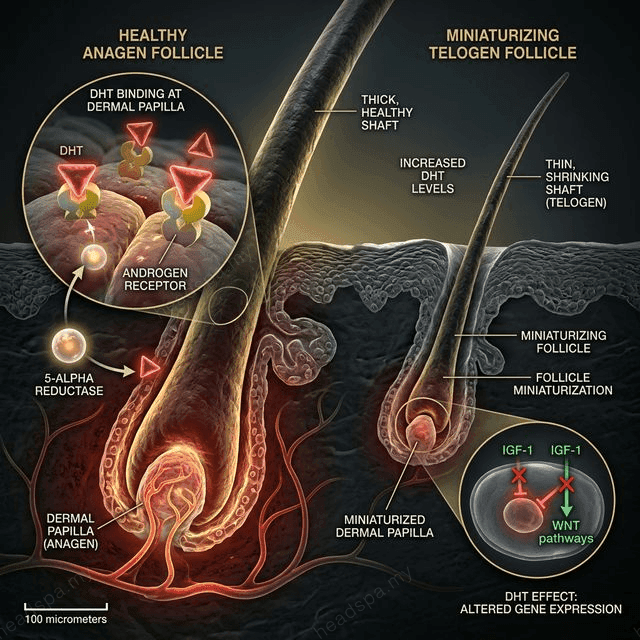
DHT blockers are the most purchased hair loss product category in Malaysia — and the most misused. Most commercially available "DHT blocker" serums target the wrong enzyme isoform, are applied to the hair shaft rather than the scalp dermis, or are bought by people whose hair loss is caused by iron deficiency, telogen effluvium, or thyroid dysfunction — conditions DHT blockers cannot address. Before your next Shopee order, read what the clinical evidence actually supports.
What DHT Actually Is — and Why "Blocker" Is a Marketing Term
Dihydrotestosterone (DHT) is a potent androgen produced when the enzyme 5-alpha reductase (5AR) converts testosterone. DHT binds to androgen receptors in the hair follicle dermal papilla, progressively shortening the anagen (growth) phase with each hair cycle — a process called follicular miniaturisation. The follicle produces progressively thinner, shorter hairs until it produces none.
What "DHT blocker" actually means clinically: You cannot block DHT as a molecule in circulation. What these products attempt is either (a) inhibiting the 5AR enzyme that produces DHT, or (b) blocking the androgen receptor that DHT binds to at the follicle. "DHT blocker" is a marketing simplification of these two distinct mechanisms — and the distinction determines whether a product can actually work for your specific loss pattern.
The key: androgenetic alopecia (genetic hair loss) is DHT-driven. Telogen effluvium, iron deficiency hair loss, thyroid hair loss, postpartum hair loss, and stress-related hair loss are not DHT-driven. Buying a DHT blocker for any of these conditions will produce no measurable effect regardless of how consistently you apply it or how premium the formulation.
The Two Isoforms of 5-Alpha Reductase — Why This Matters
5AR exists in two forms:
| Isoform | Location | DHT contribution |
|---|---|---|
| Type 1 | Sebaceous glands, liver, skin | ~33% of scalp DHT production |
| Type 2 | Hair follicle dermal papilla, prostate | ~67% of scalp DHT production |
Most OTC "natural DHT blocker" products — saw palmetto, pumpkin seed oil, green tea EGCG — primarily inhibit Type 1. They act on the sebaceous gland isoform, not the dermal papilla isoform where the actual follicle miniaturisation occurs. This is why clinical trials on natural DHT blockers show modest, inconsistent results for androgenetic alopecia: they are addressing the wrong target.
Finasteride (prescription) blocks Type 2 specifically — the dermal papilla isoform — and has the strongest clinical evidence for male androgenetic alopecia. Dutasteride blocks both Type 1 and Type 2, showing stronger results than finasteride but with a broader side-effect profile.
Non-obvious insight: Saw palmetto inhibiting Type 1 is not completely useless — it reduces sebum androgen production, which has a mild secondary benefit for scalp microbiome balance. But it is not achieving what most buyers believe they are buying it for.
Minoxidil Is Not a DHT Blocker
This is probably the most common misconception in the hair loss product market. Minoxidil — the most clinically validated hair loss treatment after finasteride — works by vasodilation: it opens potassium channels in blood vessel walls, increasing blood flow to follicles and extending the anagen phase. It does not reduce DHT. It does not inhibit 5AR. It does not touch the androgen pathway at all.
Minoxidil is frequently sold alongside DHT-blocking serums and bundled with DHT blocker marketing, which creates the impression that they share a mechanism. They do not. Minoxidil works on non-DHT-driven hair loss (telogen effluvium, iron deficiency, postpartum effluvium) as well as androgenetic alopecia — precisely because its mechanism is vascular, not hormonal.
If you are using a "DHT blocker + minoxidil" combination product, the minoxidil is doing most of the measurable work.
Rosemary Oil: The Legitimate Outlier
Rosemary oil deserves its own treatment because it has the best clinical evidence of any natural hair loss product — but not for the reason most people think.
Panahi et al. (2015) published a randomised controlled trial in *SKINmed* comparing 2% minoxidil to rosemary oil applied topically for 6 months. Both groups showed comparable hair count improvement at 6 months. Rosemary oil was not inferior to minoxidil.
The mechanism is not DHT blocking. Rosemary oil (specifically its carnosic acid component) works via VEGF stimulation — increasing vascular endothelial growth factor at the follicle level, the same mechanism as professional scalp stimulation. It does not inhibit 5AR. Marketing rosemary oil as a "DHT blocker" is factually incorrect. It works, but not by blocking DHT.
The Shopee Problem: What You Are Actually Buying
Malaysia's Shopee and Lazada hair loss category is dominated by products with ingredient lists citing saw palmetto, biotin, caffeine, and rosemary — with "DHT blocker" as the primary marketing claim. Most of these products:
- Are oil-phase formulations applied to the hair shaft, where absorption into the scalp dermis (where follicles live) is minimal
- Contain the active ingredients at concentrations below the effective doses used in clinical trials
- Cannot distinguish the cause of your hair loss — they are sold as universal solutions for a condition that has five distinct causes requiring different treatments
The average Malaysian spending RM 180–350/month on OTC DHT blocker serums without a professional assessment of the actual cause of their loss is, in most cases, wasting that money.
The Correct First Step: Identify the Cause
Before any treatment, the question is not "which DHT blocker should I buy?" — it is "is DHT even causing my hair loss?" The differential requires:
- Trichoscopy: Visual examination of follicle miniaturisation pattern. DHT-driven loss shows a specific miniaturisation distribution. Telogen effluvium shows different follicle staging.
- Serum ferritin (target >40 ng/mL, not just >12)
- Thyroid panel (TSH, free T4)
- Timeline and trigger history (recent illness, COVID, delivery, major stress event)
TTE Elephant Head Spa uses AI scalp trichoscopy at both Mid Valley KL and Eco Botanic JB to provide a diagnostic baseline before any treatment protocol — specifically to avoid the common pattern of treating the wrong mechanism for months. See Hair Fall & Thinning for the complete diagnostic framework and Scalp Biology for the broader follicle science.
Social Proof With Evidence
Over 195 clients in KL and JB have completed TTE's scalp analysis protocol — the majority of whom had been using OTC hair loss products for 6–18 months before their first professional assessment. The most consistent finding: the cause of loss differed from what they had been treating.
Frequently Asked Questions
Q: Do DHT blockers actually work for hair loss? A: For androgenetic alopecia (genetic hair loss driven by DHT sensitivity), yes — particularly pharmaceutical-grade 5AR Type 2 inhibitors. For other causes of hair loss including telogen effluvium, iron deficiency, thyroid dysfunction, and postpartum hair loss, DHT blockers have no mechanism of action and will not work regardless of quality or dosage.
Q: Is saw palmetto effective for hair loss in Malaysia? A: Saw palmetto shows modest evidence for hair loss in small clinical trials, but primarily inhibits 5AR Type 1 (sebaceous glands) rather than Type 2 (dermal papilla) — the isoform responsible for follicular miniaturisation. The result is inconsistent and generally weaker than prescription alternatives. It is most useful as an adjunct, not a primary treatment.
Q: How do I know if my hair loss is caused by DHT? A: The key indicators are: family history of androgenetic alopecia, gradual progression over years (not sudden), miniaturisation visible on trichoscopy, and patterned distribution (crown thinning in women, hairline recession in men). Sudden onset, diffuse shedding, or correlation with a trigger event (illness, delivery, dietary change, COVID) points away from DHT as the primary cause.
Q: Can women use DHT blockers? A: Some — topical minoxidil is approved and effective. Finasteride is not recommended for premenopausal women due to teratogenicity risk. Post-menopausal women can use it under medical supervision. Natural compounds like saw palmetto are generally considered safe for women but have weaker evidence. The hormonal context for women is significantly more complex than for men, making professional assessment before any DHT-targeting treatment more important, not less.