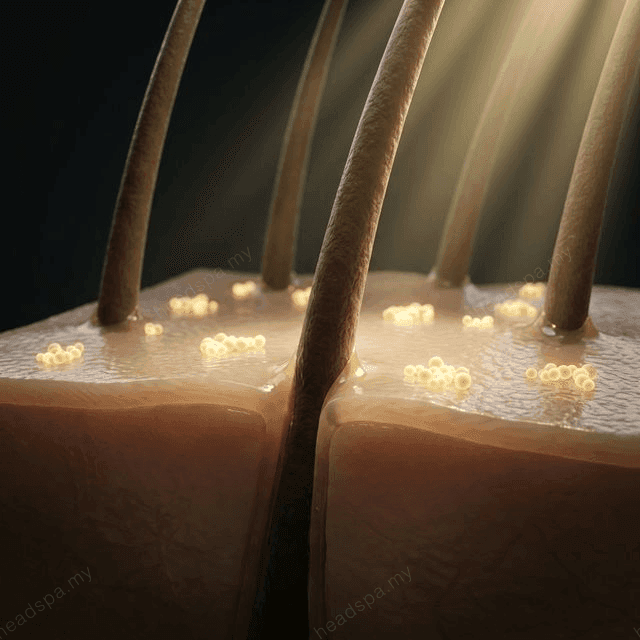
A scalp wrapped under a hijab in Malaysia’s tropical climate faces an extraordinary environmental challenge. The microclimate beneath the fabric immediately increases the localized skin temperature by 2–4°C and traps humidity at near 100%. This extreme occlusion requires specialized, clinical intervention, specifically because standard shampoos and generalized hair salon treatments fundamentally fail to address the three compounded risks: rapid Malassezia proliferation, aggressive sebum oxidation, and mechanically induced traction alopecia.
What is the Science of the "Hijab Microclimate"?
The human scalp functions optimally when it can thermoregulate. It cools itself directly via the evaporation of sweat, maintaining a surface temperature of around 32°C. When a Malaysian Muslimah dons an inner cap (anak tudung) followed by a hijab, she introduces two or more layers of textile over a densely vascularized, actively sweating surface.
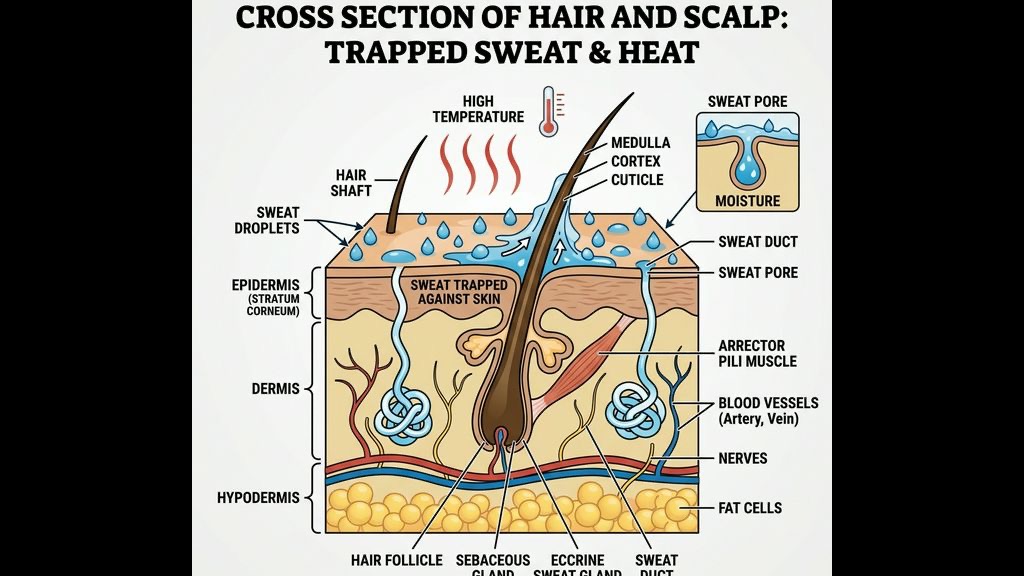
In a tropical environment like Kuala Lumpur or Johor Bahru, where the ambient temperature consistently hovers between 32°C and 34°C, the physics of this covering become severe. The textile layers act as insulators. The localized temperature of the scalp beneath the hijab rises by 2–4°C compared to uncovered skin. More critically, the evaporation of sweat is severely restricted. As the sweat becomes trapped against the scalp, the localized relative humidity (RH) skyrockets from an already high ambient 80% to nearly 100% RH.
This artificial, hyper-humid, and hyper-heated environment is known clinically as an "occlusive microclimate." It completely disrupts the scalp’s natural acid mantle. The trapped sweat dilutes the acidic sebum, dragging the scalp's optimal pH of 4.5–5.5 toward a more alkaline state (around 6.5–7.0). An alkaline, wet, and overheated scalp is the absolute optimal incubator for opportunistic microbial pathogens.
Data highlights the clinical consequences of this occlusion: a 2019 study published in the South East Asia Journal of Public Health (SEAJPH) revealed that hijab-wearing women in tropical climates experience a 2.7× higher frequency of scalp dermatological interventions compared to their non-hijab-wearing cohorts.
How Does Occlusion Cause Rapid Malassezia Proliferation?
The most immediate danger of the hijab microclimate is the explosive overgrowth of *Malassezia* genus fungi. These lipophilic yeasts exist naturally on every human scalp, but they are typically kept in check by the acidic mantle and open airflow.
However, *Malassezia* thrives exponentially in high humidity and elevated temperatures—precisely the conditions created under a hijab. Because they lack the ability to synthesize their own fatty acids, they must consume the sebum produced by the scalp. The 2–4°C temperature rise beneath the fabric drastically reduces the viscosity of scalp sebum, causing it to liquefy and spread rapidly, providing an endless, easily accessible food supply for the fungi.
As *Malassezia* gorges on the trapped sebum, it excretes highly irritating oleic acid. Because the scalp is physically occluded by the inner cap, this oleic acid cannot dissipate. It becomes pressed firmly against the epidermal barrier for 8 to 12 hours a day. This causes profound irritation, triggering the stratum corneum to rapidly shed cells in a desperate attempt to slough off the irritant, presenting clinically as severe dandruff. The constant dampness also macerates (softens) the skin barrier, making it dramatically more susceptible to bacterial superinfections, culminating in painful, pus-filled scalp acne known as Scalp Folliculitis.
What is Traction Alopecia and Why Does the Inner Cap Cause It?
While the microbial issues are invisible, the physical damage inflicted by the structural wear of the hijab is plainly visible along the hairline. Traction Alopecia is the form of gradual hair loss caused primarily by continuous pulling or tension applied to the hair shafts.
For a hijab to remain securely draped and maintain its intended aesthetic, the hair beneath is typically tied tightly into a bun (sanggul), and a tight inner cap (anak tudung) is worn to provide friction against the outer fabric. The continuous, 12-hour-a-day tension exerted by pulling the hair backward into the bun places immense mechanical stress directly on the hair follicles, predominantly affecting the frontal hairline and the temporal regions above the ears.
The hair follicle is anchored in the dermis. Continuous upward and backward pulling causes micro-trauma inside the follicle structure. In response to this trauma, the body mounts an inflammatory immune response around the hair bulb (perifollicular inflammation). Over months and years, if the tension is not relieved, this chronic inflammation destroys the stem cells in the bulge region of the follicle. The follicle slowly miniaturises, producing weaker hair, and eventually scars over completely, rendering the hair loss permanent.
This mechanical damage is often exacerbated by the fact that many women tie their hair while it is still damp to expedite their morning routine. Wet hair has altered hydrogen bonds; it stretches more easily but is structurally weaker. Tying wet hair tightly under an inner cap massively increases the risk of hair shaft breakage (trichorrhexis nodosa) on top of the root trauma causing traction alopecia.
Why Do Standard Salons Fail at Hijabi Scalp Care?
Treating the extreme conditions of the hijab microclimate requires a medicalized understanding of the scalp barrier. When a Muslimah presents to a standard high-street salon with complaints of intense itch, odor, or hair fall, the typical response is to prescribe an aggressive "deep cleansing" sulfate shampoo, followed by a heavy silicone-based keratin mask to temporarily smooth the hair shaft.
This approach is catastrophic for the occluded scalp. Harsh alkaline sulfates completely strip the remaining natural ceramides from the barrier. The skin, sensing it is utterly defenseless, triggers an emergency response to produce a massive wave of protective sebum. When the individual puts her hijab back on, this fresh, massive surge of sebum is immediately trapped in the 100% RH microclimate, oxidized by the heat, and rapidly consumed by the *Malassezia* that survived the wash. The silicone mask further suffocates the follicle ostia, creating an impenetrable plug that traps anaerobic bacteria underneath. The localized odor and itch will return, far more aggressively, within 24 hours.
What is the Specialized Protocol for Muslimah Care at TTE?
At TTE Elephant Head Spa, our dedicated Hijabi Scalp Care protocol recognizes that we are not treating basic oiliness; we are treating a biologically compromised, chronically occluded ecosystem struggling with mechanical trauma.
Understanding the absolute necessity for privacy, aurat is strictly maintained. Our treatments are conducted in completely private, enclosed rooms by female specialists, allowing Muslimah clients to fully uncover and relax without anxiety.
Our clinical intervention focuses on three precise physiological resets:
### 1. Biomimetic Sebum Decalcification We avoid all alkaline sulfates. Instead, we utilize targeted lipophilic exfoliants that specifically dissolve the oxidized squalene peroxide plugs and oleic acid buildup that are suffocating the follicles, without stripping the vital structural ceramides of the epidermis. This clears the runway for healthy follicle function.
### 2. Acidiculation and Microbiome Suppression Because the trapped sweat pushes the scalp alkaline, the immediate clinical objective is to aggressively drag the pH back down. We apply specialized botanical astringents and bio-identical NMFs (Natural Moisturizing Factors) calibrated strictly between 4.5 and 5.5 pH. Restoring this acidic baseline naturally forcefully suppresses the *Malassezia* population, stopping the itch at its biological source rather than just washing away the flakes.
### 3. Neuromuscular Tension Release To counter the physical stress of traction alopecia and the tight inner cap, our protocol integrates sustained mechanoreceptor stimulation along the occipital ridge and the epicranial aponeurosis. This deep tissue, neurologically targeted mobilization physically breaks down the fascial adhesions caused by keeping the hair tightly pulled back for 12 hours. By physically releasing the galeal tension, we drastically improve local microcirculation, ensuring oxygen and nutrients can actually reach the traumatized follicles along the hairline to support Hair Fall & Thinning recovery.
Managing a hijab-wearing scalp in Malaysia is entirely possible, but it requires accepting that the scalp is operating under extreme physical and thermal stress. Professional, clinical maintenance is not a luxury; it is a structural necessity to prevent permanent follicular scarring.
Frequently Asked Questions
Q: Why does my scalp itch so much when wearing a hijab in Malaysia? A: Malaysia’s 32–34°C heat and high environmental humidity get trapped under the layers of your hijab, causing localized temperatures to rise 2–4°C and humidity to reach near 100%. This extreme "microclimate" causes sweat to dilute your scalp's acidic barrier, providing a perfect, hot, alkaline breeding ground for *Malassezia* fungi to rapidly overgrow, which triggers intense itching.
Q: Can wearing a tight inner cap (anak tudung) really cause permanent hair loss? A: Yes, this is known as Traction Alopecia. The constant physical pulling and tension placed on the hair follicles (especially at the front hairline) from a tight inner cap causes micro-trauma and chronic inflammation at the root. Over time, this inflammation destroys the follicle's stem cells, leading to permanent scarring and baldness if not addressed.
Q: Why does my scalp smell sour even after I wash it in the morning? A: The sour odor is caused by the rapid oxidation of your sebum combined with bacterial byproducts. When you put a hijab over damp or freshly washed hair, you trap the moisture. The hot, damp, occluded environment allows specific anaerobic bacteria to rapidly break down your sweat and sebum into short-chain fatty acids (like isovaleric acid), which produce that distinct sour, "cheesy" odor.
Q: Do I really need a special head spa if I already use an anti-dandruff shampoo? A: Commercial anti-dandruff shampoos only treat the surface fungus temporarily, and often use harsh, alkaline sulfates that destroy your scalp's protective barrier. The TTE Hijabi protocol not only clears the hardened, oxidized sebum deep inside the follicle but actively restores the acidic pH your scalp needs to naturally fight off fungus while providing essential tension relief for the follicles damaged by traction.
***
References
- Miteva, M., & Tosti, A. (2012). *Hair and scalp dermatoses*. Journal of the American Academy of Dermatology, 67(5), 1040-1048.
- Billero, V., & Miteva, M. (2018). *Traction alopecia: the root of the problem*. Clinical, Cosmetic and Investigational Dermatology, 11, 149-159.
- Schwartz, J. R., Messenger, A. G., Tosti, A., Todd, G., Hordinsky, M., Hay, R. J., ... & Dawson, T. L. (2013). *A comprehensive pathophysiology of dandruff and seborrheic dermatitis - towards a more precise definition of scalp health*. Acta Dermato-Venereologica, 93(2), 131-137.
- Yeo, S. P., & Hashim, H. (2019). *Prevalence and risk factors of scalp dermatoses among hijab-wearing women*. South East Asia Journal of Public Health, 9(1), 34-40.