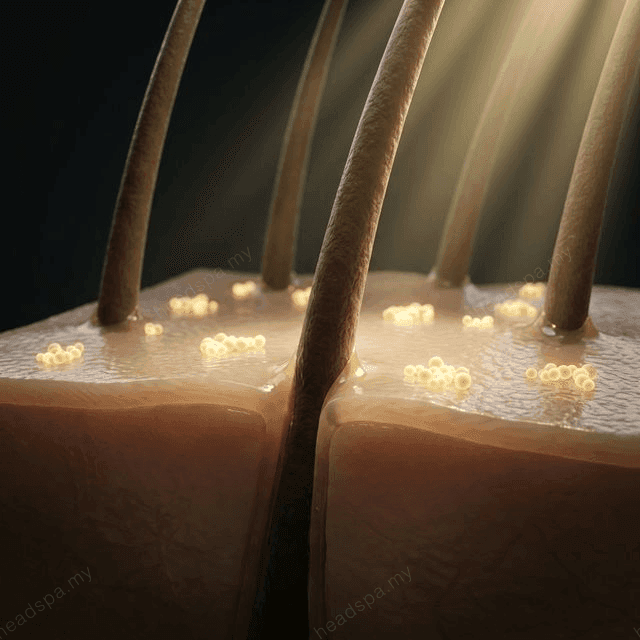
A healthy scalp is not simply defined by the absence of disease—it is not merely the lack of dandruff, oiliness, or shedding. True clinical scalp health is a highly dynamic, actively defended biological state. It represents a perfectly balanced ecosystem operating with an intact epidermal barrier, a regulated microbiome, and optimal blood flow to the dermal papilla.
However, maintaining this state of homeostasis is exponentially more difficult in Malaysia than in temperate climates like Europe or Japan. The relentless 34°C heat, the 90% humidity, and the massive environmental humidity swings caused by ubiquitous air conditioning actively, continuously assault the scalp barrier. Operating on a "reactive care" model—only treating the scalp when it starts itching or shedding—guarantees structural damage over time. Protecting your hair density in this climate requires shifting to a proactive, clinical maintenance protocol.
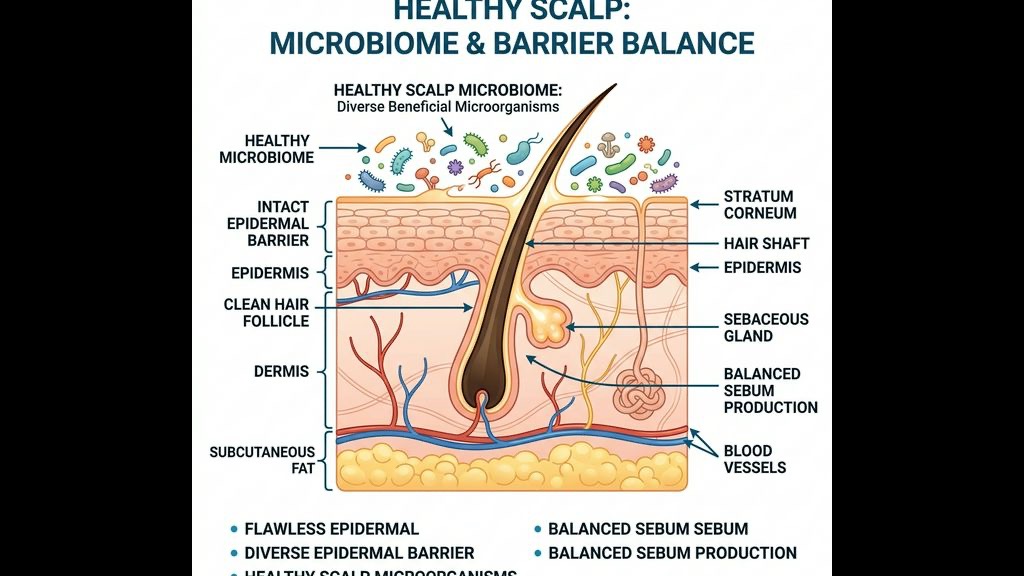
What Does Clinical Scalp Health Actually Look Like?
When evaluating a scalp at TTE Elephant Head Spa, we do not rely on subjective feelings. True health is defined by specific, measurable biological benchmarks visible primarily through 200x magnification trichoscopy.
### 1. The Translucent Epidermis and Peripilar Signs A healthy scalp is visually clean but not stripped dry. Under trichoscopy, the epidermis should appear somewhat translucent, with a pale, slightly pearlescent to flesh-colored hue, completely devoid of any diffuse erythema (redness). The follicular ostia (the openings where the hair exits the scalp) should be clear and open—they should not be choked with hardened, oxidized yellow sebum (squalene peroxide) or surrounded by a thick, white hyperkeratotic ring (built-up dead skin cells).
### 2. The 4.5–5.5 pH Acidic Mantle The foundation of a healthy scalp is its acidic mantle. This is the imperceptible, ultra-thin film composed of sebum, sweat (lactic acid and amino acids), and structural lipids tightly coating the stratum corneum. To activate the enzymes responsible for creating ceramides (the primary mortar holding skin cells together) and to naturally repel pathogenic bacteria, this mantle must maintain a strict pH between 4.5 and 5.5. When Malaysia’s heavy humidity causes excessive sweating, or when harsh alkaline drugstore shampoos are used daily, this pH spikes to 6.5 or above. In an alkaline state, the stratum corneum rapidly disintegrates, and *Malassezia* fungi proliferate aggressively.
### 3. High Microbiome Diversity Index The scalp microbiome is a vast forest of thousands of distinct bacterial and fungal species. In a healthy state, no single species dominates. *Cutibacterium acnes*, *Staphylococcus epidermidis*, and *Malassezia* fungi all coexist, keeping each other’s populations in check. True scalp health is characterized by a "high diversity index." When the ecosystem crashes—usually due to environmental heat stress or using antibiotics indiscriminately—one species rapidly overgrows the others (e.g., *Malassezia* dominating 90% of the flora), directly triggering dandruff or folliculitis.
Why is Maintenance Exponentially Harder in Malaysia?
If you were living in a crisp 18°C environment, your scalp’s baseline lipid production would form a semi-solid, highly protective wax layer near the base of the hair, naturally sustaining the acid mantle and requiring minimal intervention.
In Kuala Lumpur or Johor Bahru, the biological reality is fundamentally different. 1. Liquefied Lipids: At 34°C, your scalp sebum’s viscosity collapses. It liquefies and rapidly spreads out, ceasing to protect the follicle base and instead acting as a vast, highly accessible food source for fungal overgrowth across the entire scalp. 2. Accelerated Oxidation: With high UV indices and high PM2.5 particulate urban pollution, the squalene in your sebum oxidizes into squalene peroxide incredibly fast. This toxic liquid essentially "bakes" into the follicle, hardening into a deep plug that acts as a physical barrier preventing new vellus hairs from successfully emerging. 3. Humidity Shock Fractures: The constant transition from 90% outdoor humidity to 45% office air conditioning physically expands and contracts the corneocytes (skin cells), creating microscopic cracks (micro-fissures) in your acid mantle every single day.
Because the environmental degradation is so constant and aggressive, relying on a basic "shampoo and conditioner" routine is biologically inadequate for maintaining Healthy Scalp parameters.
The 21-Day Stratum Corneum Renewal Protocol
The human epidermis is a constantly renewing organ. New skin cells (keratinocytes) are born in the basal layer and slowly migrate upward to the surface, eventually dying and shedding as the horny layer (stratum corneum). For a healthy adult, this complete cellular journey takes roughly 21 to 28 days.
This biological timeline strictly dictates the required clinical maintenance cadence. If you intervene too often, you strip the barrier before the ceramides have had time to fully form. If you wait too long (e.g., going 3 months between deep cleanses), you allow 3 or 4 complete cycles of dead keratin to pile up, trapping massive amounts of oxidized sebum in the follicles and suffocating the emerging hair.
Therefore, the optimal clinical maintenance cadence for a healthy scalp operating in a high-stress, high-heat tropical environment is once every 21 to 30 days. This is not an arbitrary timeline; it is perfectly aligned with the biological shedding cycle of the human epidermis.
Proactive vs. Reactive Scalp Care
The core philosophy of dermatological maintenance is simple: Prevention is drastically cheaper, faster, and more successful than medical restoration.
By the time you notice significant hair thinning in the mirror, you have already lost 50% of your follicular density in that area. By the time you feel the intense burning itch of inflamed follicles, your immune system has already severely compromised the local stems cells.
Reactive care involves panic: buying harsh, stripping medicated shampoos, rushing for steroid injections, and applying chemical minoxidil in a desperate attempt to force growth from a scarred, inflamed scalp.
- Consistent Follicular Sweeping: Monthly, precise removal of the deeply lodged squalene peroxide plugs *before* they can oxidize enough to choke the hair bulb, ensuring every follicle remains permanently open.
- Continuous Re-Acidification: Actively applying bio-mimetic tonics to drag the pH down to 4.5, denying *Malassezia* the alkaline environment it requires to overpopulate *before* it can trigger dandruff.
- Stress Modulation: Utilizing vagus nerve stimulation consistently to physically suppress systemic cortisol *before* the HPA axis can command the hair follicles to prematurely enter the shedding (telogen) phase.
Partnering with TTE for Long-Term Defense
At TTE Elephant Head Spa, our goal is not just to extinguish the immediate fire of an active scalp infection; our mission is to serve as your long-term, clinical maintenance partner. We provide the deeply targeted, barrier-respecting environmental resets that are fundamentally impossible to achieve in a home shower.
Living and working in Malaysia requires accepting the environmental load placed upon your biology. However, by adhering to a scientifically validated, monthly clinical maintenance protocol aligned with your body’s natural cellular renewal rate, you can completely secure the foundation of your hair for decades to come.
Frequently Asked Questions
Q: How often should I get a clinical head spa if my scalp is mostly healthy? A: If no active disease (severe dandruff or severe hair fall) is present, the biological gold standard is once every 21 to 30 days. This perfectly synchronizes with the natural 28-day cellular turnover rate of the human epidermis, clearing out the accumulated dead keratin and oxidized sebum right as a new layer of skin establishes itself.
Q: Why do I need a head spa if I use expensive, professional shampoo at home? A: Even the world's most expensive daily shampoo cannot safely dissolve the deeply hardened, oxidized sebum (squalene peroxide) lodged deep inside the follicle ostia without using harsh chemicals that would simultaneously destroy your surface barrier. TTE uses specialized, micro-exfoliant bio-enzymes to perform a deep follicular sweep that superficial daily washing cannot achieve.
Q: How do I know if my scalp's pH is unbalanced? A: The most immediate signs of an alkaline pH shift are the sudden onset of mild but persistent itching, the hair feeling unusually rough or porous at the roots, a noticeable increase in rapid sebum production (greasiness within 12 hours of washing), or a sour odor caused by opportunistic bacteria digesting your sweat.
Q: Is it normal for my scalp to feel completely tight and "squeaky clean" after a wash? A: No. A "squeaky clean" feeling indicates that you have completely stripped away all of your structural ceramides and destroyed the acidic mantle. A clinically healthy, perfectly balanced scalp should feel exceptionally clean but distinctly supple, hydrated, and absolutely free of any tight, pulling sensation.
***
References
- Ali, S. M., & Yosipovitch, G. (2013). *Skin pH: from basic science to basic skin care*. Acta Dermato-Venereologica, 93(3), 261-267.
- Sinclair, R. (2015). *Healthy Hair: What Is it?*. Journal of Investigative Dermatology Symposium Proceedings, 14(1), 2-5.
- Kligman, A. M., & McGinley, K. J. (1989). *Colonization of the stratum corneum by sebum-dependent Malassezia species*. Journal of Investigative Dermatology, 92(4), 540S-543S.
- Elias, P. M. (2005). *Stratum corneum defensive functions: an integrated view*. Journal of Investigative Dermatology, 125(2), 183-200.