Raya is over.
The open houses are winding down. The baju kurung has been folded away. The balik kampung traffic jams are a memory. And somewhere between the third day of ketupat and the sixth relative's house, your scalp quietly accumulated a month's worth of stress that nobody warned you about.
If your hair is feeling thinner at the temples, your scalp is itchy or flaky, or you're noticing more strands than usual in the drain — this is not coincidence. What happened to your scalp over Ramadan and Raya is well-documented in clinical research. What to do about it is the part nobody tells Malaysian Muslimah women.
This is that guide.
What Ramadan and Raya Actually Do to Your Scalp
Most articles about Hari Raya focus on what you wear, what you eat, and where you go. Very few focus on what happens beneath your tudung during the six weeks spanning Ramadan and the first days of Syawal — and almost none frame it in terms of scalp biology.
Here is what actually happened, in order:
1. Fasting Triggered a Nutritional Stress Response in Your Follicles
During Ramadan, your body fasts between approximately 13–14 hours daily. While this has well-documented spiritual and metabolic benefits, it also creates a predictable pattern of nutritional stress that affects your hair follicles.
Hair follicles are among the most metabolically active structures in the body. They require a continuous supply of protein (keratin is made from amino acids), iron, zinc, and biotin to maintain the anagen (active growth) phase. When caloric intake drops and eating windows compress to sahur and iftar, the body — executing its evolutionary priorities — redirects available nutrients to essential organ functions. Hair follicle maintenance drops in priority.
The clinical result is called telogen effluvium: a temporary, diffuse shedding triggered by metabolic stress that pushes follicles from the growth phase into the resting phase prematurely. You typically will not notice this shedding immediately — it appears 6 to 12 weeks after the triggering event, which means the peak shedding from Ramadan 2026 will arrive in May and June 2026.
Think of it as a delayed invoice. Your scalp is about to send you a bill for what happened in March.
2. Sleep Disruption During Sahur Elevated Your Cortisol
The Ramadan schedule — waking for sahur before Subuh, then maintaining normal work and family obligations — disrupts the circadian rhythm in a specific and well-studied way. Waking at 4–5am and then returning to sleep, or simply sleeping less overall, elevates cortisol — the body's primary stress hormone.
Cortisol is directly antagonistic to healthy hair growth. At elevated levels, it signals hair follicles to enter the resting phase early, restricts blood flow to the scalp (reducing nutrient delivery), and suppresses the activity of dermal papilla cells — the structures that initiate hair shaft production.
Malaysian Muslimah managing full-time jobs, young children, and the preparation demands of Raya while fasting during Ramadan carry a compounded cortisol burden that is clinically significant. You are not imagining the extra shedding. The science confirms it.
3. Extended Hijab Hours Changed Your Scalp Microbiome
This is the finding that most scalp care advice misses entirely.
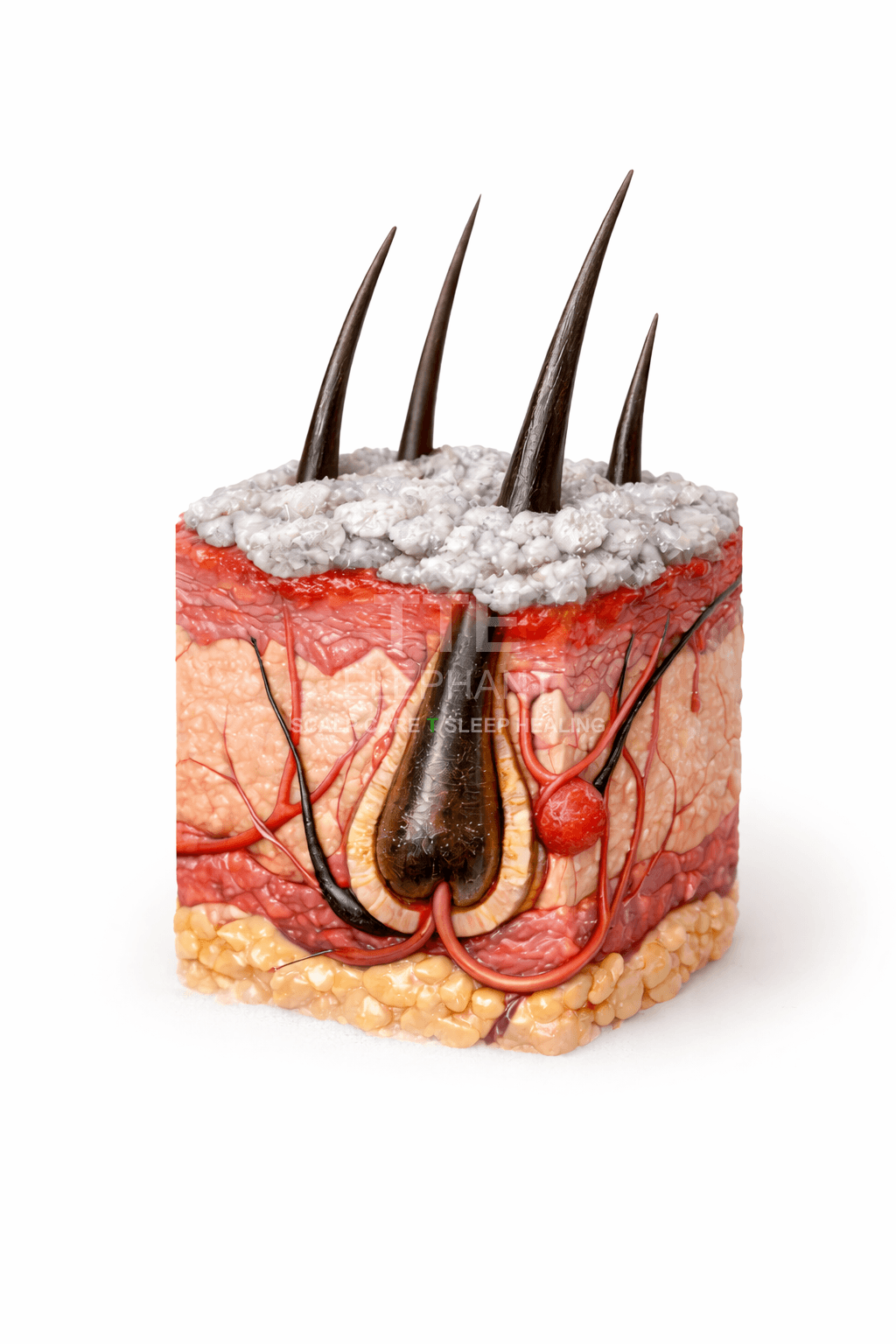
A 2023 cross-sectional study published in Scientific Reports compared the scalp microbiome of hijab-wearing women against non-hijab-wearing women using Next Generation Sequencing. The finding was specific and striking: hijab-wearing women showed a higher abundance of *Malassezia restricta — the fungal species most strongly associated with seborrheic dermatitis and dandruff — relative to Malassezia globosa, which was more common in the non-hijab group.
The mechanism is straightforward. The hijab creates an occluded microenvironment: higher temperature, higher humidity, reduced airflow. M. restricta thrives in exactly this environment. During Raya — when styling sessions run long, when you may wear your tudung for 14–16 hours in the heat of rumah terbuka gatherings, when the weather in Klang Valley in late March reaches 33–35°C — this microbiome shift accelerates.
The practical result: dandruff, itchiness, and scalp inflammation that feel worse than usual after Raya are not about your shampoo choice. They are about a microbial imbalance that your scalp has been accumulating for weeks.
![[Diagram showing the scalp microbiome shift in hijab-wearing women: elevated M. restricta abundance creates the conditions for seborrheic dermatitis — flaking, itchiness, and inflammation beneath the hijab]](/images/symptoms/muslimah-scalp-raya-microbiome-inline.png)
4. Raya Styling Caused Mechanical Damage to Your Follicles
Hari Raya brings out the sanggul, the bun, the carefully pinned inner ninja cap, the hair donut, and sometimes the full hijab wedding-style updo for open houses. Malaysian Muslimah know the drill.
The research does not flatter the tradition. A 2024 survey study published in the International Journal of Dermatology found that 34.6% of hijab-wearing women reported hair loss they attributed to their hijab — and of those, 72.2% identified the frontal hairline as the primary location. A separate 2024 JAAD review found the incidence of traction alopecia in hijab-wearing women is 10.4%, compared to 7.5% in non-wearers.
Traction alopecia is the hair loss caused by sustained mechanical pulling on follicles — the exact force applied by a bun held with a tight elastic, by inner ninja caps pulled down firmly, by heavy hijab styles worn for hours across multiple days of celebrations.
The frontal hairline is the first to show it: a gradual widening of the parting, a recession at the temples, fine hairs breaking off rather than growing out. Caught early, it is reversible. Caught late — after years of the same Raya styling patterns — it can become permanent scarring alopecia.
The Four-Week Post-Raya Recovery Protocol
You cannot undo what Ramadan and Raya did to your scalp in one wash. Recovery is a process, and it follows the biology of the hair growth cycle. Here is what to do in each week of April.
Week 1 (1–7 April): The Reset
Your scalp has accumulated sebum, sweat residue, product buildup from styling, and a disrupted microbiome. Before you can recover, you need to create a clean foundation.
Daily scalp massage: 5 minutes
Use the pads of your fingertips (not nails) in small, firm circular motions starting from the nape and working forward. A 2016 study in ePlasty showed that standardised scalp massage for 4 minutes daily increased hair thickness measurably after 24 weeks. The mechanism is increased blood flow to the dermal papilla. Do this every morning, on a dry scalp, before showering.
Clarifying wash twice this week
Use a gentle anti-fungal or zinc pyrithione shampoo to address the Malassezia shift that Raya accelerated. Leave the shampoo on your scalp for 3–5 minutes before rinsing — it needs contact time to be effective. Do not use this more than twice weekly; it will dry the scalp if overused.
What to avoid this week:
- Tight buns or high-tension pinning — your follicles need a mechanical rest
- Heat styling directly on the scalp
- Inner ninja caps that are too tight at the hairline — loosen one full size if possible
Traditional remedy that works: Coconut oil pre-wash
Pure, cold-pressed coconut oil (minyak kelapa dara) applied 30–60 minutes before shampooing has documented antifungal properties against Malassezia and reduces hygral fatigue (damage from water absorption and drying cycles). This is one traditional Malaysian practice with real clinical support. Apply to scalp and mid-lengths only; rinse thoroughly.
Week 2 (8–14 April): The Nourish
With the scalp reset, Week 2 focuses on rebuilding the nutrient supply that Ramadan depleted.
Reintroduce these foods deliberately:
- Iron: Beef liver, sirloin, bayam merah (red spinach), lentils — iron deficiency is the single most commonly missed cause of female hair shedding in Malaysia
- Protein: Two eggs daily, fish, ayam kampung — hair is made from keratin; without amino acids there is nothing to rebuild with
- Zinc: Pumpkin seeds, chickpeas, red meat — zinc deficiency directly impairs follicle function
- Biotin: Eggs, sweet potato, almonds — supports keratin infrastructure
Scalp serum (optional but effective)
If you can access one: look for serums containing caffeine (vasodilatation at the scalp), niacinamide (strengthens the follicular barrier), and peptides (signal follicle activity). Apply to the scalp directly after washing, part by part. Do not rinse.
Traditional remedy that works: Pandan leaf rinse
Boil 10–12 pandan leaves in 1 litre of water, cool completely, and use as a final rinse after shampooing. Pandan (Pandanus amaryllifolius) contains alkaloids and flavonoids with demonstrated anti-inflammatory properties. It also reduces scalp temperature — relevant when your hijab creates heat retention throughout the day. This is genuinely good for your scalp and costs almost nothing.
Traditional remedy that doesn't work as claimed: Telur ayam kampung as hair mask
Raw egg applied directly to the scalp is a popular tip in Malaysian hair groups. The protein in raw egg cannot penetrate the hair shaft or the scalp at meaningful depth in a short-contact mask application. It is not harmful, but it is not the treatment its reputation suggests.
Week 3 (15–21 April): The Strengthen
Your scalp's immediate inflammatory and microbial responses are settling. Week 3 is about addressing the mechanical damage and rebuilding follicle resilience.
Change how you wear your hair under your hijab:
- Switch your bun position — even 2cm lower or to the side distributes tension differently and gives the stressed follicle sites a rest
- Replace tight elastics with silk scrunchies or loose clips — the elastic's contact surface area is the problem, not elastic itself
- If you use an inner ninja cap: choose one with a cotton interior that sits at least 1cm above the hairline, not pressing directly on the frontal follicles
Supplement check
If you haven't already, have your GP run a ferritin panel (not just haemoglobin — ferritin is the stored iron that the hair follicle uses, and women in Malaysia are frequently mildly deficient without knowing it). Optimal ferritin for hair health is above 70 µg/L; many women functioning normally sit at 15–20 µg/L and wonder why their hair won't grow.
Henna: yes, but correctly
Traditional Malaysian henna (inai) — the pure, botanical Lawsonia inermis variety, not compound henna with chemical additives — has documented anti-inflammatory and antifungal properties. Used as a scalp paste for 30–45 minutes, it can calm seborrheic inflammation and strengthen the hair shaft. However, it will coat and slightly loosen the cuticle if left too long. Pure botanical henna on the scalp, once monthly, is a legitimate post-Raya treatment with cultural and clinical backing.
What is not backed by evidence: Telur + olive oil + honey masks
These are popular in Muslimah beauty groups but the molecular weight of honey and egg protein means neither penetrates the scalp at meaningful clinical depth in the application formats used. They are not harmful, but they are not efficient use of your time.
Week 4 (22–30 April): The Professional Reset
Weeks 1–3 of home recovery address the surface-level and dietary causes of post-Raya scalp stress. They cannot address everything. Week 4 is when a professional scalp treatment provides what home care cannot.
What a head spa does that home care cannot:
AI Scalp Analysis: A clinical-grade scalp camera examines follicle density, sebum distribution, inflammation markers, and miniaturisation (early thinning) at a magnification not visible to the naked eye. After a month of Ramadan and Raya stress, this gives you an honest baseline: which areas are recovering well, which need intervention, and whether the frontal recession at your temples is traction alopecia beginning or just temporary shedding.
LED Therapy: Red and near-infrared light at the correct wavelengths (620–680nm red, 800–880nm near-infrared) penetrates the scalp and stimulates cytochrome c oxidase in follicle mitochondria — directly accelerating follicle metabolism and the return to the anagen phase. This is not achievable with home-use LED combs at meaningful depth. Professional-grade devices deliver 10–15x the irradiance.
Scalp Lymphatic Drainage Massage: The occlusion and heat retention of the hijab — especially during a high-activity period like Hari Raya — creates scalp fluid stagnation. Professional lymphatic drainage massage (distinct from surface scalp massage you can do at home) manually moves this stagnation through the lymphatic channels at the nape and temples, reducing inflammation and puffiness at the follicle base.
Clinical Serum Infusion: Professional serums contain peptides, growth factors, and botanical actives at clinical concentrations that cannot be preserved in over-the-counter products without compromising stability. At TTE Headspa, our post-Raya protocol uses a ginger and black seed (habbatus sauda) botanical base with clinical peptide infusion — warm, grounding, and specifically formulated for the post-fasting scalp environment.
A note on private rooms: All TTE Headspa treatment rooms are private and Muslimah-comfortable. You will never be in a shared space during your treatment. The recovery session is yours entirely — and for many mothers who have just spent Raya managing everyone else's needs, this hour is the first quiet, personal space they've had in weeks.
What to Expect in May and June 2026
Even with excellent recovery practice throughout April, you should prepare yourself for one more wave.
The telogen effluvium triggered by Ramadan's nutritional stress typically manifests 6–12 weeks after the event. This puts the peak shedding period in late May to early June. You will likely notice more hair in the shower drain, more on your pillow, more in your hijab pins when you remove them.
This is not a setback. It is the predictable biological sequence, and it is temporary. The follicles that entered telogen (resting phase) during Ramadan are completing their rest cycle and will return to anagen (growth) — but they shed the old hair shaft first. If your April recovery was consistent, the new growth will already be beginning underneath before the shed is visible.
What accelerates recovery during this phase:
- Iron supplementation if your ferritin is below 70 µg/L — the single highest-impact intervention
- Consistent scalp massage — maintains the blood flow stimulation follicles need to re-enter anagen
- Stress management — continued elevated cortisol from post-Raya return-to-work demands will extend the shedding window
- A second professional treatment in June, timed to the peak shedding phase, to support the follicle re-activation
For Malaysian Muslimah Specifically: The Private Room Difference
Many Malaysian Muslimah women delay professional scalp care because conventional salons are not designed for them. Removing your hijab in a shared salon space is not something every woman is comfortable with, and it should not be a barrier to getting the treatment your scalp needs.
At TTE Headspa, every treatment is in a fully private room. You will not be asked to remove your tudung in any shared or visible space. The treatment process is designed with Muslimah comfort as a non-negotiable standard, not an afterthought. Our therapists are trained in the specific concerns of hijab-wearing scalp health: the traction points, the microbiome shift, the heat retention patterns, and the frontal hairline preservation that matters most.
The same cultural intelligence that shapes how we speak about your scalp care shapes how we provide it.
Five Questions Malaysian Muslimah Ask Most Often After Raya
1. My rambut is falling a lot since Raya ended — is this normal?
Yes — if it started within 2–6 weeks of Hari Raya. This is consistent with telogen effluvium from the combined stress of Ramadan fasting, sleep disruption, and the physical demands of the festive period. It is temporary. If shedding continues beyond 6 months, or if you notice patches of no hair (rather than diffuse thinning), see a dermatologist.
2. I've been wearing hijab for 10+ years. Is my frontal hairline thinning permanent?
Not necessarily. Traction alopecia caught in its early stages — before follicular scarring occurs — is reversible with mechanical rest (changing styling habits) and professional stimulation (LED therapy, scalp massage, growth factor serums). The key window is catching it before the scar tissue replaces the follicle. An AI scalp analysis will tell you which stage you're at.
3. Is it safe to do a head spa while I'm breastfeeding?
Yes. TTE Headspa's standard botanical serum protocol — ginger, black seed, peptides — contains no minoxidil, no finasteride, no harsh chemical agents, and is safe during breastfeeding. Always inform your therapist that you are breastfeeding, and we will confirm the specific products being used in your session.
4. My scalp is very gatal (itchy) after Raya. Is it dandruff or something else?
It depends on the pattern. If the itch is widespread and accompanied by white flakes, it is likely Malassezia-driven seborrheic dermatitis — the microbiome shift confirmed by the 2023 hijab microbiome study. If it is itchy in specific small areas, with small red bumps, it may be folliculitis (bacterial) from the occlusion and sweat of extended hijab wearing. Both are treatable; they require different approaches. An AI scalp analysis distinguishes between them within minutes.
5. Can I use henna on my scalp after Raya?
Pure botanical henna (Lawsonia inermis) — yes, once monthly, for 30–45 minutes. It has documented antifungal and anti-inflammatory properties relevant to post-Raya scalp recovery. However, avoid compound henna (often sold as "black henna" or henna with PPD — paraphenylenediamine) entirely. Compound henna can cause severe allergic contact dermatitis. If the henna is jet black rather than orange-brown, it almost certainly contains PPD and should not be applied to the scalp.
Closing: You Gave Everyone Else a Beautiful Raya. Now It Is Your Scalp's Turn.
Hari Raya in Malaysia is a month-long act of giving. You prepared the food, you ironed the baju, you managed the balik kampung logistics, you hosted and visited and smiled through the heat of open house after open house. Your scalp absorbed the stress of all of it — the fasting, the broken sleep, the heat under your tudung, the tight styling — without complaint.
April is your window. The biology is predictable and the recovery is achievable, but it requires intention. A month of home care and one professional scalp reset is all the difference between a scalp that quietly recovers by June and a scalp that continues to struggle.
Selamat Hari Raya, and selamat pulih.
Artikel Berkaitan